Raytek has expanded its Marathon series two-colour infrared temperature measurement capability with the addition of the full Ircon range since the acquisition.
How colour ratio pyrometers work
In standard (one-colour) infrared thermometry, the instrument captures some of the infrared (IR) energy that is emitted by an object. From this the temperature of the object can be by proportionality and the amount of energy emitted by an ideal radiator at the same temperature.
In contrast to one-colour IR thermometers, ratio (two-colour) instruments pass the captured IR energy through two filters that split the radiation into discrete wavelengths. The two spectral frequencies are then directed to separate detectors where they are converted to electrical signals; the instruments microprocessor determines the ratio, and this is proportional to the temperature of the object.
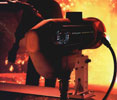
A range of accessories to protect the thermometer from harsh environments is available as options
Ratio thermometers will tolerate up to a 95% reduction of energy due to obscuration or attenuation and still remain accurate. So if users can see only 5% of the object due to dust or smoke they can still obtain an accurate reading. A standard instrument measuring the same object with the same percent of energy attenuation will produce a 30% error in the temperature reading.
Areas of application
Because ratio thermometers are less affected by obscuration and energy attenuation than standard instruments, they are ideal for use in many applications where a standard instrument cannot provide an accurate temperature measurement.
The following are the most common conditions where a ratio thermometer is the best solution:
* Energy reaching the instrument is reduced because of dust, smoke, steam, or particles in the atmosphere.
* The sighting optics are dirty.
* The instrument’s field-of-view is partially blocked or obscured.
* The target does not fill the instrument’s field-of-view.
* The target is smaller than the instrument’s field-of-view and is moving or vibrating.
* Changes in object emissivity due to slag or scale.
Most ratio thermometers are designed for use in high temperature applications. A typical temperature range for a ratio instrument is 600 to 3000°C, with response times as fast as 10 ms.
The Raytek and Ircon two-colour ratio units have the ability to switch between single and two-colour allowing users to select the best mode for the application.
One sensor, three switchable output modes with IO-Link
Temperature Measurement
: Siemens’ new Sitrans TS200 IO-Link temperature sensor is available in three sizes, and offers three switchable output modes in one device with remote firmware update capability and an integrated LED for quick status checks.
Read more...SCE appointed authorised Vaisala distributor for South Africa
Temperature Measurement
SCE has been appointed the authorised Vaisala distributor for South Africa, giving local engineers direct access to world-class humidity, temperature and CO2 measurement technology backed by full in-country calibration and technical support.
Read more...Thermal imaging camera with high thermal resolution Vepac Electronics
Temperature Measurement Maintenance, Test & Measurement, Calibration
Vepac Electronics introduces a compact thermal imaging camera that helps technicians spot temperature problems before they become costly failures.
Read more...Test bench for temperature calibrating power semiconductors Beckhoff Automation
Temperature Measurement
Precise temperature characteristics are essential for performing power cycling tests on power semiconductors. Infineon Technologies determines these characteristic curves on a test bench using PC-based control. As a result, calibration has become more precise and the efficiency of the entire test laboratory has increased significantly.
Read more...Fire prevention strategies with thermal imaging
Temperature Measurement
Effective fire prevention strategies focus on identifying, reducing and managing fire risks before they become incidents. Through proactive measures, planning and reliable detection technologies, organisations can create safer environments and minimise the likelihood of fire outbreaks.
Read more...High-precision fill quantity control in food supplement production
Temperature Measurement
Vital Products was looking for a precise and efficient solution to check the weight and ensure the completeness of its products. Minebea Intec, a specialist in industrial weighing and inspection technologies, was able to provide a solution.
Read more...Infrared solutions for glass manufacturing challenges Instrotech
Temperature Measurement
In the glass industry, infrared temperature monitoring is crucial for maintaining product quality and process efficiency. Instrotech has infrared sensors and cameras which provide non-contact temperature measurements, making them ideal for these high-temperature environments.
Read more...Decarbonising a heat and power plant Valmet South Africa
Temperature Measurement
Valmet is delivering a boiler fuel conversion for a combined heat and power plant in Poland. After modernisation, coal will be replaced entirely with certified forest biomass supplied by local providers.
Read more...New temperature transmitters with Profibus connectivity
Temperature Measurement
Siemens is enhancing its temperature measuring device portfolio with the transmitter duo, Sitrans TH420 PA and Sitrans TF420 PA. Both devices feature Profibus connectivity, advanced safety functions and expedited commissioning all in one unit.
While every effort has been made to ensure the accuracy of the information contained herein, the publisher and its agents cannot be held responsible for any errors contained, or any loss incurred as a result. Articles published do not necessarily reflect the views of the publishers. The editor reserves the right to alter or cut copy. Articles submitted are deemed to have been cleared for publication. Advertisements and company contact details are published as provided by the advertiser. Technews Publishing (Pty) Ltd cannot be held responsible for the accuracy or veracity of supplied material.










 printer friendly version