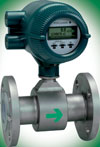
Yokogawa has developed the Admag AXF series of flowmeters, which it claims to be the world's first magnetic flowmeters with electrode adhesion diagnostics technology and 75/160 Hz dual frequency excitation.
The new AXF series magmeter from Yokogawa incorporates electrode adhesion diagnostics technology and dual frequency excitation
Today's magmeters allow precise and reliable measurement of most process media: chemically aggressive, highly viscous, explosive, sticky and abrasive. While previous Admag meters with dual frequency excitation - for example the AE series - were successfully used in the chemical, pharmaceutical, food and beverage and pulp and paper industries, the new series provide high quality flow measurement with a digital process diagnostic tool - all in the same instrument.
This series has already been used for a long time and with great success in critical flow applications and problem liquids - even under unfavourable installation conditions such as high vibration and pulsed flow with slurries and liquids with suspended solids. The dual frequency of this technology is able to reduce error signals by a factor of 2,5 (>6 dB), ensures a high degree of zero stability with fast response time, and an accurate and stable output signal. The AXF series automatically compensates for internal and external errors. The instrument also has empty pipe detection.
Other features of the AXF-series are electrode-coating detection and its appropriate status alarm, removable electrodes starting for meters greater than DN15, increased compensation of error signals (fluid/noise detection) by >6 dB, the ability to measure liquids with a conductivity of as low as 1 μS/cm. AXF magmeters are customised via a multilingual menu-driven display interface with optical infrared setting switches. All instrument outputs conform to NE43.
Hygienic ultrasonic flow sensor ifm - South Africa
Flow Measurement & Control
The SU Puresonic Hygienic ultrasonic sensor from ifm detects flows of conductive and non-conductive media with high precision.
Read more...VEGA pressure instrumentation supports resilient water network management VEGA Controls SA
Pressure Measurement & Control Flow Measurement & Control
As rapid urbanisation and climate pressures strain water networks across Africa, accurate real-time pressure monitoring has become a strategic necessity. VEGA’s pressure instrumentation helps utilities reduce losses, protect infrastructure and meet sustainability targets.
Read more...Yokogawa digital plant to accelerate green hydrogen revolution Yokogawa South Africa
Editor's Choice Electrical Power & Protection IT in Manufacturing
Yokogawa explains how a digital plant approach and autonomous operations can integrate the full green hydrogen value chain, from renewable power generation to end-use applications, and why digitalisation and system integration are central to making green hydrogen viable in South Africa.
Read more...Flow imaging microscopy for the early detection of harmful algal blooms Yokogawa South Africa
Flow Measurement & Control
Yokogawa’s advanced flow imaging microscopy technology, FlowCam is helping utilities move from reactive treatment to proactive prevention of harmful algal blooms in reservoirs, dams and freshwater sources.
Read more...Yokogawa’s free chlorine analyser is gold standard for water treatment utilities Yokogawa South Africa
Analytical Instrumentation & Environmental Monitoring
One of the key factors in ensuring safe drinking water is the accurate monitoring of free chlorine residuals. This is where advanced online analysers, such as Yokogawa’s FC800 free chlorine analyser, are becoming increasingly valuable for water treatment operators and municipal utilities.
Read more...Never waste a drop
Flow Measurement & Control
Manufacturers of pumps, valves and related equipment have an important role to play when systems for water are being designed or upgraded and should be included at every stage of a project to ensure that the work is carried out within the equipment’s capabilities.
Read more...Ultrasonic flow meters ifm - South Africa
Flow Measurement & Control
The ultrasonic flow meter of the SU series from ifm - South Africa monitors liquid media such as water, glycol solutions or industrial oils. It detects the three process categories volumetric flow quantity, consumed quantity and medium temperature.
Read more...How utilities identify water losses in Northern Europe
Flow Measurement & Control
Norwegian leak detection specialist, Ovarro outlines how municipalities are responding to hidden water loss using acoustic monitoring and analysis tools that provide early indications of developing leaks.
Read more...Senix sensors provide flood warnings Instrotech
Flow Measurement & Control
To create the world’s most sophisticated flood monitoring and forecasting system, the US State of Iowa’s Flood Centre (IFC) uses more than 200 Senix ToughSonic 30 and ToughSonic 50 ultrasonic sensors to measure water levels in streams across the state.
While every effort has been made to ensure the accuracy of the information contained herein, the publisher and its agents cannot be held responsible for any errors contained, or any loss incurred as a result. Articles published do not necessarily reflect the views of the publishers. The editor reserves the right to alter or cut copy. Articles submitted are deemed to have been cleared for publication. Advertisements and company contact details are published as provided by the advertiser. Technews Publishing (Pty) Ltd cannot be held responsible for the accuracy or veracity of supplied material.










 printer friendly version