With the help of Adam-5510 PC-based programmable controllers, Beijing's wastewater treatment plant has successfully built a reliable wastewater process control system. This has provided it with a saving over using a traditional PLC solution.
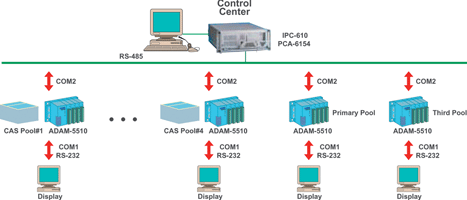
System architecture of Beijing water treatment plant
In the past, because of plentiful labour and relaxed environmental restrictions, the quality of wastewater treatment and the output of clear water at Beijing's treatment plant were not closely monitored. Recently, local government has required the plant manager to solve these quality problems and reduce staffing levels.
Process
The process of wastewater treatment involved at the plant has three principal steps:
* Filter out the particulates in the wastewater pumping room and de-sanding pool.
* Add chemical to the water in the four CAS (carbon absorption system) pools.
* Drain the intermediate water into the purification pool for the final refining process.
Key requirements
The key requirements for the replacement system were that it should:
* Integrate widespread data from the different pools and respond to the control centre reliably and quickly.
* Collect and process the data in a timely and accurate manner.
* Operate with reduced staff levels.
System description
Advantech Beijing developed a PC-based process control system using Adam-5510 controllers to solve the plant's need. There are six PC-based Adam-5510 programmable controllers installed at the CAS pools, de-sanding pools and purification pools. These monitor and control the field devices. The plant equipment status is shown on a field display and simultaneously fed back to the control centre through an RS-485 network. The system also uses Adam-5060 6-channel relay output modules, Adam-5051 16-channel DI modules for facilities monitoring and Adam-5017 8-channel AI modules for flow rate and volume monitoring.
At the de-sanding pool the Adam-5510 handles pump on/off control, gate open/close control, and monitoring of input flow rate, water level and related equipment's on/off and alarm outputs.
In the CAS pools the Adam-5510 responds to commands from field stations or the control centre to control the four sub-steps in each CAS reaction. One important function is to detect fully automatic or semi-automatic signals and respond promptly with control logic.
At the purification pool, 10 purification devices are monitored and controlled by the programmable controllers. The control processes are similar to those used in the CAS pools and also feature automatic and semi-automatic modes.
The benefits that the Adam controllers provide in this data acquisition and control system are:
* Flexibility of communications.
* Data memory storage capacity.
* Ease of programming with the C language.
* A distributed data acquisition system architecture.
Network-capable remote relay system with flexible channel assignment Phoenix Contact
PLCs, DCSs & Controllers
Phoenix Contact has launched a modular PLC-Interface Ethernet Gateway remote relay system with up to 56 configurable I/O channels, multi-protocol support including Profinet Class C and S2 redundancy, and compatibility with established controller software for straightforward network integration.
Read more...Seven checks before replacing an obsolete industrial control component
PLCs, DCSs & Controllers
An obsolete control component rarely fails in isolation. Before ordering an exact spare, manufacturer successor or engineered alternative, maintenance and procurement teams should work through seven checks to define the problem properly and avoid a costly mismatch.
Read more...Loop signature Part 2-6
PLCs, DCSs & Controllers
This instalment of the Loop Signature series introduces frequency plot theory as a foundation for understanding process dynamics, explaining Bode plots, dynamic gain, phase lag and their relationship to control loop tuning.
Read more...The rise of software-defined brownfield automation Schneider Electric South Africa
PLCs, DCSs & Controllers
Schneider Electric’s EcoStruxure Automation Expert is enabling brownfield operators to modernise incrementally, decoupling control logic from hardware to bridge legacy equipment and future-ready operations without disrupting production.
Read more...Upgrading alarm systems for critical industries Omniflex Remote Monitoring Specialists
PLCs, DCSs & Controllers
Omniflex’s OMNI16R alarm annunciator platform provides a direct replacement for legacy CSA systems such as MPAS 90 and SA9100, enabling operators in oil and gas, nuclear and power generation to modernise alarm infrastructure without sacrificing the clarity required for safe operations.
Read more...How DCS can step off the hardware obsolescence treadmill Schneider Electric South Africa
PLCs, DCSs & Controllers
Schneider Electric argues that virtualising DCS environments breaks the cycle of hardware obsolescence, giving plant operators a smarter path to lifecycle modernisation without production disruption.
Read more...Loop signature Part 2-6
PLCs, DCSs & Controllers
The Loop Signature series turns to frequency plot theory, explaining Bode open-loop plots and how dynamic gain, phase lag and crossover frequency can be extracted from test data to inform more accurate control loop tuning.
Read more...PC-based control in surgery Beckhoff Automation
Editor's Choice PLCs, DCSs & Controllers
Researchers at the University of Basel are using Beckhoff PC-based control technology to develop a miniature laser robot for minimally invasive bone surgery.
Read more...How the DCS can step off the hardware obsolescence treadmill Schneider Electric South Africa
PLCs, DCSs & Controllers
Ageing servers and unsupported operating systems are quietly eroding the stability of process plants that rely on distributed control systems. Kobus Vermeulen of Schneider Electric explains how virtualising the DCS environment can break the hardware obsolescence cycle without disrupting operations.
While every effort has been made to ensure the accuracy of the information contained herein, the publisher and its agents cannot be held responsible for any errors contained, or any loss incurred as a result. Articles published do not necessarily reflect the views of the publishers. The editor reserves the right to alter or cut copy. Articles submitted are deemed to have been cleared for publication. Advertisements and company contact details are published as provided by the advertiser. Technews Publishing (Pty) Ltd cannot be held responsible for the accuracy or veracity of supplied material.










 printer friendly version