Company environments are constantly changing due to the pressure from competition and the need for profitability. It is critical that companies take advantage of opportunities as they present themselves. The challenge of today's world is to find the appropriate solution for customers' needs.
CANopen is an open network that is supported by over 400 major companies worldwide. The rigid systems of the past restricted companies' abilities to adapt, either by implementing new functions or due to a changing environment. To overcome the restrictions of a closed system, companies on an exponential basis are adopting the use of networks that are open and designed to international standards, as the benefits are increasingly apparent.
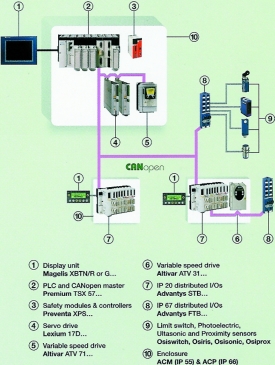
CANopen modularity: This implementation provides an answer for compact machines where performance, modularity and customisation are important. Typical applications include automotive, machining, packaging and a multitude of other machines
Its mission to assist companies to both protect their investments and improve productivity is why Schneider Electric has adopted CANopen technology in its products, seeing CANopen and Ethernet as the two standards of the future, alongside its support of Profibus, DeviceNet and other network standards.
Says Schneider Electric automation product manager, Linda Eales: "automation architectures are selected according to the requirements of the end-user and the constructor of the automation system. From the beginning, CANopen was developed for machines and installations and has proven its reliability, safety record and versatility over the past 10 years. This is one of the reasons why it is used in such mission-critical applications as medical equipment, aeroplanes, trains and lifts."
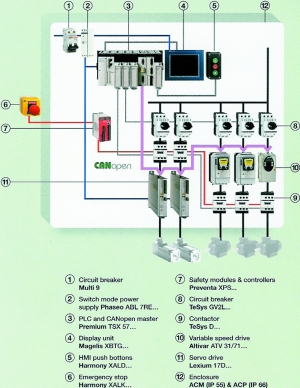
CANopen compact: This implementation is ideally suited for large machines or installations where performance in distributed installation is required. It also affords maximum performance, modularity and customisation. Typical applications include machining, materials handling, hoisting and storage, and for production lines
The network access on CANopen is non-destructive. What is meant by this is should any one CANopen device transmit its data, the system automatically generates, and takes into account, the priority of the message. A telegram loss by means of a collision is impossible and wasting time until the next idle state of the network is avoided. CANopen's providing absolute reliability in transmission of data is just one of the reasons why CANopen networks are being used in medical equipment and as a basis for safety networks.
CANopen's flexibility is coupled to the fast network response speed. Within less than 1 ms, 256 digital I/O points can be services at 1 mbps (source: Grid Control).
Breakdowns are time-consuming, costly and in the event of mission critical equipment, can compromise the safety of people's lives. CANopen is suited to increase the uptime as much as possible. With its Hamming distance of 6, CANopen has very good error detection and correction mechanisms.
"Indeed," continues Eales, "with a probability of one undetected error in 1000 years (one bit error each 0,7 seconds at 500 kbps; eight hours a day, 365 days a year), the network has proven to be the most reliable for machines and installations.
"In the event that the network has an error condition, the CANopen watchdog is the first possibility to monitor the device status. Furthermore, CANopen provides clear diagnostic information. Each diagnostic message contains the source and the reason for the fault, which allows a fast reaction and a reduction in the shut down time".
Additional diagnostic information is implemented to improve the diagnostics of complex CANopen devices and to support those responsible for maintaining the network. Over and above detecting random faults, an error history is also available.
In reviewing the primary reasons for using a network, CANopen's unique ability to adapt data transmission further enhances flexibility and performance. Based upon the producer-consumer model, CANopen allows for a data transmission broadcast, peer-to-peer, change-of-state and cyclic communication. This means that it transmits data only when required or on a specified time basis. Process data objects can be individually configured and parameters can be changed at runtime.
Concludes Eales: "Schneider Electric will continue to collaborate with CAN to offer a truly open network with openness and interoperability of our systems and products. Over and above this, is the significant cost advantage that can be enjoyed by our customers."
The next generation of engineers is building living labs of innovation Schneider Electric South Africa
IT in Manufacturing
Graduate engineers at Schneider Electric East Africa designed, integrated and commissioned the smart building systems in the company’s new Nairobi head office, demonstrating how practical, real-world project experience accelerates engineering capability and confidence.
Read more...Accelerating pharmaceutical digital compliance and operational efficiency Schneider Electric South Africa
IT in Manufacturing
Cosmos Limited, one of Kenya’s leading pharmaceutical manufacturers, has partnered with Schneider Electric to implement an integrated monitoring, energy management and digital validation platform that has improved operational visibility, data integrity and regulatory compliance readiness.
Read more...How certified industrial automation channels become co-creators in the AI era Schneider Electric South Africa
System Integration & Control Systems Design
As industrial automation becomes software-driven and AI-enabled, the role of channel partners is shifting from equipment supply to outcome-based consulting, software integration and lifecycle services that require continuous certification and capability development.
Read more...Mining’s decarbonisation journey starts now Schneider Electric South Africa
Electrical Power & Protection
Mining companies are embedding decarbonisation into core operational strategies as technology, advisory services and digital platforms help translate ESG commitments into measurable environmental and business outcomes.
Read more...AI data centres, nature and innovation Schneider Electric South Africa
IT in Manufacturing
Artificial intelligence is driving unprecedented demand for data centre capacity, with liquid cooling now central to managing the heat generated by high-density GPU clusters. Schneider Electric examines how next-generation data centres can balance performance with environmental responsibility.
Read more...Decarbonising the energies and chemical industry without the risk Schneider Electric South Africa
Electrical Power & Protection
Schneider Electric argues that decarbonisation in Africa’s energies and chemical industry need not compromise production or profitability. A phased, digitally enabled approach, starting with energy efficiency improvements, can reduce emissions while strengthening competitiveness.
Read more...Isolated Modbus gateways with built-in Wi-Fi for industrial IoT applications Vepac Electronics
Fieldbus & Industrial Networking
Vepac Electronics offers the Sielco Sistemi SS10680 series of isolated Modbus gateways with built-in Wi-Fi, providing three configurations for industrial data acquisition: cloud publishing via MQTT, local USB and FTP logging, and straightforward Modbus TCP to Modbus RTU conversion.
Read more...The rise of software-defined brownfield automation Schneider Electric South Africa
PLCs, DCSs & Controllers
Schneider Electric’s EcoStruxure Automation Expert is enabling brownfield operators to modernise incrementally, decoupling control logic from hardware to bridge legacy equipment and future-ready operations without disrupting production.
Read more...Predictive maintenance is the critical enabler for AI data centre liquid cooling systems Schneider Electric South Africa
IT in Manufacturing
As liquid cooling becomes essential for AI data centres, predictive and condition-based maintenance are emerging as critical enablers of thermal stability. Schneider Electric argues that the infrastructure is already generating the data needed and the question is whether operators are equipped to use it.
While every effort has been made to ensure the accuracy of the information contained herein, the publisher and its agents cannot be held responsible for any errors contained, or any loss incurred as a result. Articles published do not necessarily reflect the views of the publishers. The editor reserves the right to alter or cut copy. Articles submitted are deemed to have been cleared for publication. Advertisements and company contact details are published as provided by the advertiser. Technews Publishing (Pty) Ltd cannot be held responsible for the accuracy or veracity of supplied material.










 printer friendly version