



Here is a 'new old way' of protecting reciprocating machines from catastrophic failure and reducing the cost of repairs: the impact transmitter. Reciprocating machines are unique and do not follow the usual rules we use for condition monitoring of rotating machines. The Impact transmitter's innovative approach takes advantage of the reciprocating machines failure modes and is already saving machines, money and reputations.
Traditional vibration analysis focuses primarily on the steady tones generated by rotating equipment. In some cases, special accommodations have been added to identify impact type events such as the inaudible and audible clicks generated by flaws on a rolling element bearing. Although these transient clicks and impacts may be quite clear to a human ear, they do not constitute a significant portion of the total energy within the overall signal sensed by a vibration transducer. Thus, while the characteristics can be heard and seen by a human with our remarkable processing ability, they will not appear in a conventionally detected level displayed on a vibration monitor.
A reciprocating machine is quite different and far more complex than a rotating machine. For this reason, conventional vibration monitoring and analysis techniques, employed very successfully on rotating machines, do not work very well on reciprocating machines. There is simply too much din and transient activity in the vibration signal to accurately identify what a single component is attempting to say. If the vibration system is set to a high sensitivity in order to recognised small changes, false trips are likely to be experienced. If the sensitivity is set too low, the monitored machine may suffer extreme damage without a trip from the vibration monitoring system.
The Impact transmitter is designed for sensitivity to high amplitude, short duration transient spikes that characterise most potential problems found on reciprocating machinery. These spikes do not represent a significant portion of the total energy within a steady state vibration signal. They are lost in the traditional signal processing used for monitoring rotating machines. Within the impact transmitters, special peak detection circuitry captures and counts impact events above a threshold value during a specified length of time. This counting method has proven very reliable in practice. Transient conditions where impact events appear and go are differentiated from mechanical flaws where impact events appear and stay.
Since the impact transmitter is focused on identifying conditions, such as looseness, cracks and leakage, it is typically mounted on the crosshead or distance piece perpendicular to rod motion. The transmitter produces a 4-20 mA output equivalent to the number of impact events above an adjustable threshold level within a preset time window. In this configuration, the transmitter is a very cost-effective addition to the control and monitoring systems present on most reciprocating machines.
Ronny Schooler of Kinder Morgan in Snyder, Texas, has close to 100 impact transmitters installed on electric drive CO2 compressors. These machines range from 6 MW down to 1,68 MW In all cases; the impact transmitters are installed on top of the crosshead guide. Since these are relatively new machines, gaskets and bolting have relaxed during initial operation. The Impact transmitters have caught this condition in plenty of time to fix it before any damage occurred. In one case, an Impact transmitter indicated a problem that defied identification. Clearances were checked, and there were not any external signs of looseness such as bubbles or oil weeping. Everyone jumped to the usual conclusion - it must be the instrumentation. Another Impact transmitter produced exactly the same results. Finally, after much searching, two 11/8 studs were found improperly torqued. When the studs were torqued to their proper value, the impact transmitter returned to normal - a great indication of the sensitivity of impact monitoring technology.
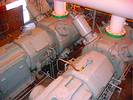
If you are responsible for reciprocating machinery and you are looking for a new but thoroughly tested means for protection, impact transmitters are a good choice. They use the inherent dynamic characteristics of reciprocating machines to warn and trip in the event of defects such as loose and cracked parts, valve and gasket leaks and assorted other problems unique to this type machinery. This impact transmitter works with reciprocating characteristics rather than against them to provide one with confidence that the machinery will not fail unattended and unnoticed.
Impact transmitter technology was developed in the USA by Metrix Instrument and is represented locally by PREI Instrumentation.
For more information contact Pieter Erasmus, PREI Instrumentation, 011 448 2172.
| Tel: | +27 11 867 5001 |
| Email: | [email protected] |
| www: | www.prei.co.za |
| Articles: | More information and articles about PREI Instrumentation |






© Technews Publishing (Pty) Ltd | All Rights Reserved
 printer friendly version