


Motion Control & Drives


AC drive suitable for traditional DC drive applications

August 2004 Motion Control & Drives Design Automation

Rockwell Automation has released a compact, high-horsepower electric drive that brings a host of advantages, even to traditionally DC drive-powered applications.

The Allen Bradley LPM 20 AC drive is a PWM (pulse-width-modulated) liquid-cooled drive that provides sensorless vector and general purpose Volts-per-Hertz regulation for high-power applications. Featuring an active-rectifier with input filter, the LPM 20 meets IEEE519 standards and CE standards for Europe for line harmonics. Full line regeneration capability produces a braking system by pulling power back into the AC line.
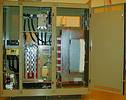
The active front-end, high-horsepower Allen Bradley LPM 20 AC drive, a PWM (pulse-width-modulated) liquid-cooled drive provides sensorless vector and general purpose Volts-per-Hertz regulation for high-horsepower applications

As a benefit of the LPM 20's synchronous rectifier front ends, IGBTs will allow power to flow into or out of the drives. This is beneficial in that it allows an AC drive to absorb power from the application and put it back on the AC line with the same level of efficiency as it exhibits when motoring. This one feature allows AC drives to be used in almost any application, which was previously solved with a DC drive.

A synchronous rectifier can also regulate the voltage level on the DC bus. The 'buck boost' nature of the topology allows voltage levels on the DC bus to be higher than the peak of the AC line. During line sags, brownouts and other low voltage conditions, the synchronous rectifier can maintain the DC bus at its rated voltage and thus provide full output voltage to the motor under almost all low line conditions. A 480 V motor can be run on a 380 or 480 V supply, delivering full torque across the speed range. For a 380 V supply, the output to the motor can be a maximum of 480 V at maximum speed.

The current waveforms produced by a synchronous rectifier are regulated to be sine waves. Thus the current harmonics can be regulated to meet IEEE519, with no additional modifications. Current harmonics are less than 5%, while voltage harmonics in the range of 0,5 to 2% are typical at the drive.

Just as critical as it is to keep the DC bus above an acceptable voltage level, it is also possible to be too high. A synchronous rectifier will regulate the DC bus and lower the voltage if it rises above the desired set point during regeneration. Repetitive line spikes will increase the DC bus voltage during the spike, however the synchronous rectifier will reduce the level as soon as the spike has passed, thus preventing the ratcheting up of the DC bus voltage level with each spike. The LC filter formed by the rectifier and the DC bus capacitors will also limit the transient voltage excursions.

The input line currents are regulated by the synchronous rectifier, permitting a predetermined power factor to be set by the controls. This power factor is usually set to unity to maximise the unit's current draw; however, it is possible to dynamically change the power factor to meet the user's desire to have an improved plant power.

Each of these benefits have varying degrees of importance to a user, but with a good synchronous rectifier, the user always has the option to avoid issues and improve performance. With a fix front end, options are limited and there may be no solution for some problems that arise in the field.

LPM 20 drives are built on the Allen Bradley Powerflex 700 AC drive regulator. The LPM 20 drive is mounted in a IP 20 enclosure. Specific chiller options and water-to-water or water-to-air cooling options can be configured to meet specific application needs. The LPM 20 has a displacement power factor of 30,99, with a line frequency of 50/60 Hz (±2 Hz) and carrier frequency of 2 kHz standard (software-selectable).

For more information contact Jeff Sandison, marketing communications manager, Rockwell Automation, 011 654 9700, [email protected]


Credit(s)


Share this article:
Share via emailShare via LinkedInPrint this page

Further reading:

Solving common automation challenges with Festo’s servo drive and servo motor solutions
Festo South Africa Motion Control & Drives
Automation projects face challenges that include limited installation space, the need for precise and repeatable linear motion, rising cycle-speed demands, and seamless integration with existing control architectures. Festo’s servo portfolio directly addresses these issues with compact, modular drive and motor solutions designed for specific applications.

Read more...
Inside the Giant Magellan Telescope with mechanical engineering at astronomical scale
Motion Control & Drives
Construction of the Giant Magellan Telescope, set to become the world’s largest Gregorian optical infrared telescope, is well underway. While its scientific mission is to transform astronomy, its performance depends heavily on advanced mechanical, hydraulic and pneumatic engineering.

Read more...
Filtration as a reliability driver in motion control systems
Parker Hannifin - Sales Company South Africa Motion Control & Drives
This article highlights the importance of filtration in motion control systems, how contamination affects performance, and what fleet managers, operators and maintenance teams in southern Africa can do to reduce downtime, avoidable wear and costly repairs, aided by Baldwin Filters.

Read more...
Supporting construction of next-gen floating offshore wind turbines
Motion Control & Drives
While windy locations naturally make ideal spots for offshore wind farms, they bring challenges when it comes to assembling wind turbines, particularly in ports. Mammoet was approached by Euroports to support with the marshalling and assembly of the components that make up the three turbines at Port-la-Nouvelle in France.

Read more...
Rollers excel where profits balance on a knife edge
igus Motion Control & Drives
Polymer component specialist manufacturer, igus has developed a range of lubrication-free long-life knife edge rollers designed to improve the transfer of products between conveyor belts in high-speed production environments.

Read more...
Bringing physical AI to the factory floor by deploying humanoids in industrial operations
Siemens South Africa Motion Control & Drives
Siemens and Humanoid have marked a landmark milestone in the journey to bring physical AI from vision to industrial reality. Humanoid’s humanoid robothas been successfully tested in operations at Siemens’ electronics factory in Germany, performing autonomous logistics tasks.

Read more...
Next-generation oil-free motor systems with active magnetic bearings
WEG Africa Motion Control & Drives
WEG and SpinDrive are collaborating to integrate SpinDrive’s AMBs and built-in IoT condition monitoring into WEG’s market-leading electric motor offering, creating an oil-free, maintenance-free drive solution.

Read more...
Rising demand for advanced coolant technology
Motion Control & Drives
As modern engines become smaller, more powerful and increasingly complex, coolant technology has undergone a fundamental transformation.

Read more...
Addressing cost, supply and disease pressures in Africa’s feed industry
Motion Control & Drives
Feed producers across Africa are operating in an increasingly complex and volatile environment. The pressures are forcing producers to rethink how they operate, balancing cost control, production efficiency and the need for greater flexibility in an unpredictable market.

Read more...
Rapid headframe replacement for Canada’s biggest potash mine
Motion Control & Drives
Mammoet has supported Ledcor with the construction of BHP’s new Jansen potash mine.

Read more...


While every effort has been made to ensure the accuracy of the information contained herein, the publisher and its agents cannot be held responsible for any errors contained, or any loss incurred as a result. Articles published do not necessarily reflect the views of the publishers. The editor reserves the right to alter or cut copy. Articles submitted are deemed to have been cleared for publication. Advertisements and company contact details are published as provided by the advertiser. Technews Publishing (Pty) Ltd cannot be held responsible for the accuracy or veracity of supplied material.


© Technews Publishing (Pty) Ltd | All Rights Reserved

