Absolute rotary encoders in stainless steel housing
June 2004Maintenance, Test & Measurement, Calibration
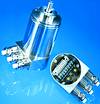
Posital has enlarged its product range to include robust and compact absolute rotary encoders in stainless steel housings. Conventional rotary encoders cannot be used in applications with harsher environmental conditions, such as in the chemical, the heavy industrial or the food industry. The aluminium or sheet steel casings of these encoders risk corrosion. Posital stainless steel encoders are resilient and durable in the above-mentioned industries because of their stainless steel features.
40 MHz, 16-bit microprocessors calculate and evaluate the optically registered angular position. This suits the demand for high realtime capability and distributes the control intelligence from the master control to multiple sensors. The user can easily program most of the encoder parameters such as resolution per revolution, total resolution and preset values. Programmable encoders offer maximum flexibility and convenience.
Electrical features
Posital single-turn absolute rotary encoders have a resolution of up to 16-bit (65 536 steps); the multiturn encoder can register 12 bit (4096 revolutions) with a 28-bit total resolution.
The encoders come equipped with any one of the following interfaces: DeviceNet, CAN-bus, InterBus-S and ProfiBus, as well as the standard interfaces, such as SSI (synchronous serial interface) and Bit-parallel (push-pull).
Suitable for the food industry
Extremely high standards for corrosion resistance and hygiene are essential for the food industry. The use of aluminium is prohibited, as it might contaminate food, meat products and drinks, especially those containing lactic acid. Furthermore, aggressive chemicals used to clean containers and pumps aggravate corrosion. These complications may be avoided by using Posital stainless steel encoders.
Robust stainless steel housing for heavy industry
Higher standards are critical for motion control equipment in galvanising plants as well as steel and rolling mills. During production, aggressive gas, dust and oil taxes the encoders over time. The iron and steel industry's rough environment necessitates the use of sensors with robust stainless steel housings. Highly resistant to dust particles and water, Posital rotary encoders in weatherproof and corrosion-free, stainless steel housings meet the standards of NEMA 4 (IP65). NBR shaft seals keep out mineral oil, grease and fuel.
For more information contact Wim Annandale, ATI Systems, 016 986 2267.
Infrared thermometers for electrical, industrial and HVAC applications Comtest
Maintenance, Test & Measurement, Calibration
: Comtest, distributor of Fluke test and measurement equipment, explains how handheld infrared thermometers are transforming maintenance in electrical, industrial and HVAC environments, with three measurement strategies and a wide range of practical applications.
Read more...Reverse-engineering legacy industrial gearbox parts
Maintenance, Test & Measurement, Calibration
WEG Africa’s turbine workshop uses 3D scanning technology to reverse-engineer components for legacy gearboxes, turbines and compressors, enabling equipment to run for decades after OEM support and spare parts have dried up.
Read more...Unlocking ICCP remote monitoring Omniflex Remote Monitoring Specialists
Maintenance, Test & Measurement, Calibration
Cathodic protection keeps buried and submerged pipelines safe from corrosion, but verifying it traditionally means costly, hazardous manual site visits. Omniflex explains how a retrofit module brings remote monitoring to ageing transformer rectifiers without replacing functional infrastructure.
Read more...Microdieseling – the explosions you never hear
Maintenance, Test & Measurement, Calibration
Microdieseling is a pressure-induced thermal degradation mechanism in which entrained air bubbles are compressed so rapidly that the surrounding oil ignites, producing soot, varnish and sludge. WearCheck explains how it happens, why the damage varies, and how oil analysis detects it.
Read more...Electrostatic spark discharge – when static strikes back Wearcheck
Maintenance, Test & Measurement, Calibration
WearCheck technical manager, Steven Lumley explains how static electricity accumulates in modern low-conductivity lubricants, why compact system designs and fine filtration make ESD more likely, and how to recognise the degradation it leaves behind.
Read more...High-speed cameras for crash testing Horne Technologies
Maintenance, Test & Measurement, Calibration
Vision Research has expanded its Phantom C-series with two cameras optimised for crash and safety testing, offering 4 and 8 megapixel sensors rated to 170G, up to 1180 frames per second, and Phantom Academy application training planned for South Africa next year.
Read more...SKF extends remanufacturing expertise to bearing clearance modification SKF South Africa
Maintenance, Test & Measurement, Calibration
Using its clearance modification expertise, SKF helped a mining equipment OEM salvage spherical roller bearing inventory that would otherwise have been scrapped, confirming a new capability within its remanufacturing services and avoiding redundant procurement.
Read more...When maintenance-system compliance starts replacing plant reliability Wearcheck
Maintenance, Test & Measurement, Calibration
WearCheck ARC division manager, Annemie Willer argues that the greatest threat to effective maintenance is no longer a lack of technology, but the gradual replacement of technical judgement by CMMS compliance, leaving no one owning the machine.
Read more...Nitration: the acid you didn’t see coming Wearcheck
Maintenance, Test & Measurement, Calibration
Nitration is as destructive as oxidation in many engines but far less understood. WearCheck technical manager, Steven Lumley explains how nitrogen oxide gases degrade lubricants, why the process is difficult to detect, and what oil analysis can reveal before damage occurs.
While every effort has been made to ensure the accuracy of the information contained herein, the publisher and its agents cannot be held responsible for any errors contained, or any loss incurred as a result. Articles published do not necessarily reflect the views of the publishers. The editor reserves the right to alter or cut copy. Articles submitted are deemed to have been cleared for publication. Advertisements and company contact details are published as provided by the advertiser. Technews Publishing (Pty) Ltd cannot be held responsible for the accuracy or veracity of supplied material.










 printer friendly version