Electromagnetic flowmeter liners improve according to customer requirements
September 2003Flow Measurement & Control
Security Services & Risk Management
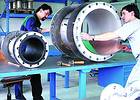
Expanding process parameters, coupled with the requirements of cleaning and sterilisation in the food and pharmaceutical industries has given rise to a number of new EMF (electromagnetic flowmeter) liners and liner technology. Liners are used to coat metal pipes, thereby electrically insulating the fluid from the pipe and allowing accurate flow measurement.
Because there is no liner technology that can be used for the entire range of nominal diameters from DN 2 to 2000, as well as the fact that each customer application is unique, Endress + Hauser has adapted four different liner materials: rubber, polyurethane (PU) and two different fluoro plastics - polytetrafluor ethylene (PTFE) and perfluoroalkoxy (PFA).
Historically, rubber has been the liner of choice and, as such, Endress + Hauser has decades of field experience with this type of liner. The steps to this process include sand blasting the metal pipe, applying a bonding agent and then the liner, inserting caoutchouc matting, followed by placing the measuring pipes in an autoclave, where the caoutchouc is vulcanised (at 145°C for three hours) into rubber. As a liner, rubber exhibits good resistance to water and alkaline solutions, but is not suited to oils or acids and fails to meet the hygienic requirements of the food and pharmaceutical industries.
The most recent liner technology to be introduced by Endress + Hauser is the fabrication of PU liners with the aid of a rotational casting process. Casting moulds are mounted on the flanges, followed by the injection of the two basic components - isocyanate and polyhydric alcohol - into the rotating measuring pipe. Once these components set, the liner is poured through a nozzle. PU liners are particularly suited to the fresh water and wastewater industries.
To manufacture a PTFE liner, PTFE tubes are inserted into the steel pipes - with the exterior diameter of the tube being slightly larger than the interior diameter of the pipe. The range of applications for this liner is, however, limited, as the liner is not mechanically bonded with the pipe wall. At large nominal widths, the liner could collapse due to negative pressure. Similarly, in cases of excessive fluid temperature, the tension in the liner could become too great, due to expansion. Nevertheless, this liner exhibits good resistance to chemicals and high temperatures (-40°C to 130°C), as well as CIP (cleaning in place) requirements of the food industry.
One of the problems of PTFE liners is that during fabrication tiny micropores are generated in the liner material. If the fluid enters a steam phase, steam could diffuse through the pores and condense on cooling. If the fluid is again heated, the condensed water will expand into steam, causing the micropores to stretch. Thus, if a process involves steam phases, coupled with frequent temperature variation, it would be better to opt for a PFA liner.
Liquid PFA at 400°C is isothermically injected into the pre-heated mould. A pre-defined cooling temperature ensures that no micropores are present in the material. To reduce tension in the liner, the pipes are tempered in an oven for 24-hours. PFA liner is resistant to chemicals and high temperatures (up to 180°C), meets CIP and SIP (sterilisation in place) requirements, and has received sanitary approval for Endress + Hauser's hygienic flowmeter Promag H.
Thus, with a variety of liners, Endress + Hauser is able to offer customers a cost-effective and tested liner for specific applications. Where more than one liner material could be used, tests will be carried out to determine which is better suited.
The line between locking residents out and restricting their access
News & Events Security Services & Risk Management Residential Estate (Industry)
A June 2026 High Court judgment has clarified one of the most contested issues in modern estate governance: when an HOA's digital access restrictions amount to unlawful self-help or spoliation, and when they do not.
Read more...Modernise field communications with Push-to-Talk over Cellular
Products & Solutions Security Services & Risk Management
Sentiv is bringing Hytera’s Push-to-Talk over Cellular (PTToC) portfolio to organisations that need a more structured and controlled way to coordinate field teams, without extending a full private radio model to every team, site, or function.
Read more...Zero-touch automation certificate life cycle management loop
Products & Solutions Information Security Security Services & Risk Management
ManageEngine completes the certificate life cycle management loop with CA-agnostic, zero-touch automation. New post-deployment automation in Key Manager Plus removes the last manual step in certificate renewal as lifespans gradually shrink to 47 days
Read more...Fire safety in South Africa Technoswitch Fire Detection & Suppression Technews Publishing SMART Security Solutions
Fire & Safety Security Services & Risk Management Editor's Choice
Fire safety is sometimes ignored, sometimes relegated to whatever is cheapest, and sometimes treated with the seriousness it deserves, given that it focuses on protecting life and assets. SMART Security Solutions asked Brett Birch, MD of Technoswitch, for some insights into the realities of fire safety in South Africa.
Read more...Sophos launches AI-native cybersecurity defence system
News & Events Information Security Security Services & Risk Management
Built for a threat landscape reshaped by AI, Sophos Fusion unites security operations, endpoint, network security, identity, email, and cloud into one defence system that prevents, detects, investigates, and responds at AI speed.
Read more...Stop supplier fraud at the moment of payment
News & Events Security Services & Risk Management
Cape Town-built platform bridges the gap between onboarding and transaction by securing identity inside the live channels where companies exchange invoices and banking details.
Read more...Inspiration for times of change Endress+Hauser South Africa
News
More than 2000 customers, partners and experts gathered in Basel, Switzerland, for the Endress+Hauser Global Forum in April 2026. Under the theme of driving sustainable transformation together, the event combined keynote sessions on strategy, technology and the future of work with practical case studies from across the process industry.
Read more...Ungoverned AI agents and deepfakes pose critical threats
Information Security Security Services & Risk Management
Global study reveals 64% of South African organisations already deploy autonomous AI agents with little to no governance, while 63% of employees admit they are unlikely to be able to spot attacks such as deepfakes
Read more...A risk-based approach to fire safety
Fire & Safety Security Services & Risk Management Industrial (Industry) Agriculture (Industry)
A report by fire engineering consultancy ASP Fire is challenging blanket assumptions around combustible-core sandwich panels, arguing instead for a rational, risk-based approach that balances fire safety requirements with commercial realities in sectors such as agriculture, manufacturing and industrial processing.
Read more...Preventing and suppressing lithium fires SMART Security Solutions Technews Publishing
Editor's Choice Fire & Safety Security Services & Risk Management Smart Home Automation SMART Security Solutions asked Clyde Becker, director of Pyro Brand, for some insight into the mechanics of lithium-ion battery fire risks, especially thermal runaway, and to define a comprehensive, layered approach to fire detection and suppression.
While every effort has been made to ensure the accuracy of the information contained herein, the publisher and its agents cannot be held responsible for any errors contained, or any loss incurred as a result. Articles published do not necessarily reflect the views of the publishers. The editor reserves the right to alter or cut copy. Articles submitted are deemed to have been cleared for publication. Advertisements and company contact details are published as provided by the advertiser. Technews Publishing (Pty) Ltd cannot be held responsible for the accuracy or veracity of supplied material.










 printer friendly version