



Economic design of signal transfer in installations in the processing industries is becoming ever more important. There are high expectations regarding installation safety and availability while installations themselves become more complex.
Significant cost savings in the parallel wiring of relatively large signal volumes can be achieved in compact and yet still flexible installations. The Process Interface product line from Phoenix Contact demonstrates how these demands can be met and at the same time installation costs and expensive downtime can be reduced.
Unlike manufacturing, which is characterised by distributed installations primarily utilising digital signals, in the automation of the processing industries analog signals (0/4 to 20 mA) continue to play a significant role in the measurement of variables. In order to automate processing sequences, many items of information concerning the immediate value of different process parameters are needed. Here, the major functions are the detection of the variables of pressure, temperature, flow and level. Also, in addition to analog closed-loop control signals there are numerous digital reporting and open-loop control signals. A further feature of installations in the processing industries is the proliferation of areas in which explosive atmospheres can occur. Devices for use in such areas may be installed only if special safety measures are observed; in other words, using them may under no circumstances lead to an explosion.
In the area of measurement and control, the 'intrinsic safety' (EEx-i) class of explosion protection in accordance with the European standard EN 50020 has become widespread. By limiting the power run into the Ex-zone, this ensures that no spark capable of igniting an explosion, or thermal effect, can occur.
An intrinsically safe measuring circuit consists of:
* The intrinsically safe equipment installed inside the zone at risk of explosion, eg a pressure transmitter, in which all the internal circuits are 'intrinsically safe'.
* The related equipment, such as transducer feed isolators, which converts an intrinsically safe signal into a nonintrinsically-safe signal and therefore also contains nonintrinsically safe circuits.
* The connecting wires (Figure 1).
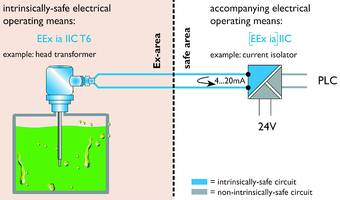
Related equipment may be either pure signal isolators (safety barriers) or signal-processing devices such as measuring transducers, isolation switching amplifiers or valve control modules. These items are installed in the nonhazardous area. The advantages of intrinsic safety as a class of explosion protection lie in the comparatively simple operation which allows maintenance during operation and in the low-cost installation. Expensive flameproof enclosures and field distribution boxes are not required.
This is also the reason that distributed installation designs are to date much less significant in the processing industries than they have become in the manufacturing industries. Alongside serial designs, in the future parallel wiring concepts will also be economical, for example with remote I/O stations, installed in Zone 1.
Phoenix Contact, with its Process Interface product line, has met customer wishes by bringing an interface system onto the market that takes up little space and yet offers simple signal handling, even in large volumes. At the same time it meets the high expectations as to installation availability (through loop integrity, among other features), short commissioning times, clarity of layout and ease of service.
Only 12,4 mm wide: compact and easy to service
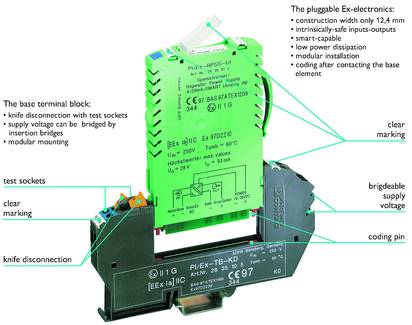
The Process Interface (PI) system consists of a standard base only 12,4 mm wide, plus plug-in and keyed electronics modules, also only 12,4 mm wide (Figure 2). This low constructional width is possible thanks to the use of patented flat-designed Ex-i isolating transformers and modern SMD technology with low dissipation. The standard base, or base terminal block, with the connection convenience of a marshalling terminal, has test jacks on the field side for every conductor, and these are upstream and downstream of the integrated knife disconnector. The knife disconnection system guarantees rapid and safe isolation of the signal path when service is required. For diagnostic purposes, a meter can be conveniently coupled into the current loop, without any need to interrupt the signal circuit.
Minimised marshalling and space requirement
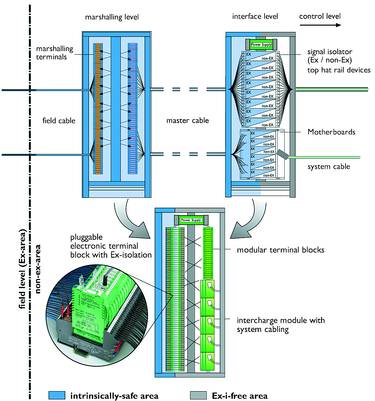
The Process Interface product line offers the possibility of wiring the PI base terminal block directly into the input strip of the marshalling distribution box. 32-pin jumpers put the power supply into operation rapidly and safely, without any need for wiring. Matching to the various functions is by means of plugging in the appropriate PI modules which are keyed into place and are vibration-proof once they have snapped in. Marshalling can now take place outside the 'Ex zone' which is advantageous owing to the less severe installation stipulations for nonEx signals.
Depending on the individual application, marshalling can be either through the modular terminal blocks or through the interface modules from the Varioface range, which provide a low-cost and safe connection to the control system level, via system wiring (Figure 3). By combining the marshalling and interface levels in this way, and as a result of the low constructional width of 12,4 mm, the space needed in the switch cabinet is considerably reduced.
Motherboards made to measure
It will not always be possible or productive to attempt this combination, for example if separate marshalling and interface levels already exist or if there is no marshalling. For such applications, and in addition to the modular PI base terminal blocks, multichannel PI module carriers (motherboards) are now also available. In interface levels, motherboard designs are common and are often less expensive than separate top-hat rail devices.
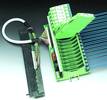
The PI universal motherboard has 16 receptacles for PI modules and is integrated into an enclosure that can be installed on a top-hat rail. Power supply is handled centrally. On the system side, a multi-function plug connector allows direct connection to the input/output sub-assembly. As a result of the compact design, these devices permit a high packing density without loss of integrity of the individual measuring circuits. It is planned to develop individual variants, and the design already allows for this. By means of a composite approval it is possible to implement customer-specific designs rapidly. Thus, for example, depending on individual requirements, four, eight or 16-channel designs with various field connection terminal blocks (screwed, spring cage, Quix) and differing multiple plugs such as D-Sub, ELCO or FLK for connection to a PLC wiring concept can be implemented rapidly and simply (Figure 4).
A comprehensive range of products
The range of PI modules which is being continuously expanded, consists of intrinsically safe, SMART-compatible transducer feed devices, NAMUR [German Measurement and Control Standards Committee] switching amplifiers, valve control modules, isolating amplifiers and programmable temperature transducers for resistance thermometers and thermocouples. A common feature of all modules is the low dissipation with transmission errors <0,05% of the final value. They have status displays, offer loop integrity in order to increase installation availability and are compatible with all well-known field devices.
The intrinsically safe Process Interface components are approved at the [EEx ia] II C level as related equipment for all zones and gases and certified in accordance with the ATEX 100 a directive that will become mandatory after 1 July 2003.
The Process Interface product line from Phoenix Contact provides a system that is both tried in practice and taking the future into consideration, allowing the efficiency of interface levels in various applications to be increased through a wide variety of functionalities.
| Tel: | +27 11 801 8200 |
| Email: | [email protected] |
| www: | www.phoenixcontact.co.za |
| Articles: | More information and articles about Phoenix Contact |






© Technews Publishing (Pty) Ltd | All Rights Reserved
 printer friendly version