



German-based Maturo is a global specialist in electromechanical positioning systems for EMC, automotive, radio and radar measurements.
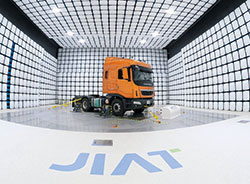
The only reliable way to test the EMC properties of heavy trucks and buses weighing tons is using a facility with interference-free control based on fibre optic communication, which supports precise positioning of rotary tables up to 14 m diameter. Flexible PC-based control and drive technology are key factors for Maturo’s ability to cover a wide range of applications and diverse customer requirements.
Maturo offers a wide range of rotary positioning tables for application in EMC cabins and in field installations. The table diameters can range from 0,3 up to 14 m, with payloads between 10 kg and 100 tons. Manual, semi or fully automatic antenna masts and tripods for different measuring heights or loads and movements are used for positioning the required radiation antenna. The overall facility is operated with three controllers developed in-house, including the new NCD, which can control up to eight multi-axis devices. These can be comprised of any combination of antenna masts, rotary tables, rotary units, sliding tracks or other positioning devices.
Markus Saller, technical director of Maturo, explains the configuration for a classic EMC application: “An EMC-shielded space generally contains a rotary table and an antenna mast with a radiation antenna. A controller, such as the newly-developed NCD based on Beckhoff technology, is connected to the outside via a fibre optic cable to protect against interference. The NCD is used to control different measuring distances between the test device and the antenna as well as the rotary table and antenna positions. In addition, high-precision applications with a rotary table positioning accuracy of up to 0,01° are becoming increasingly important. This is implemented for antenna calibration or to minimise the necessary measuring distances and reduce the required size of the EMC space, among other applications.”
PC-based control offers a wide, scalable product range
Regardless of the basic configuration of an EMC application, the solutions offered by Maturo must be flexibly adaptable to a wide range of individual customer requirements. According to Stefan Lehner, manager of the software department at Maturo, the high flexibility of PC-based control and drive technology from Beckhoff were major factors in the decision process: “The Beckhoff product range is expansive and has the additional benefits of high modularity and scalability. In this way, both standard and special functions can be quite easily implemented according to the customer’s requirements – for example, through integration of different interfaces or special safety functions. Additional benefits are offered through the openness of the system, which facilitates the incorporation of third-party components. Here, we are optimally supported by the EtherCAT communication standard, which was originally developed by Beckhoff and is now established worldwide. EtherCAT is tried and tested as an extremely powerful and easy-to-handle bus system.”
The flexibility of the automation technology from Beckhoff also benefits Maturo in other ways. One aspect is the use of optical fibre as transmission medium. Lehner explains: “Without fibre optic technology, our solutions would not be possible. A key factor is that this type of cabling can be seamlessly integrated with the control technology we use. In contrast to many other systems, PC-based control offers the capability of holistic system integration, without the need for an intermediate LAN to fibre converter.” This is implemented in the new NCD controller, which includes four EK1521 EtherCAT fibre optic junction terminals, through which all other devices are addressed. A customised CP6907 control panel ensures optimal usability, while a CX1020 embedded PC provides the required computing power. TwinCAT NC PTP software is used to control the numerous axes in the application. A TwinCAT XML Data Server handles the data management, while a TwinCAT TCP/IP Server supports communication with the higher-level control system.
Flexible and compact control technology with high precision
According to Lehner, the modularity of PC-based control results in another benefit: “In many cases, our projects are very challenging in terms of limited available space. Therefore, we never use conventional control cabinets since we have to be able to install the automation components in different positions, including horizontal or suspended, not to mention the need for modular, distributed components. The modularity of PC-based control helps us address these challenges, especially since the control technology can be flexibly scaled to individual needs. For example, the I/Os can be used precisely as required for each channel or added later on, which avoids the need to specify large, oversized I/O modules. Another advantage: In conjunction with the EL7041 stepper motor terminals and the EL7211 servomotor terminals, we use the new ZB8610 fan cartridge, which facilitates more compact configurations in installation. In the past, we used an external fan, which required significantly more space and installation effort.”
For high precision, Maturo also uses the options offered by eXtreme Fast Control (XFC). Lehner elaborates: “Via the EL2262 EtherCAT Terminal, we can specify the positions with an oversampling factor of 100 and reach a far higher resolution than would be possible with the underlying control cycle. This is the only way to transfer the required commands to the drive technology at relatively high speeds and with 0.01° resolution. The XFC technology based on the distributed clocks feature provided by EtherCAT is a prerequisite for the hot-connect functionality, which ideally supports the highly flexible bus configuration with EtherCAT.”
Compact drive technology for numerous axes
The high complexity of EMC test facilities is illustrated by the large number of motion axes required in many cases. It is not uncommon that up to 50 axes have to be programmed. In addition to the rotary table axis, these include axes for several antenna masts, which can each have up to seven axes. For the rotary tables this is realised via servo axes. For the antenna masts, which require a higher torque, stepper motors are used. Saller concludes: “With our wide range of requirements, we benefit greatly from the diverse Beckhoff drive portfolio. Added benefits come from the simplified installation and commissioning with the One Cable Technology (OCT), including electronic type plates. In particular, we benefit from the compact drive technology, specifically the servo and stepper motor terminals, which we prefer to use whenever possible. Because the drivetrain can easily be assembled in a highly compact configuration according to individual needs, maximum flexibility is assured for customer implementations.”
For more information contact Michelle Murphy, Beckhoff Automation, +27 (0)11 795 2898, [email protected], www.beckhoff.co.za.
| Tel: | +27 11 795 2898 |
| Email: | [email protected] |
| www: | www.beckhoff.com |
| Articles: | More information and articles about Beckhoff Automation |






© Technews Publishing (Pty) Ltd | All Rights Reserved
 printer friendly version