



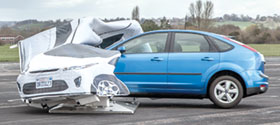
Car sales have soared in the last decade and there are now more cars than ever on our road network. This growth has seen a rise in the number of accidents and the trend has spurred car manufacturers to introduce advanced driver assistance systems (ADAS). In light of this, leading vehicle test equipment supplier, AB Dynamics, looked to gearing specialist, Harmonic Drive UK, when developing the test technology for the next generation of cars.
With a 38% growth in international car sales between 2000 and 2014, there are now over 72 million cars worldwide, according to a recent report by Scotiabank. To combat this problem, car manufacturers have developed a variety of ADASs to take control of a vehicle during an emergency and take evasive action to prevent a collision.
ADAS technologies include features that use radar to monitor cross-traffic, apply emergency brakes, warn drivers of forward collisions and lane departure, as well as provide information on blind spots when merging on slip roads and even automatic high beam support during night-time driving.
Testing new cars
Before rolling out final production models, car manufacturers are required to put new vehicles through their paces in hundreds of hours of driven and driverless testing routines on closed test tracks. To accomplish this, they turn to specialist vehicle testing companies such as AB Dynamics.
Specialising in areas of vehicle testing from kinematics and compliance, dynamics and ADAS, as well as driverless vehicle and steering system testing, AB Dynamics has built a reputation as the go-to supplier of advanced vehicle testing systems. By using technology from AB Dynamics, car manufacturers can develop and test ADAS technology without the risk of two cars actually colliding.
Human vs robot
In recent years, car manufacturers have used driverless setups with robots operating the vehicle controls to stage near-miss scenarios that test the evasive action of onboard ADAS sensors. Here, the paths of two vehicles are defined such that a high speed collision is only just avoided and the efficacy of the ADAS can be observed without expensive test vehicles being destroyed or damaged.
Guided soft target
One of the latest innovations in vehicle ADAS testing, developed by AB Dynamics, is the use of a guided soft target (GST). With a total vehicle height of only 125 mm, the GST is an ultra-low profile driverless vehicle that measures in at 2,8 m long and 1,5 m wide. The GST provides the platform on which to mount a full sized car body constructed from a chassis of expanded foam sections with a vinyl cover over it. A metallic mesh weaved into the cover material means the GST registers the same radar signature in the approaching vehicle’s ADAS sensor.
The GST and driverless vehicles are then programmed to follow guided paths via GPS to allow staged collisions to take place at speeds in excess of 80 kph. The test vehicle can repeatedly crash and drive over the GST without causing any damage to either vehicle.
The brief
Directional control of the GST is achieved via an on-board motion pack, an enclosed inertial navigation device with built in GPS correction coupled to a steering actuator controlling the front wheels. Because of the demands for the very limited space within the GST, it became clear early on in the design process that the motion pack would need to be packaged in the same vehicle compartment as the steering actuator, meaning an actuator no more than 125 mm long had to be found. At the same time, this actuator needed to provide sufficient torque to turn the wheels with the vehicle stationary and be strong enough to withstand shocks transmitted through the steering gear during operation.
To achieve this goal, AB Dynamics turned to gearing specialist Harmonic Drive UK. With over forty years experience in providing innovative and well engineered products to industries from aerospace and military to industrial and automotive, Harmonic Drive is a specialist in high precision actuator technology. The company’s competitive advantage lies in providing zero-backlash gears with high reduction ratios.
“The criteria we gave to Harmonic Drive focused on four key areas: size, weight, durability and precision,” explains Colin Martin, director of mechanical design at AB Dynamics. “The actuator needed to be compact enough to fit in front of the motion pack without forcing a change to the profile of the GST.
“This is especially challenging because the nose of the GST tapers to a sloping wedge shape at the front and the front wheels are inevitably quite far forward in the vehicle. These factors put a limit on the gearbox diameter of around 66 mm. Supplying a small actuator is one thing, but being able to provide a sufficient torque output meant that an actuator with a high power density was essential.
“During use, the GST is subject to high G-forces and experiences all weather conditions, including subzero temperatures when test tracks may be salted. As a result, as well as shock and vibration from the repeated high impact collisions sustained during testing, the motion pack needs to cope with large temperature variations as well as to withstand ingress from the elements and corrosion from road salt. “Finally, precision operation and lack of backlash were vital considerations for precise steering control,” he adds.
Gearing up
Managing director of Harmonic Drive, Graham Mackrell explains that having developed actuators for some of the most extreme environments on earth, and even for the Mars Rovers, the company is often asked to meet demanding specifications. “We took a standard off-the-shelf product from our CobaltLine range – a high torque capacity component set with extended temperature range – and customised it with the dimensions, torque rating and flange connectors required for use in AB Dynamics’ GST application,” he says.
The resulting actuator measures in at a length of just 119 mm, a diameter of 64 mm and a weight of 1,8 kg. The range itself is available with gear ratios between 50 and 160:1, offering repeatable peak torques between 23 and 841Nm and a power density of up to 545 Nm/kg.
Additionally, the actuator is sealed to prevent ingress, all of its external surfaces have appropriate surface treatments to withstand the corrosive environment and the gears use a specially formulated lubricating grease to provide a wide operating temperature between -40 and 90°C. To withstand repeated shock and vibration, Harmonic Drive actuators use a low part-count, as well as the latest aerospace and military-grade materials. This combination ensures the GST can provide car manufacturers with reliable results in extreme conditions, anywhere in the world.
The final challenge was finding an actuator that was precise. The GST uses AB Dynamics’ path following system to guide the vehicle along pre-defined paths, monitoring its position, speed and time. The controller needs to make small and accurate steering corrections to ensure the GST stays on course. Backlash in the gear could make it difficult or impossible to hold the exact path and could place excessive demand on the steering motor. This would waste battery capacity and could ultimately lead to overheating.
“Although a multistage planetary gear might have given us sufficiently low backlash and high torque capacity, the increased length of the unit would have prevented the motion pack from fitting in the same compartment, making it impractical,” explains Martin. “Harmonic Drive’s solution was smaller, had less backlash and lower mass than any other alternative.
“Pushing the limits of performance is never going to be any easy task when developing new engineering projects. Setting out the criteria for the GST, we didn’t expect to easily find the right product for the job.
“Harmonic Drive’s flexibility in producing customised and special variants of existing catalogue products gives us the flexibility to develop increasingly competitive vehicle testing solutions without reengineering off-the-shelf products to fit housings and connectors,” he concludes.
The future of testing
As we move towards a society largely dependent on autonomous vehicles of one kind or another, it is increasingly important that we can trust the built-in safety systems to perform in an emergency. Older innovations such as antilock brakes (ABS) and electronic stability control (ESC) technologies that were rare just a few years ago, are now commonplace. Similarly, ADAS systems are now paving the way for the next generation of autonomous, self-driving vehicles. If we are to truly embrace a future devoid of accidents, facilitating reliable testing is something we must prioritise in the here and now.
For more information contact Rhi Guthrie, Shrike Marine, +27 (0)21 447 6877,[email protected], www.shrikemarine.com






© Technews Publishing (Pty) Ltd | All Rights Reserved
 printer friendly version