



System Integration & Control Systems Design


ABB Instrumentation for bleaching of pulp suspensions

May 2016 System Integration & Control Systems Design

Unbleached pulp has a brown colour due to the remaining lignin of the mechanical pulp. As a result, the pulp requires bleaching to achieve the required quality for producing white paper.

Bleaching is a process that improves the purity and brightness of fibre suspensions using chemicals. Usually, a bleaching plant comprises the reaction container and machines, the piping, the equipment for refilling, storing and conditioning the bleaching chemicals, and the control system for pulp bleaching. A bleaching plant normally comprises several bleaching stages, for economic reasons.

A conventional multi-stage bleaching plant contains several bleaching towers and peroxide stages with downstream washing units. Using multi-stage systems on one hand reduces the expenditure regarding chemicals and heat, but on the other, requires specific bleaching chemicals and processing conditions to achieve some targets (e.g. a high degree of whiteness combined with a low stability loss of the fibres).
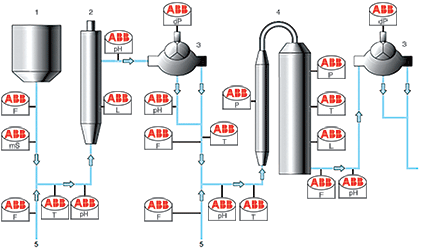
Principle of operation

Coloured pulp is conveyed from the digester via the delignification to the first stage of the bleaching system. The pulp reaches the first bleaching tower, where a hydrostatic pressure transmitter (L) and electromagnetic flowmeters (F) provide for constant levels and optimal production rates. Additionally, the chemicals are supplied to the bleaching tower.

Electromagnetic flowmeters (F) are used for dosing control. Pressure transmitters (P), temperature sensors (T) and pH measuring systems (pH) monitor the chemical reactions and reduce both quality variations and the energy cost.

After this, the pulp reaches the washing unit, where a wash filter removes the bleaching products. Conductivity measuring systems (mS) ensure an optimal washing process and provide for constant balancing of the salt content in the process. Filter and sieve monitoring for long-term efficient filtration is realised using differential pressure transmitters (dP).

The process described here repeats in subsequent oxygen and peroxide stages.

ABB offers a comprehensive portfolio for optimal papermaking. Engineered solutions for process measurement advanced systems ensure process efficiency together with state-of-the-art instrumentation.

(F) Electromagnetic flowmeter FSM4000, separated model:

• Suitable for multi-phase liquids.

• High performance due to DSP technology.

• Short response time undisturbed output.

• Local indication of measuring value.

• Integrated monitoring and diagnosis functions.

(T) Temperature sensor TSP121 with integrated head mounted transmitter TTH300:

• Various process connections.

• Optionally with tip for short response time.

• Measuring insert replaceable during operation.

• Various selectable transmitter types.

(P,L) Pressure transmitter 261G:

• Wide range of possible spans.

• Various process connections.

• Optional control and display panel.

• Optimised for harsh process conditions.

(dP) Transmitter for differential pressure 266DS:

• High base accuracy 0.04%.

• Long term stability.

• Wide range of available sensors.

• Various process connections.

(pH) pH/Redox measuring system with transmitter TB82pH and sensor TB557:

• Single-rod measuring cells with wood diaphragm.

• Various electrode models, resistant to deposits.

• Long life cycle, minimum maintenance requirements.

• Robust transmitter with sensor diagnostics.

(mS) Conductivity measuring system with transmitter TB82EC and sensor TB465:

• High pressure and temperature resistance.

• Various optimised designs.

• Robust transmitter with sensor diagnostics.

• High availability and easy operation.

For more information contact ABB South Africa, +27 (0)10 202 5000, instrumentation@za.abb.com, www.abb.com/measurement


Credit(s)


Share this article:
Share via emailShare via LinkedInPrint this page

Further reading:

How certified industrial automation channels become co-creators in the AI era
Schneider Electric South Africa System Integration & Control Systems Design
As industrial automation becomes software-driven and AI-enabled, the role of channel partners is shifting from equipment supply to outcome-based consulting, software integration and lifecycle services that require continuous certification and capability development.

Read more...
Why integration defines the next competitive edge in pulp and paper
System Integration & Control Systems Design
ABB’s Arvin Ramjee argues that fragmented automation, assembled from different suppliers at different stages of a plant’s lifecycle has become one of the pulp and paper industry’s most overlooked commercial risks, and that true integration, rather than surface-level connectivity, is what delivers measurable business value.

Read more...
Integrated automation enhances water treatment at dairy facility
Process Dynamics System Integration & Control Systems Design
Process Dynamics delivered the electrical, instrumentation, control and automation integration for an advanced water treatment and reverse osmosis system at a major South African dairy processing facility, achieving a 50% reduction in the client’s water utility costs.

Read more...
Intelligent process control is reshaping cement production in Africa
System Integration & Control Systems Design
Advanced process control, predictive analytics and automation are helping African cement producers cut energy use and stabilise output as they contend with rising electricity costs and tighter margins.

Read more...
Schneider Electric’s Alliance Programme turns system integrators into trusted technology partners
Schneider Electric South Africa System Integration & Control Systems Design
: Schneider Electric’s Alliance Partner Programme is helping system integrators across Africa move beyond one-off projects and build the skills and service models needed to become long-term industrial technology partners.

Read more...
Process Dynamics – Integrated Automation for Dairy Water Treatment
Process Dynamics System Integration & Control Systems Design
   Project and industry Process Dynamics delivered the electrical, instrumentation, control and automation integration for an advanced water treatment and Reverse Osmosis (RO) system at one of South Africa’s ...

Read more...
New SI programme strengthens Schneider Electric’s partner ecosystem
Schneider Electric South Africa System Integration & Control Systems Design
Schneider Electric’s SI Energise 2.0 programme offers system integrators a competency-based framework to develop deeper expertise in EcoStruxure and AVEVA software, enabling them to deliver full-lifecycle industrial automation solutions.

Read more...
AI and smart solutions for underground proximity detection systems
System Integration & Control Systems Design
Booyco Electronics explains why fitting proximity detection systems underground is far more complex than installing sensors, and how integration, data and intelligent analytics are helping mines manage the challenge.

Read more...
Women shaping engineering at ABB
ABB South Africa News
Two ABB engineers share how curiosity, mentorship and an inclusive culture have shaped their careers, and what they see as the most exciting opportunities for women in engineering across Africa.

Read more...
Why cloud-ready BMS is reshaping building operations
Schneider Electric South Africa System Integration & Control Systems Design
Smart sensors and non-contact radar are reshaping industrial measurement, feeding connected platforms that predict failures before they happen.

Read more...


While every effort has been made to ensure the accuracy of the information contained herein, the publisher and its agents cannot be held responsible for any errors contained, or any loss incurred as a result. Articles published do not necessarily reflect the views of the publishers. The editor reserves the right to alter or cut copy. Articles submitted are deemed to have been cleared for publication. Advertisements and company contact details are published as provided by the advertiser. Technews Publishing (Pty) Ltd cannot be held responsible for the accuracy or veracity of supplied material.


© Technews Publishing (Pty) Ltd | All Rights Reserved

