



With its equipment, the machine-building industry also exports safety standards to the global markets. In this way, the predominant type of protection in Germany and Europe, Intrinsic Safety (Ex i), is gaining increasing distribution. In the event of maintenance or replacement, measuring instruments in this category require no additional protective measures within the Ex area. This is convenient for the operator. However, there is one challenge that should not be underestimated: the proof of intrinsic safety.
Overview
For any explosion to occur, whether in a mine or in an industrial plant, three factors must come together: oxygen, flammable gas or dust, and also an ignition spark. As a result, the fundamental measures for explosion protection are derived from this. They are divided into three main types: The primary explosion protection is to prevent the formation of a hazardous explosive atmosphere, for example, by ventilation or extraction. The secondary explosion protection excludes the possibility that an ignition spark could let a potentially hazardous gas-air mixture explode. The tertiary explosion protection limits the effects that any explosion that occurs may have. For all electronic equipment, in general, there exists a risk of spark generation within the device. All measures which inhibit spark generation from the outset, prevent them from entering the explosive environment, or limit their energy, are counted as types of protection: Constructional design possibilities with a pressure transformer are, for example, the encapsulation of the electronic components with oil or sand (type of protection Ex m) or their flameproof enclosure (Ex d). Intrinsic Safety (Ex i), on the other hand, means an electronic solution. It relies on reducing the energy in a component – here in the transmitter – sufficiently so that it is always under the minimum ignition energy for an explosive atmosphere.
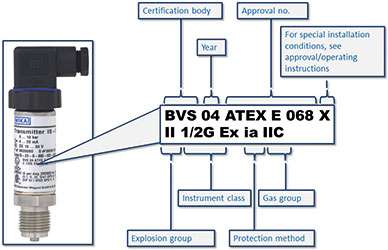
Ex i and the other types of protection are subject worldwide to various standards – in Europe this is the ATEX 94/9/EC product directive. The instrument marking compliant with the standards indicates for which Ex areas the specific product is approved. The WIKA pressure transmitter shown here is an intrinsically safe instrument which may be used in a permanently explosive atmosphere (protection type Ex ia). The instrument class 1/2G indicates that the sensor, for example, can be screwed into the side wall of a tank with explosive contents, with the electronics, however, installed outside and therefore in a less hazardous zone. (see Figure 1.)
Principles of operation
How does Ex i function in detail? Basically, the higher the electrical power, the higher is the chance of the (ignition) energy being released through the occurrence of a spark. With capacitances, sparks occur on the closing of an electrical circuit, with inductances, during the opening. Explosion protection through intrinsic safety thus means limiting the energy of the sparks. In an intrinsically safe pressure transmitter, such as the IS-3 from WIKA, it is ensured that, in normal operation as well as in the event of a fault, the minimum ignition energy of the hazardous area for which the instrument is approved is never exceeded. In addition, the surface temperature never exceeds the approved value, and thus, nor does it exceed the ignition temperature of the gas or dust mixture according to the temperature class defined in the standard.
This is mainly achieved through the limiting of voltage and current. Capacitance and inductance are also reduced in order to limit the energy of opening and closing sparks.
The design of the sensor has been matched to these low values for current and voltage.
In addition, for a safe power supply for the transmitter, an additional barrier is always required, for example a Zener barrier or an intrinsically safe isolated barrier. Effectively, a Zener barrier consists of a Zener diode and a fuse. When working on the circuit, such as during installation or maintenance, there is a risk that a short circuit could occur. In such an event, the fuse in the barrier could be destroyed and then, generally, the entire device must be replaced.
For this reason, the use of an intrinsically safe isolated barrier is recommended. By using an optocoupler (an integrated interconnection of an LED and a photo diode), this device galvanically isolates the intrinsically safe from the non-intrinsically safe circuit – in this way, the circuit is free from earth potential and thus enables a clean isolation of the earth potential in the safe and in the hazardous areas. In some cases, the barrier can already be integrated into the PLC. The PLC is located outside the Ex area, while the pressure transmitter (sticking with this example) is mounted in the hazardous area. The connection cables between both components must be correctly installed and specifically marked.
The proof
The ATEX standards do not only define the parameters for intrinsic safety. They also stipulate the proof, if an Ex i device and associated equipment are interconnected (in our example, pressure transmitter and isolated barrier). This subject confronts operators with a complex task, in which they are not safe from pitfalls and therefore must build in a considerable expense. First of all, they have to keep up to date on the current details of the standards. The procurement of individual components on an ATEX basis requires detailed checking: For which zones and explosion groups are the individual components approved? Is the barrier matched to the transmitter? Are the cables correctly dimensioned in order to ensure the required energy flow? Given the multitude of possible equipment variants, it can sometimes be difficult to make the right choice. For the proof of intrinsic safety, the individual approval and safety data of all components must subsequently be collated and recorded completely. Not every manufacturer makes, for example, the required ATEX approval certificate available for download. In this case, the document must be requested additionally.
With exception of petrochemical companies, Ex areas do not belong to the everyday routine of most plant designers and machine-building engineers. For this reason, experience shows us that for everyone with Ex i related tasks, two to three hours of engineering time should be estimated, per measuring point. Alternatively, the operator can turn to expert suppliers to the industry, in order to eliminate potential errors and, on top of that, save time. Against this background, WIKA has developed an ‘all-inclusive’ solution: The intrinsically safe pressure transmitter comes as part of a package with a matched barrier as well as all the data for the Ex i proof. This considerably simplifies the setting up of an ATEX-compliant measuring point and also the documentation connected with it.
For the proof of intrinsic safety, from a technical point of view, there needs to be a complete analysis of the circuit: The electrical parameters of the transmitter, isolated barrier and cable need to be matched and recorded. If the conditions specified in the standard are met, the interconnected measuring arrangement is considered to be intrinsically safe and can be installed.
In the documentation for intrinsic safety, the pin assignment of the entire system is also presented as a drawing.
The Ex i proof is part of the “explosion protection” chapter in the plant documentation. With this, operators ensure that their plant or machinery poses no risk to life or limb.
| Tel: | +27 11 621 0000 |
| Email: | [email protected] |
| www: | www.wika.co.za |
| Articles: | More information and articles about WIKA Instruments |






© Technews Publishing (Pty) Ltd | All Rights Reserved
 printer friendly version