



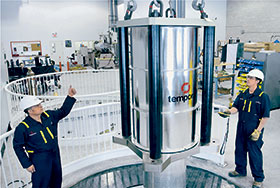
Increased usage of renewable energy in power production often leads to grid fluctuations. These spikes and dips must be balanced in order to ensure that power supplies remain reliable. Flywheels are ideal for this purpose: By storing excess energy and releasing it back into the grid when required, they can respond to grid variations in a split second. Technology innovator Temporal Power, based in Ontario, Canada, uses this technology in its high-performance energy storage and regulation systems to provide a new avenue for grid balancing and support in alternative energy implementations.
Feeding power from renewable power sources into energy grids often results in frequency fluctuations. If the power generation is higher than what is consumed, the frequency rises. Alternatively, if there is too much load and not enough generation, the reverse happens and the frequency drops below recommended levels. Traditional assets used to avoid outages stemming from such frequency fluctuations include gas generation and hydroelectric systems. However, the process is resource-intensive, and these systems are much slower to react, requiring time to reach full power. Flywheel energy storage provides an ideal solution, particularly the systems designed and manufactured by Temporal Power.
The efficiency and value of the Temporal Power systems led Canadian energy storage developer NRStor to choose its flywheel system. In 2014, NRStor opened a 2 MW storage array that employs Temporal Power’s flywheel-based frequency regulation technology. This innovative project has not gone unnoticed, highlighted by Temporal Power’s recent naming as the 2014 Company of the Year by the Ontario Energy Association.
A new ‘spin’ on renewable energy storage
The basic premise of a flywheel-based energy storage system centres on a rotating steel cylinder, suspended by bearings inside a vacuum chamber to reduce friction, and connected to a combination electric motor and electric generator. Energy from the source is applied to the flywheel assembly, causing it to spin at very high speed, up to around 12 000 rpm. Once at speed, the power is disconnected and the combination of the vacuum-sealed system and high-tech bearings allows the mass to continue spinning with minimal loss from friction. When drawing the power back out of the system, the kinetic energy from the flywheel is transferred back into the grid.
Traditional mechanical bearings can cause significant losses in the kinetic potential energy as a result of friction. “Temporal Power’s proprietary magnetic bearings significantly reduce friction and enable the system to achieve 97% mechanical efficiency,” said Jeff Veltri, president and CTO at Temporal Power. “This design methodology offers a next-generation power solution that is both robust and environmentally sound,” added Cameron Carver, Temporal Power CEO.
Grid monitoring with EtherCAT: Response times in the millisecond range
In the earliest stages of development, Temporal Power sought to reduce latency with a faster, more robust communication system for data transfer. The Beckhoff system now used consists of a CX2020 Embedded PC with directly connected I/O terminals, EtherCAT as the communication system, and TwinCAT 3 as the automation software. “The PC-based control platform offered us an ideal solution for our application,” said Veltri. “Thanks to EtherCAT’s high response speed, the system now has the potential to provide much tighter control of frequency regulation, allowing our high-performance flywheel system to follow the signal that comes from the grid operator with minimal delay. As opposed to traditional systems, Temporal Power’s flywheel can pull energy in and push energy out continuously. This is a function of the robust thermal management and monitoring system built on PC-based control.”
With the need to make fast and accurate measurements of the voltage on the grid, Temporal Power relies on high-precision EL3773 XFC terminals with power monitoring and oversampling – offering six-channel, simultaneous power measurement and sub-100 µs response times for data transfer to the control system. Based on EtherCAT’s distributed clocks functionality, measured values can be synchronised with very high precision (1 μs), and internal sampling times of 10 ns can be achieved. Veltri continues: “In our application, we’re not simply acting as a generator; we are actively providing grid support. Thanks to the high speed of the EL3773, we can respond to a frequency drop with immediate voltage support to the grid.”
IP67 I/O modules save space in electrical cabinets
The robust design of the EtherCAT Box modules has drastically reduced electrical cabinet needs on the flywheel portion of Temporal Power systems. The fully-sealed I/O modules with IP67 rating are mounted directly onto the flywheels, saving space and reducing costs. “The EtherCAT Box modules work very well for our installation needs. Since the flywheel systems are located in vaults below ground, we need protection from moisture, vibration, and temperature variation,” according to Veltri.
Faster, more powerful systems for exceptional energy storage
With plans for future energy storage installations already in the works, Temporal Power is ideally positioned to address the rapidly growing need for alternative energy storage. As rising consumer energy use shows no signs of slowing down, energy utilities remain on the lookout for cost-effective, reliable solutions to regulate the energy grid and keep customers’ lights on. “The PC- and EtherCAT-based systems have exceeded expectations in our flywheel installations,” noted Veltri. “Response time for flywheel control is now literally 100 times faster; moving from 500 ms down to the current level of 5 ms. The TwinCAT 3 platform offers excellent integration between the PLC and I/O layers of the software, as well as offering far better information management capabilities with a wide range of standard IT tools. This allows us to make changes in the field more quickly and flexibly. We look forward to new developments with PC-based control technology and finding ways to continue our partnership with Beckhoff in the future.”
For more information contact Kenneth McPherson, Beckhoff Automation, +27 (0)11 795 2898, k.mcpherson@beckhoff.com, www.beckhoff.co.za
| Tel: | +27 11 795 2898 |
| Email: | info@beckhoff.co.za |
| www: | www.beckhoff.com |
| Articles: | More information and articles about Beckhoff Automation |






© Technews Publishing (Pty) Ltd | All Rights Reserved
 printer friendly version