



When RET Automation Controls launched the first uprox factor 1 sensor in South Africa in 1994, conventional inductive proximity switches had already been in use for around 40 years. Then and now, uprox from Turck can claim to be a sensor that considerably reduces the wide range of different sensor types required: one proximity switch with the same switching distance for all metals – hence the term factor 1 – large operating temperature ranges and suitability for different mounting requirements. At that time, the new air coil system was superior to the conventional ferrite core in virtually every situation. Besides the factor 1 features, it also provided such a high magnetic field immunity that the uprox sensor could be operated fault-free in close proximity to electric welding plants, induction ovens or linear drives.
PCB coils instead of ferrite core
The classical uprox principle consists of a transmitter and two receiver coils, and is considered as the forefather of all differential transformer sensor systems. The developers of the uprox+ furthered this idea and used two pairs of transmitter and receiver coils directly on the chip in order to increase the effective signal. This second generation offered the benefits of larger switching distances together with designs and mounting options that were previously impossible.
Ten years later and Turck is setting another milestone in the development of inductive proximity switches and is releasing the uprox3. Although the existing uprox+ sensors offered large switching distances for all metals, these can be increased in the uprox3 by up to 50%.
The basic operating principle of the uprox sensor, which has been proven in millions of applications, did not have to be altered. A modified electronic architecture and the use of the latest chip and production technologies enable the third generation of the uprox sensors to achieve some of the largest switching distances of any inductive sensors on the market, including factor 1 sensors. For flush mounting, this is a previously unattainable 3 mm for the M8 design, 6 mm for M12 and 10 mm for M18. Thanks to the continuous development of its uprox technology, Turck has been able to achieve these larger switching distances without any compromises in terms of performance and mounting requirements.
uprox3 for restricted mounting conditions
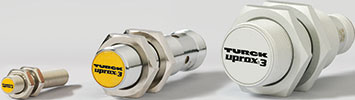
With this new version of the uprox series, Turck is launching two particularly interesting designs for industrial sectors that are characterised by a shortage of mounting space. The extremely compact 4 mm diameter smooth barrel and M5 threaded barrel sensors are now available as factor 1 sensors – a world first.
The smart mini sensors have a 1 mm switching distance – for flush mounting in all metals. These miniature uprox models are particularly suited to detecting small parts made of non-ferrous metal or stainless steel. The mini uprox3 will be able to simplify several applications in the special machine building sector. As a factor 1 sensor it switches just as well with aluminium targets, such as are frequently used in lightweight construction, as with steel targets. The other designs of the third generation also stand out on account of their shorter housing designs as well as the larger switching distances. As the trend towards miniaturisation in machine building continues, this meets the requirements of many designers and planners.
Finding typical applications for the uprox in factory automation is as easy as naming regions of Germany where they like to drink beer: actually everywhere. In the automotive industry, particularly in body construction, the previous generations of uprox have become the sector standard, and this will not be any different with the uprox3, as has been confirmed by the field tests to date.
Field test in automobile production
In field tests at automobile manufacturers, where the previous 8 mm switching distance of the M18 uprox+ was reaching its limits, the new factor 1 sensor proved to be a perfect enhancement.
In the automotive industry vacuum grippers are frequently used for picking up and moving sheet metal. Suction cups are applied to the sheets and a negative pressure is generated. An inductive sensor close to one of the suction cups detects whether the gripper was able to grip metal or not. However the sensor cannot be mounted too close to the target, otherwise it may be damaged when a sheet is picked up. A safety distance of 1 to 2 mm must be ensured.
When the gripper moves with the held sheet, the rubber suction cups are expanded by the weight and the inertia. Depending on the acceleration and weight of the sheet, the suction cups may be extended so much that the proximity switch can no longer detect the target, resulting in a switching error. As a slower process is out of the question, the larger switching distance of the uprox3 solves a critical problem here. The larger switching distance also makes a critical contribution to more reliable and efficient production processes as the cycle times will continue to decrease in the future.
The welding spark resistant M8, M12 and M18 variants with PTFE-coated housings will be used for welding applications in the automotive sector in particular. As with previous generations, the design of all uprox3 sensors provides them with an extremely good EMC performance and immunity to magnetic fields. The coating reliably prevents welding spatter from sticking.
For more information contact Brandon Topham, RET Automation, +27 (0)11 453 2468, [email protected], www.retautomation.com
| Tel: | +27 11 453 2468 |
| Email: | [email protected] |
| www: | www.turckbanner.co.za |
| Articles: | More information and articles about Turck Banner Southern Africa |






© Technews Publishing (Pty) Ltd | All Rights Reserved
 printer friendly version