



One of the highlights of the recent automation calendar was Schneider Electric’s inaugural Xperience Efficiency held at the Birchwood Hotel Conference Centre during the last week of August. It was a smoothly organised event at which a large gathering from industry and the media were introduced to all the company’s latest technology offerings and services. A standout among these is PlantStruxure Process Expert System (PES), which integrates the functionalities of Schneider Electric’s PlantStruxure collaborative architecture with StruxureWare Process Expert, a single software environment that combines the control applications, supervision and field devices necessary to configure and operate an entire control system.

PlantStruxure PES will enable the region’s manufacturers to meet their automation needs while optimising operations and energy management by connecting the field, process and enterprise levels within a business. SA Instrumentation and Control caught up with PlantStruxure PES marketing manager, Herve Vandemeulebroucke, to examine the DCS nature of the new architecture and clarify the statement that it is a cutting-edge offering in the field of process automation that brings together the best from the PLC/scada and DCS worlds to deliver superior value throughout the lifecycle of a plant.
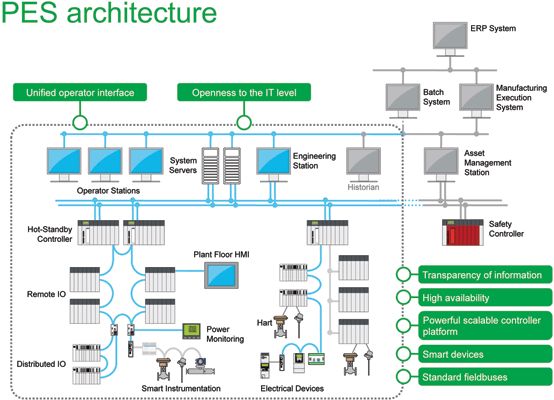
To get the discussion started I asked Herve to explain Schneider Electric’s PlantStruxure, PlantStruxure PES and the relationship between them. “It’s actually quite simple,” he says. “PlantStruxure is the collaborative architecture that covers the entire spectrum of automation solutions that Schneider Electric can deliver to a customer. PlantStruxure PES is a subset of this that forms an integrated platform that is very much like a DCS in that everything can be engineered and operated from a single platform.”
For clarification, PlantStruxure covers automation solutions from multiple vendors and the system may contain many different databases. PlantStruxure PES, on the other hand, is designed to implement end-to-end Schneider solutions by incorporating the two DCS pillars of control and supervision in an integrated engineering platform served by one database. “Before the Invensys acquisition Schneider did not have a DCS offering,” Herve explains. “We designed PES to address this shortfall by integrating Citect Scada with Schneider PLCs under a single common engineering platform.”
Nevertheless, even with this end-to-end Schneider solution, third-parties field devices can be integrated since not all the field devices needed by one application can be provided by Schneider Electric; this is how the platform remains open.
The benefits of the single database architecture begin to gel as we get further into the discussion. “A single database ensures consistency during configuration,” says Herve. “Using PES, everything is centrally configured during the engineering phase. Once this is done, the information is then spread by PES to populate the entire system. For instance, a control loop configured in PES will propagate down into the supervision environment, or relevant PID control information will propagate directly to the correct host controller.”
“What about instrumentation?” I ask.
“We have object libraries in PES to cover this,” he answers. “The beauty of this is that once you select an object in the library, for instance a valve template, you can associate multiple instances of that device anywhere in the system. Then, everywhere an instance occurs, all the information pertinent to that particular object can be viewed without the need for any special operator consoles. Once the valve is assigned to a particular controller, the code is created and the link between the supervision and control layers is automatically generated by PES. This is a very powerful feature as firstly no tedious duplication of engineering work is required, and secondly, all the specifications, calibration data and maintenance instructions are available for that device from anywhere in the system.”
At the moment the object libraries are all organised by industry, but Herve outlines how in the future the plan is to integrate the benefits of FDT/DTM technology into PES. Once this is done, any third-party instrument that is FDT/DTM compliant will be treated as if it were a Schneider Electric device. This will increase the flexibility of the system enormously.
It turns out though, that the architecture not only provides all these handy engineering and configuration features, but there are operational benefits as well – and they are very DCS in nature. “PES object models are configured in the database with all the facets (that can be seen as different point of views of the same object) required for the different parts of the system. The device facet, the supervision facet and the control facet are all automatically configured by PES in the common database,” explains Herve. “What this means is that the operator can switch between facets, for instance from supervisory to control, to see exactly how a particular device is performing in the system at any given time. This is much easier than having to look inside the controller for this information, as you would in a classic PLC plus scada system configuration. Now, all you need to do is switch to the control view in PES and it will automatically take you to the right location in the database. This can save both operators and maintenance personnel a significant amount of time and effort.”
This is called Navigation Runtime Services and it is a key benefit of PES. Using these services all the data available on a particular device can be accessed at the click of a button, whether it is related to installation, configuration, calibration, maintenance or setting up an alarm. Another benefit of this unified architecture is the ability to interrogate PES about all the other objects that may influence a device – a PID function block for instance – which can be of tremendous benefit when troubleshooting a problem in a particular part of the plant.
Some would maintain that PlantStruxure PES is not a true DCS because of the discrete scada and PLC elements. “The single software platform and database are hybrid in nature,” says Herve, “but when combined with the Runtime Navigation Services I maintain that this is true DCS functionality – or at least, Hybrid ++.”
The argument is compelling. “But what does Schneider Electric need PES for now that it has a fully fledged DCS in the form of Foxboro Evo?”
“The post Invensys acquisition landscape makes a lot of sense for both systems,” answers Herve. “Foxboro Evo is designed to cater for large continuous processing applications, while PES is designed for small to mid-size systems, so there is very little overlap. In addition, we address different market segments. PES targets food & beverage, water, mining and metals for which additional libraries have been built to embed Process Knowledge, while with Foxboro Evo it is oil & gas, petro chemicals and power generation.”
Herve explains that it actually goes further than this because the company now has two scada systems as well – Citect and Wonderware. The plan is to integrate Wonderware Software Platform into PlantStruxure PES to open up new markets and create cross selling opportunities to existing Invensys industry segments. However, the detail of this is still under discussion and remains confidential.
In conclusion I ask how PlantStruxure PES is being accepted by South African manufacturing companies. “For PES, South Africa is one of the most active countries within Schneider,” says Herve. “Only two years after its launch, we already have one hundred projects globally and eight of those are in South Africa. We achieved this because before PES a lot of experience was gained locally for delivering integrated systems based on Schneider scada and PLC products. Using PlantStruxure, the South African office built an extremely competent team capable of developing system level solutions for its customers. They were delighted when PES appeared as they now no longer needed to do everything from scratch.”
Thoughts and conclusions
It turns out that the local Schneider team has been doing by hand much of the work that has now been automated in the integrated platform that is PlantStruxure PES. Whether you call it a hybrid system or a DCS, the fact remains that there is demand for a solution like this in certain sectors of South Africa’s industry. To date, projects in mining, water and food & beverage are on the go. It will be interesting to see what happens as the integration of FDT/DTM technology, safety systems and Wonderware scada evolves over the next few years. Schneider Electric has always been an engineering powerhouse, but the Invensys acquisition has leapfrogged it ahead through access into the process and DCS markets. I think we will be hearing a lot more about PlantStruxure PES.
For more information contact Ntombi Mhangwani, Schneider Electric South Africa, +27 (0)11 254 6400, [email protected], www.schneider-electric.co.za
| Tel: | +27 11 254 6400 |
| Email: | [email protected] |
| www: | www.se.com/za/en/ |
| Articles: | More information and articles about Schneider Electric South Africa |






© Technews Publishing (Pty) Ltd | All Rights Reserved
 printer friendly version