



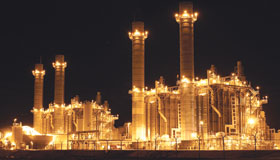
When most people think of facilities management, they think of monitoring building systems and environmental variables. Both are typically associated with institutional or commercial facilities, such as banks, office complexes, fast food restaurants, hospitals or educational institutions such as school systems or college campuses. Less obvious and less visible, but equally important, is the role facilities management plays in the manufacturing sector.
The primary relationship between manufacturing and facilities is that every manufacturing plant is a facility, and manufacturing facilities have all of the same issues that other types of facilities have, plus the additional challenge of production operations.
With the exception of pharmaceutical manufacturing, the conventional manufacturing model has always concentrated on the manufacturing process with environmental and facilities considerations being secondary, if considered at all. However, with increased global competitiveness, manufacturers are realising that facilities management plays a critical role in product quality and manufacturing cost. Now, with this new awareness, manufacturers are realising that accessing facilities systems and data brings its own set of opportunities and challenges.
* Monitoring and control of facilities systems can have a significant impact on operations, product quality and costs.
* In low-margin industries, the ability to manage total production costs including those associated with facilities can be the difference between profit and loss.
* Inability of manufacturing systems to access facilities data and systems leads to lost opportunities to coordinate all aspects of manufacturing.
* Proprietary vendor-specific solutions for facilities management leads to additional integration issues.
* Engineering and manufacturing staff have little or no domain knowledge of the facilities applications, leading to inability to control these variables.
* Uncontrolled and often unmonitored environmental systems introduce costs related to the manufacturing facility or the manufacturing process.
* Inability to track and analyse facilities and manufacturing data as integrated and inter-dependent variables masks problems in the overall operation.
The situation is greatly simplified if the manufacturing process and facilities management can be viewed as one environment, providing a comprehensive view of both facilities and manufacturing operations. Further, if this environment is approached with an integrated solution where the facilities management and manufacturing systems are combined, these issues become manageable.
Utility costs
The ability to control utility cost is a major factor in modern manufacturing operations. Facilities management can have a significant impact on utility costs in areas such as electric and gas energy management and water usage.
Of these, the area where facilities management can have the greatest impact on cost is energy management. Energy costs are and will remain one of the highest production costs for every manufacturing operation. When manufacturing monitoring and control and facilities management are integrated, energy use can be monitored and controlled like any other process variable. This enables energy use to be monitored in real-time and recorded to the historian with other process data, where it can be analysed within the context of the manufacturing process. Energy use can then be analysed and viewed on the basis of energy costs per batch, per product, per shift and even normalised for occupied area.
In addition, with an integrated control system, manufacturers have the potential to manage their energy cost by scheduling production, based on time-of-day rates or demand response schedules. Further, when facility and process systems are integrated, all cost savings associated with consistency, training, maintenance, operations and overhead are realised throughout the plant, site, region and enterprise.
Cost benefits associated with utility management in facilities management in manufacturing:
* Total operational cost is easier to manage when one integrated system monitors and controls both the process and facilities.
* Energy costs such as those for electrical power and natural gas used in the actual manufacturing process can be managed.
* Water consumption for the manufacturing process can be monitored and controlled.
* Facility energy costs for electrical power, natural gas and water can be monitored and controlled.
* Process and facility data can be integrated and analysed for cost impact and reduction.
* Operational and maintenance costs can be reduced due to operating and maintaining one control system instead of two.
Since environmental variables can have a direct impact on manufacturing cost and quality, the benefits of managing facilities and the manufacturing process with one system and one team are greater than the sum of the benefits to each process individually.
Quality control
In today’s global economy, product quality has become a differentiator no matter what the industry. Increasingly, facilities’ environmental factors, such as air quality, water quality and temperature, are having an effect on product quality. This is especially true in the life science industries such as pharmaceutical manufacturing and in the food and beverage industry where compliance to stringent governmental regulations is mandated. In these industries, data monitoring, collection and historisation are critical to the delivery of a product that meets industry and government specifications. The ability to access an integrated process and facilities data in one system for review, analysis and reporting not only helps ensure product quality but also cost control.
Even in manufacturing processes, where strict regulation is not a factor, the ability to control the facilities as a factor of the manufacturing process can have a direct bearing on product quality. By integrating facilities management and manufacturing systems, manufacturers can have the ability to determine if product quality can be adversely affected by environmental factors within the facility.
Quality benefits to manufacturing facilities of an integrated control system:
* Product quality is improved due to integrated monitoring and control of all related variables within the manufacturing process.
* Record-keeping is improved due to the capture of a complete set of environmental and process variables.
* Quality is improved by staff knowledgeable in integrated control systems and the manufacturing process.
* Variations in product quality from facility to facility are reduced with one system controlling the facility and the process at multiple sites.
* Quality is improved through coordination of facility and process variables within the manufacturing process.
* Quality problems due to environmental variables that would not previously be considered part of the manufacturing process can be identified and corrected.
Security and regulatory reporting requirements
In addition to the direct manufacturing considerations of facilities management, there are indirect implications. While not directly related to a specific manufacturing process, there are general facilities-related issues with cost implications that can be controlled and monitored by a facilities management system. These include lighting control, emissions monitoring, wastewater and hazardous waste management, as well as security. Governmental agencies at both the federal and local level are increasingly requiring not only management of waste and emissions from manufacturing operations, but reporting and data retention. Those installations failing to maintain required data storage or reporting requirements are often subject to fines or other punitive action.
An integrated process and a facilities management system make managing these issues significantly easier. Integrated process and facilities data can be extracted from the historian and included in either custom or pre-formatted reports.
By integrating facilities data with production data on a common platform, process and cost analysis can be more accurate and more realistic. When all factors associated with production are included in an analysis, the impact of facilities variables on the quality and cost of production can be ascertained and where necessary, adjusted.
Conclusion
The primary benefits of managing facilities and the manufacturing process with one system and one team increases efficiency, improves product quality and helps manage costs for the facility and the product.
The benefits of facilities management in a manufacturing environment are well documented. When facilities and manufacturing management are integrated on a common platform the benefits are apparent in every aspect of the business model.
For more information contact Jaco Markwat, Invensys Operations Management, +27 (0)11 607 8100, [email protected], www.iom.invensys.co.za






© Technews Publishing (Pty) Ltd | All Rights Reserved
 printer friendly version