




The use of PC-based automation platforms from Beckhoff proves that individualised customer solutions and standardisation do not have to be contradictory.
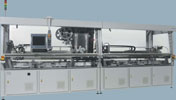
Komax AG produces fully automated systems for safe and precise solar technology. In the thin-film contacting system presented here, the substrate is first fed to the machine and positioned; in the first cell, a dispensing head applies the conductive adhesive to the substrate.
This process is visually monitored. After application of the adhesive (dispensing), the substrate is transferred to the second cell and repositioned. The contact ribbon is subsequently stretched out over the entire length of the substrate and set down precisely on the adhesive track. A special unreeling system ensures exact positioning. Finally, a cover tape is rolled out over the contact ribbon and it must be ensured that no air gets trapped beneath it. “Our customers expect a complete working solution from us,” explains Peter Beerle, software group leader at Komax. “Therefore, we must design our systems to run 24 hours a day without malfunctioning. Naturally, remote maintenance is utilised for simple, highly efficient service work.”
PC-based control platform redefines the standard
Komax relies on automation platforms from Beckhoff for some assembly systems and for all of its contacting systems. These usually include bus terminals and EtherCAT Terminals, a central C6140 industrial PC and one or more control panels with touch screens, which are connected via CP-Link.
EtherCAT is used for system communication. The drive controllers with CAN interface are currently integrated in the EtherCAT Terminal system via a CANopen terminal. On the software side, TwinCAT PLC and TwinCAT NC PTP are used. Komax intends to develop this standard concept further: “We are planning to couple the drive equipment and all peripheral units to the central IPC via EtherCAT in the future,” says Beerle.
In addition to the electric motor-driven actuators for positioning the transport systems, the contacting systems are also equipped with pneumatic actuators driven by valve terminals. On top of that, the dispenser unit for the application of the contact adhesive, the contact ribbon reels, the pressing roller and other units – depending on the version of the contacting system – need to be moved. “We are also making efforts to standardise the peripherals as far as possible,” explains Beerle. “Nevertheless, due to tailoring the plant to suit the customer’s specifications, we have to allow for a great deal of variation and adaptation, which necessitates the use of a scalable automation platform.”
A new safety solution with TwinSAFE
Previously, each independent part of the plant had its own safety circuit, consisting of separate hardware components. Gerhard Meier, MD of Beckhoff Switzerland is convinced that the logical integration of TwinSAFE and TwinCAT will also give Komax considerable advantages: “In this case, one should not just consider the price of the hardware, but also the engineering costs.”
The Komax machines are designed as independent systems which, in combination with other parts of the plant, are connected to superordinated master computers, the exchange of production-relevant data being the focus of attention. This allows the associated process and quality data to be assigned to each finished product. This data is normally made available to the customer or the superordinated system by means of a TwinCAT OPC server.
Flexible control concept keeps Komax satisfied
Komax’s fundamental decision in favour of the Beckhoff automation platform arose from the desire to change the previous variety of hardware products to a more streamlined and flexible platform. Beerle says: “Besides the software PLC, we can also run other applications on the IPC without having to use a second PC. Furthermore, we want to use a uniform operating concept that covers our requirements for interaction and diagnostic capabilities. In addition to that, we need to access a variety of components that can all be integrated into the complete system via a fast fieldbus. Above all else, this concerns the synchronisation of the drives. That was not possible using our previous concept, but these expectations can be met without difficulty using the Beckhoff platform.”
A flexible future
“The flexibility of the PC-based automation platform from Beckhoff gives Komax the necessary scope to handle a large variety of applications in the future,” says Meier. “Flexible software and suitable interfaces are provided for any scenario by the Beckhoff concept.”
Naturally, the scalability of the Beckhoff platform is an important aspect for Komax Beerle explains: “We endeavour to have the software PLC and the visualisation running on one CPU as far as possible. If we have to use up to 30 servo drives in one plant, the drive controllers and the visualisation require a great deal of computing power. PC-based control technology with constantly increasing processor power offers the ideal platform for this. We currently use Beckhoff Industrial PCs with Intel Core Duo processors for ‘power-hungry’ applications.”
| Tel: | +27 11 795 2898 |
| Email: | [email protected] |
| www: | www.beckhoff.com |
| Articles: | More information and articles about Beckhoff Automation |






© Technews Publishing (Pty) Ltd | All Rights Reserved
 printer friendly version