



Maintenance, Test & Measurement, Calibration


The characteristics of corrosion

January 2009 Maintenance, Test & Measurement, Calibration

Honeywell’s technology has transformed corrosion into a process variable that can be monitored in realtime.

Corrosion has never been a true process value because, up till now, the only way to measure it was reactively. Engineers know that with the process conditions, past experience and some calculations they can predict the life span of an asset. True, if you ‘assume’ that corrosion is a linear process – an assumption to which the following disasters have been attributed:

* Hydrocarbon oxidation plant explosion – the largest peacetime explosion in the UK resulted from corrosion of a bypass line into a train of six cyclohexane oxidation reactors. Result: loss of life and total destruction of the plant.

* Gas transmission pipeline ruptures – over the past decade, there have been three major pipeline explosions involving internal corrosion. These have involved reportedly dehydrated gas transmission-lines, a hydrocarbon products pipeline in the US and a sour gas pipeline in Canada. Results: loss of life, major production loss and environmental impact.

* Sulphuric acid tank explosion – corrosion damage in a tank roof and shell caused leakage and ignition of flammable vapours. Result: a significant volume of sulphuric acid was released to the environment.

* Refinery sour water corrosion incidents – over the last decade, several major incidents of ammonium bisulphide corrosion caused loss of containment in hydro-processing units. Result: explosion, damage and lost production.

(Ref. Honeywell SRG-13/09/07)

Corrosion becomes a process variable

What happens when the process changes? Who knows? Conventional methods of corrosion measurement make use of a coupon, which is usually a credit card-sized specimen manufactured from the same material as the asset (Figure 1). The coupon is fitted to the asset and left for a period of time, typically 2-6 months, after which it is removed and analysed offline in a laboratory.

Figure 1
Figure 1

This implies long delays between a process event and a corrosion measurement with NO method to correlate the corrosion rate to process variables.

But, things have changed, and Honeywell is now able to offer an in-sight to what is happening inside an asset on-line and in realtime. The Honeywell SmartCET multivariable transmitter (Figure 2) will detect general and localised corrosion (pitting) in realtime connecting to a DCS or process knowledge system via a 4-20 mA signal and compatible HART protocol. Voila!
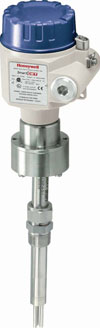
Figure 2
Figure 2

In addition to monitoring general and local corrosion parameters, the same instrument also gives the Stern-Geary constant and a fourth variable which assists in diagnosing the corrosion mechanism. The corrosion variables are generated using linear polarisation resistance (LPR), harmonic distortion analysis (HAD) end electrochemical noise (ECN) techniques.

Corrosion better recognised

“The most common types of corrosion include caustic and chloride cracking, oxidation, corrosion under thermal insulation and ammonia or hydrogen-induced cracking. Primary causes of contamination in pharmaceutical manufacturing include corrosion of embedded iron particles in vessel walls, failures of glass linings and corrosion under installation. The most important raw material for the hydrocarbon processing industry is crude oil, which often contains a fraction of water. Corrosive species that can be present in the oil/water mixture include sulphur compounds, chlorides, ammonia, sulphuric acid, hydrochloric acid, carbonic acid, phosphoric acid and cyanides,” as per corrosioncost.com.

Through realtime monitoring, it has been discovered that most corrosion damage occurs during relatively short periods of time, usually during process start-up, changes, upsets or shut-down. With this new knowledge, after implementing SmartCET, customers have modified their operational methods to limit the effects of corrosion and, in some cases, have changed the plant process streams.

For more information contact Paulo da Silva, Honeywell Southern Africa, +27 (0)11 695 6031, [email protected], www.honeywell.co.za


Share this article:
Share via emailShare via LinkedInPrint this page

Further reading:

Oils don’t die, they degrade
Wearcheck Maintenance, Test & Measurement, Calibration
WearCheck explores the main ways lubricants degrade in service and how these degradation modes affect oil performance and machine reliability.

Read more...
Real-time spectrum analyser
Vepac Electronics Maintenance, Test & Measurement, Calibration
The PXE series real-time spectrum analyser covers frequencies up to 20 GHz with a 100 MHz analytical bandwidth and ultra-fast sweep speed, supporting spectrum monitoring, interference finding and RF test and measurement functions.

Read more...
Preserving a French heritage landmark
Omniflex Remote Monitoring Specialists Maintenance, Test & Measurement, Calibration
Omniflex supplied a remotely monitored impressed current cathodic protection system for the Perret Tower in Grenoble, a protected French heritage site, combining 24/7 corrosion protection with integrated surge protection against lightning strikes.

Read more...
Operational efficiencies and safety compliance with preventive maintenance programmes
Maintenance, Test & Measurement, Calibration
Konecranes explains how its Lifecycle Care Preventive Maintenance programme reduces unexpected downtime, improves safety compliance and delivers measurable financial benefits for operators of cranes and lifting equipment across any make or sector.

Read more...
Portable appliance tester
Vepac Electronics Maintenance, Test & Measurement, Calibration
Vepac Electronics’ new portable appliance tester enables precise safety testing of electrical appliances in accordance with DGUV regulation 3 and BetrSichV, with simple three-button operation and battery-powered mobility.

Read more...
Why lubrication fails in mining and what to do about it
Maintenance, Test & Measurement, Calibration
Lubrication Engineers explains the recurring failure points behind mining lubrication problems and how the right product, storage and application practices can improve equipment reliability.

Read more...
When digital twins move from concept to critical tool
IT in Manufacturing System Integration & Control Systems Design Maintenance, Test & Measurement, Calibration
Digital twins are moving out of the lab and onto the mine, the factory floor and the transport network where they predict failures before they happen. Amritesh Anand looks at where they earn their keep, the data and integration work behind them, and the security questions every organisation should ask before switching one on.

Read more...
Why asset level intelligence is now essential for resilient wastewater plants
Schneider Electric South Africa Maintenance, Test & Measurement, Calibration
Sub-Saharan Africa’s wastewater operators face mounting pressure to keep ageing plants running smoothly and meet tougher environmental standards, all while lacking visibility into the health of their medium-voltage (MV) drives and other critical rotating assets. Adding predictive analytics, digital twins and enterprise dashboards enables optimisation across multiple sites, ensuring every drop moves safely and efficiently through the water cycle.

Read more...
How multiple boilers can minimise costly downtime
Maintenance, Test & Measurement, Calibration
Associated Energy Services explains how multi-boiler systems reduce downtime risk for South African manufacturers, covering redundancy planning, fuel source diversification and the strategic management of backup boiler capacity.

Read more...
Field calibration made easy
Instrotech Maintenance, Test & Measurement, Calibration
Instrotech’s locally designed and manufactured Calog calibrator range feature a rugged IP54-rated housing, backlit display with data logging via SD card, and a lithium-ion battery with approximately eight hours of run time.

Read more...


While every effort has been made to ensure the accuracy of the information contained herein, the publisher and its agents cannot be held responsible for any errors contained, or any loss incurred as a result. Articles published do not necessarily reflect the views of the publishers. The editor reserves the right to alter or cut copy. Articles submitted are deemed to have been cleared for publication. Advertisements and company contact details are published as provided by the advertiser. Technews Publishing (Pty) Ltd cannot be held responsible for the accuracy or veracity of supplied material.


© Technews Publishing (Pty) Ltd | All Rights Reserved

