



The last few years have seen unprecedented advances in information technology at all levels of the enterprise. Technology is no longer an excuse for not getting it right so who or what is going to be blamed when things still do not work out?

Information
With the current emphasis on improving information technology at all levels of the enterprise, it is perhaps a good time to pat ourselves on the back for having improved the hardware and software technology but to ask ourselves if we have really improved the information.
Technology will continue to evolve in ever-increasing leaps and bounds, but it cannot run a business. I cannot help thinking that the next hurdle is just around the corner and that a great deal more has to be done. New thinking must be applied to the way that technology delivers information in the future and the role of the people who use it.
Initially, IT was simply a new name for the 'data processing department' of the ’60s and ’70s where technology was an end in itself. The fact that the IT department was there to supply information that helped people run operational processes was not recognised until recently. IT focused on the business aspects of the company and that is why most of the information was only available to middle and top management (Figure 1).
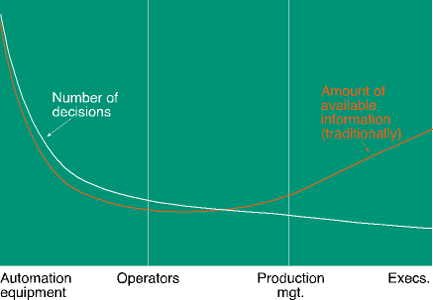
Although top management makes fewer decisions than lower echelon employees, they tend to be far weightier and can have profound implications on the business. That is why it is paramount for executives to have the right information rather than huge amounts of it (Figure 2). On the other hand, operators, technicians and engineers are responsible for no less a mission than creating the company’s wealth and IT has come to the rescue of the shop floor – this is realtime IT that copes with thousands of events every second and keeps executives abreast of what is happening on their production lines.

Standards help factory IT communicate with business IT and MES benefits greatly from this cooperation. We have spent nearly half a century getting to first base, which is the integrated delivery of necessary information throughout the enterprise. But technology and information are not ends in themselves, in fact, they are the very beginning.
Knowledge
The dictionary defines knowledge as: information and skills gained through experience or education. So, IT is part of a knowledge delivery system.
In a process control scenario information can mean one of two things: either the process can be left alone because it is doing precisely what it is supposed to or it must be changed because it is not.
If the process were to be maintained, this would provide time to ponder questions such as: Can the process be improved? Is it meeting the company’s business requirements? If the process is to be changed, how must this happen to minimise production losses or incur unnecessary expenses? Whatever the case, it is human cognition that applies knowledge to the situation (Figure 3). While technology can help, it canno’t replace human origination.

Information and its enabling technologies empower workers to make better informed decisions about the processes for which they are responsible. But they will never be truly in control of those processes until they know how to transform this information and apply it as knowledge.
Thinking outside the box
This may sound rather odd but the easy part of any undertaking is paying for systems and projects. Consultants can help with the RFP and solution selection while professional system integrators can implement the chosen systems. The result can be a state-of-the-art solution that is capable of doing everything required, but it takes a knowledgeable end-user to take ownership and constantly hone the solution if true value is to be realised.
When companies buy new machines, they typically require maintenance staff to support them and ensure optimal operation. The same applies to software support, however, having a technical resource to keep the system up and running 24x7 is a waste of time if the users do not understand the relationship between the information and its business benefit. It is a role that requires thinking outside the box and the willingness to remove blinkers. This is the domain of the knowledge worker.
The knowledge worker
In 1959, Peter F. Drucker defined the knowledge worker as a person who has been schooled to use knowledge, theory, and concept, rather than physical force or manual skill.
For companies and their employees to succeed, today’s workers have to become tomorrow’s knowledge workers. “The closer a person is to a manufacturing process, the more impact their actions have on the performance of the process,” says Dr Peter Martin, vice president of performance management at Invensys. “This is why the transition is so important in industrial operations.”
Knowledge workers are not limited to any division of an organisation. They can be on the shop floor, in accounts, in production management or in finance. Whatever their position, knowledge workers need to understand the company’s objectives and strategies if they are to measure their contributions to corporate goals. If there is a common reality and agreement between the company and its employees, a far more productive environment exists for knowledge workers to become enthusiastic about applying their skills and owning the processes under their care.
“Being a knowledge worker today means being empowered,” adds Martin. “Being empowered with the information and education necessary to perform their duty in a manner aligned with strategy, business and operational excellence is critical to today’s knowledge worker’s success.
“All it takes to become one of the esteemed is education, experience and the availability of the correct information to empower these workers,” says Martin. He refers to a good deal of today’s up and coming knowledge workers as “untapped potential to improve the operation and the business of industrial concerns". Managers would do well to better use this important resource, “by providing these workers with the strategic operational performance measurements associated with their specific jobs in realtime", he said.
Dynamic performance measurement (DPM)
DPM is a systematic measuring tool designed to improve organisational efficiencies. By measuring what matters DPM allows people to see how their actions contribute to or detract from the company’s strategic objectives.
Capitalising on the fact that access to enterprise-wide information is no longer a problem, DPM focuses on supplying individuals the exact information they need to monitor and adjust their activities and performance in terms of the company’s profit-making strategy, including stepping across the artificial boundaries of ERP, MES and automation.
DPM precisely defines the critical performance measures that IT must provide to support decisions at all levels of the organisation. There is no more guesswork as to what people may want to know. DPM can also reduce measurements to the common denominator of money – including realtime profit and loss. This provides personnel with a measurement of their performance in terms of a unit that is real to everyone and encourages them to better own their processes.
Conclusion
Today, with the shortage of skilled technicians and engineers, companies and educational institutions need to foster the concept of the knowledge worker. We have all the technology necessary to derive the correct information to support any decision. But somebody has to make that decision and it cannot always be the same person. DPM takes information to the next level and will predictably become the tool of choice for knowledge workers at all levels of the organisation.
People should want to become professional knowledge workers because knowledge workers are more valuable to any company and companies should want knowledge workers for the same reason.
“Executives of industrial firms can help catapult this faster way forward by converting all their workers into knowledge workers,” says Martin. “This will drive improved bottom line results. We can best understand what the knowledge worker has to offer by empowering each of them with the information they require to perform their tasks in the most beneficial manner for the operation and observing the results. Experience has shown that these can be dramatic.”
For more information contact Justin Tweedie, Wonderware Southern Africa, 0861 WONDER, [email protected], www.wonderware.co.za






© Technews Publishing (Pty) Ltd | All Rights Reserved
 printer friendly version