




Industry in South Africa is moving vast quantities of petroleum and chemical products for export, import, local trade, and storage. Typically, international movements are transported by sea in tankers carrying large quantities. Once a ship arrives berthing costs begin to apply requiring a speedy transfer of the product. Flowmeters are inadequate in size, and the alternative is custody transfer by tank gauging. However, there are some complications.
Introduction
Gone are the days when it was acceptable in South Africa to transfer the custody of any product by measure providing that both parties are satisfied with the measuring equipment used. It is now necessary for the apparatus to be in accordance with a South African national standard written to detail the equipment requirements, and the method of use for this equipment. However, there is a major difficulty with this in South Africa, and that is there is no standard that covers custody transfer by tank gauging.
Why required?
An obvious question comes to mind. Why is it necessary, since there is a standard for flow metering, and the transfer can be suitably monitored using this tried and trusted method? The reply in part is: flowmeters and checking devices are not large enough for metering the discharge from ocean-going supertankers.
Points for consideration
It should be remembered that in tank gauging, the level measuring instrument itself is not the difficult component in these applications. The following parameters also need consideration.
1. The tank itself:
a. The deformation of the sides due to product level, product temperature, and ambient temperature.
b. The deformation of the floor due to product level, product temperature, and ambient temperature.
c. The deformation of the roof due to tank movement and loading on the roof.
2. The product conditions:
a. The temperature.
b. The pressure
c. The transfer is normally specified in standard units rather than measured units. This requires a density correction to the measured volume to obtain standard volume. In South Africa correction is to 20°C, however, 15°C and 60°F are also used.
3. The gauge support structure.
4. The amount of water in the bottom of the tank.
5. The operator interface.

Accuracy
When tanks with large surface areas are being used as a part of a measuring system, the accuracy of the level measurement is of paramount importance.
Automatic level gauges (ALG)s are classified according to their accuracy as Classes 2 and 3. Class 3 is only applicable for tanks containing refrigerated (hydro-carbon) fluids,
Class 2 is applicable for all other tanks. The values in lines A and B are relative values of the corresponding indications and the values in lines C and D are absolute values. (Table 1).
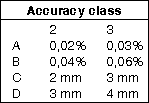
Lines A and C apply to the ALG itself, before being installed on the tank, for pattern approval and for initial verification. The maximum permissible error is the greater value of:
* The absolute value calculated from line A for the corresponding indication.
* The absolute value of line C.
Lines B and D apply to the ALG after installation on the storage tank, for initial and subsequent verification.
The maximum permissible error is the greater value of:
* The absolute value calculated from line B for the corresponding indication.
* The absolute value of line D.
Calculated outputs
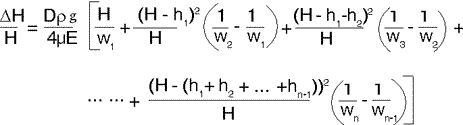
There are numerous formats required that are governed by local laws and conventions, and tank peculiarities. Internationally there are a number of Standards such as API, ASTM, IP and many others. It must also be possible to do full conversions from corrected level to TOV, GOV, NSV, weight and mass. There are also special corrections such as S&W, CTSh, floating roof, LPG Vapour, etc. An example of one of the possible 85 requirements is the correction for a vertical cylindrical tank where the relative reduction in height of the tank (lowering of the upper part of the tank shell) due to complete filling with a liquid whose density is r.( kg/m³) can be calculated using the formula below, where:
ΔH = relative reduction in height (%)
H = height of the tank (m)
D = diameter of the tank (m)
G = gravitational acceleration (m/s²)
E = modulus of elasticity (N/m²)
μ = Poisson ratio (non-dimensional) (the lateral contract ion divided by the elongation (eg, μ steel = 3,3)).
Hn = height of the nth course from the bottom (m)
Wn = thickness of the nth course from the bottom (mm)
What standards are available?
There exist a number of standards that apply to this requirement, for example.
* API American Petroleum Institute.
* Chapter 3. Level Gauging.
* Chapter 7. Temperature.
* Chapters 11 and 12. Volume Calculations.
* ISO International Standardisation Organisation.
* ISO 4266.
* Part 1. Measurement of level in atmospheric tanks.
* Part 3. Measurement of level and temperature in storage tanks by automatic methods.
* Part 4. Measurement of temperature in atmospheric tanks.
* Part 6. Measurement of temperature in pressurised tanks.
* ISO 4511/4512. Direct measurement of liquid level in storage tanks - Manual methods.
* ISO 9266. Level measurement.
* ISO 11223. Measurement of content of vertical storage tanks by hydrostatic tank gauging.
* ISO 15169. Hybrid TG.
* ISO 7507. Tank measurement.
* OMIL Organisation Internationale de Métrologie Légale.
* Global Joint Commission of all weights and measures authorities:
* P1 - Certification of systems.
* R71 - Fixed storage tanks - General Requirements.
* R85 - Level.
* R117 - Measuring system for liquids other than water.
* R125 - Measuring systems for the mass of liquids in tanks.
Conclusion
Because of the increase in the international trade with South Africa in petroleum and chemical products, for use or storage in South Africa, we have a need for a standard(s) to be introduced.
The OMIL recommendations are drawn up between all weights and measure authorities; this should form the basis for a South African standard.
Since this will not happen unless there is strong motivation from South African importers and suppliers of equipment, they should make a united effort in their approach to the relevant authorities to develop a standard from the OMIL recommendations.
References
Endress+Hauser publication IN014
Custody Transfer in Tank Gauging.
OMIL R85
For more information contact Johan van Jaarsveldt, Endress+Hauser, +27 (0)11 262 8000, johan.vanjaarsveldt@za.endress.com, www.za.endress.com
| Tel: | +27 11 262 8000 |
| Email: | info.za.sc@endress.com |
| www: | www.endress.com |
| Articles: | More information and articles about Endress+Hauser South Africa |






© Technews Publishing (Pty) Ltd | All Rights Reserved
 printer friendly version