



The measurement of degrees Brix is required in multiple industries in blending operations or as a means to grade product concentration or quality. The Brix scale can vary by industry, either by scale or reference temperature. Coriolis mass flowmeters are being used in process applications to measure degrees Brix as it correlates to density.
The measurement of degrees Brix is required in multiple industries in blending operations or as a means to grade product concentration or quality. The Brix scale can vary by industry, either by scale or reference temperature. Coriolis mass flowmeters are being used in process applications to measure degrees Brix as it correlates to density.
For years, the food industry has used degrees Brix as a measurement of the percent of dissolved sucrose. A 10% degrees Brix would equal 10 grams of sucrose dissolved in 100 grams of water.
Typical handheld, bench and in-line refractometers or hydrometers are often employed in the food industry to produce a measurement of dissolved sugar Brix to determine product quality or grade.
Refractometers measure dissolved sucrose only and do not take into account the amount of insoluble solids, minerals, pulp or sugars present in solution when producing a measurement. This can lead to a disagreement between the measurement produced by a Coriolis mass flowmeter and that produced by a refractometer.
Application description
Several degrees Brix measurement scales exist in the food industry.
The ICUMSA (International Committee for the Uniform Measurement of Sucrose Analysis) produces a table used to gauge cane and beet sugar solution concentration. This table is referenced from 10 to 80°C.
The orange juice industry must conform to USDA requirements. It has specified ranges of Brix which relate to single strength equivalent (SSE) or concentrated juice which differs from the ICUMSA table. The measurement scale for orange juice varies from 8,5 to 70° Brix. Further, the product is graded by a Brix to acid ratio and is usually corrected to 20°C.
The tomato industry uses multiple tables published by the NFPA for 'sugar scale' or refract index for grading juice, paste, ketchup, and pulp products correlated at 25°C. The tomato tables also differ from the ICUMSA table used for cane and beet sugar.
Application challenges
Brix or sugar scale measurement must always be referenced to the proper table and temperature.
Since a Coriolis meter measures actual density, the measurement of degrees Brix or sugar content can be adversely affected by:
* Measurements performed to the wrong reference temperature or scale.
* Not taking into account the effects of total soluble solids (TSS) and insoluble solids (pulp, minerals and undissolved sugars).
* Failure to use the proper expansion coefficient for correction of the measurement to a different reference temperature.
Measurement results
The PROline Promass 83F is a dual tube Coriolis high accuracy mass flowmeter suitable for hygienic applications. The meter can be provided with Tri-clamp fittings and is 3A approved. Special polish options are available.
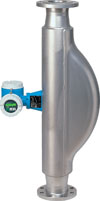
This Endress+Hauser meter with custom concentration function has been used in multiple food industry applications for the measurement of degrees Brix. The Coriolis measurement results are accurate to 0,0005 grams/cc or ±0,05 sugar scale with a high degree of repeatability. Since the Coriolis meter is a multivariable meter, it can produce simultaneous measurement of mass or volume flow, custom density, and temperature all in one unit.
Measuring principle
Coriolis meters produce a measurement of mass flow based on the Coriolis effect. An independent measurement of product density is calculated from the resonant frequency of the sensor tube vibration. A standard table for degrees Brix to the ICUMSA scale is included. Custom concentration function allows any industry table to be loaded or a customer specific table to be used. Customers can program square and/or linear expansion coefficients compensation, correlation of multiple densities at different temperatures and the incorporation of either a 2D or 3-dimensional polynomial function.
| Tel: | +27 11 262 8000 |
| Email: | info.za.sc@endress.com |
| www: | www.endress.com |
| Articles: | More information and articles about Endress+Hauser South Africa |






© Technews Publishing (Pty) Ltd | All Rights Reserved
 printer friendly version