



Trends in electric utility automation, specifically substation automation, have converged upon a common communications architecture with the goal of having interoperability between a variety of intelligent electronic devices (IEDs) found in the substation. This initiative was begun back in the late 1980s driven by the major North American utilities under the technical auspices of EPRI (Electric Power Research Institute). The resulting standard that emerged is known as the Utility Communications Architecture 2.0 (UCA2.0) and is becoming an international standard as IEC61850. This architecture, which is now being adopted worldwide by utilities and IED vendors alike, has as its underlying network technology – Ethernet.
The legacy substation
Prior to this initiative, inter-IED communications (signalling and exchange of information) was typically achieved via a combination of rigid wiring between devices and low speed serial communications. Signalling was often accomplished by having outputs from one IED connected to the inputs of another. This system was by its very nature inflexible and limited in its scope of control. Most sophisticated inter-IED control schemes would require a large number of wiring interconnections between multiple IEDs and thus were not practical. Low-speed serial communications was often limited to master/slave half-duplex arrangements and thus true peer-to-peer communications between IEDs was not feasible.
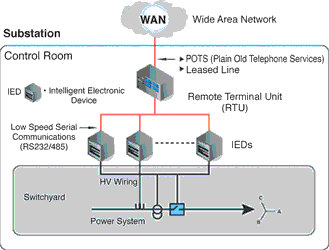
The substation LAN
The emergence of the Ethernet-based substation LAN (local area network) has been steadily gaining momentum worldwide. The main benefits of the substation LAN are:
* High-speed, peer-to-peer communications between IEDs.
* Reduced inter-IED wiring.
* Coexisting multiple protocols (eg, DNP, Modbus, IEC61850) on the same physical network.
* Enables 'Data over IP' for easy access to substation data.
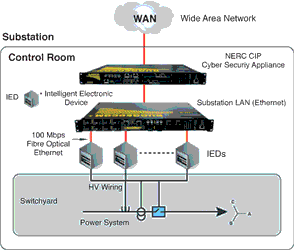
The family of substation hardened Ethernet switches from RuggedSwitch has been designed to implement the substation LAN and to meet the same EMI immunity, performance and reliability requirements and standards as mission-critical protective relaying devices.
The IEC 61850 substation
The IEC 61850 standard view of the substation has two application domains: Station Bus and Process Bus. Station Bus refers to an application domain where relays and RTUs attach to the LAN. Process Bus refers to the domain where devices such as CT/VT Merging Units (MU) provide sampled measured values of current and voltage via the LAN.
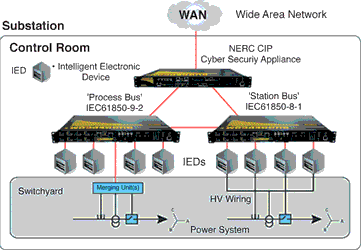
Brendan Swart of H3iSquared says: "The RuggedSwitch family of substation hardened Ethernet switches has been created to meet the requirements of IEC 61850 and to implement Station Bus or Process Bus LANs. Specifically, these devices exceed the IEC 61850-3 EMI immunity requirements and the fibre optical network interfaces help provide zero packet loss performance under EMI stress. This is a must if the Station Bus LAN is to be used for tripping or blocking of breakers or if sampled measured values of current and voltage are to be distributed over the Process Bus LAN.
For more information contact H3iSquared, +27 (0)11 454 6025, [email protected], www.H3iSquared.com






© Technews Publishing (Pty) Ltd | All Rights Reserved
 printer friendly version