Malfunctioning field devices can cause process disturbances and accounting errors. Self-monitoring in field devices can diagnose malfunctions at an early stage and enable corrective action to be taken in good time.
Drinking water of high quality and in reliable supply is something that many people take for granted. Closely monitored and controlled processes are necessary to guarantee this quality and availability. These include precise and reliable flow measurement.
Today, electromagnetic flowmeters (EMF) are used in all stages and processes of drinking water procurement and treatment. EMFs exhibit high precision as well meters, in sea water desalination and in surface water or shore filtration. They also operate correctly with untreated water that often contains high ferromanganese content. Because EMFs have no mechanical moving parts to be slowed or obstructed by sludge deposits, they operate accurately and practically maintenance-free under these arduous conditions.
For the water supply authority flowmeter errors can result in incorrect volume measurements, billing errors and also higher costs due to overdosing of disinfectant, flocculants or other agents.
Classic methods of flowmeter testing are expensive and unsatisfactory. They often involve taking the meter out of its normal operating environment and at best only show the accuracy at the time of testing, rather than on an ongoing basis.
Self diagnosis
The most effective method of flowmeter testing involves continuous self-testing during operation.
The precision of EMFs is unaffected within wide ranges by distorted flow profiles. But very severe interference with the flow profile can cause noticeable metering errors. This can occur when the required unimpeded inlet section (5 diameters) is not provided, flaps that can cause extreme distortion of the flow profile over very long distances are installed upstream of the EMF, or when gaskets protrude into the flow on one side.
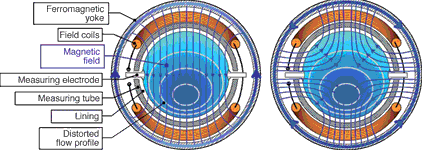
Optiflux 2300 detects flow profile distortion with its integrated flow profile monitor by periodically briefly reversing the polarity of the magnetic field in one of the two field coils (see Figure 1). This produces two opposing fields. The field in the top of the tube determines the flow rate in the top half of the tube positively. The field in the bottom of the tube determines the flow rate in the bottom half of the tube negatively because its polarity has been reversed. The electrode voltage is the sum of these two values. The voltage for this test phase is only zero when the flow rates in both halves of the tube are the same.
Figure 1. On the left: magnetic field during normal flow measurement. On the right: the half inverted magnetic field for detecting distorted flow profiles
Even deposits on the bottom of the tube or partial filling of the measuring tube are therefore detected and signalled in this way.
Hygienic ultrasonic flow sensor ifm - South Africa
Flow Measurement & Control
The SU Puresonic Hygienic ultrasonic sensor from ifm detects flows of conductive and non-conductive media with high precision.
Read more...VEGA pressure instrumentation supports resilient water network management VEGA Controls SA
Pressure Measurement & Control Flow Measurement & Control
As rapid urbanisation and climate pressures strain water networks across Africa, accurate real-time pressure monitoring has become a strategic necessity. VEGA’s pressure instrumentation helps utilities reduce losses, protect infrastructure and meet sustainability targets.
Read more...Flow imaging microscopy for the early detection of harmful algal blooms Yokogawa South Africa
Flow Measurement & Control
Yokogawa’s advanced flow imaging microscopy technology, FlowCam is helping utilities move from reactive treatment to proactive prevention of harmful algal blooms in reservoirs, dams and freshwater sources.
Read more...Never waste a drop
Flow Measurement & Control
Manufacturers of pumps, valves and related equipment have an important role to play when systems for water are being designed or upgraded and should be included at every stage of a project to ensure that the work is carried out within the equipment’s capabilities.
Read more...Ultrasonic flow meters ifm - South Africa
Flow Measurement & Control
The ultrasonic flow meter of the SU series from ifm - South Africa monitors liquid media such as water, glycol solutions or industrial oils. It detects the three process categories volumetric flow quantity, consumed quantity and medium temperature.
Read more...How utilities identify water losses in Northern Europe
Flow Measurement & Control
Norwegian leak detection specialist, Ovarro outlines how municipalities are responding to hidden water loss using acoustic monitoring and analysis tools that provide early indications of developing leaks.
Read more...Senix sensors provide flood warnings Instrotech
Flow Measurement & Control
To create the world’s most sophisticated flood monitoring and forecasting system, the US State of Iowa’s Flood Centre (IFC) uses more than 200 Senix ToughSonic 30 and ToughSonic 50 ultrasonic sensors to measure water levels in streams across the state.
Read more...Mastering inline LNG flow monitoring
Flow Measurement & Control
[Sponsored] As global demand for cleaner, more flexible energy sources continues to rise, liquefied natural gas (LNG) stands at the forefront of the energy transition. Engineered for excellence in cryogenic environments, the Anton Paar L-Cor 8000 flowmeter redefines inline LNG flow monitoring.
While every effort has been made to ensure the accuracy of the information contained herein, the publisher and its agents cannot be held responsible for any errors contained, or any loss incurred as a result. Articles published do not necessarily reflect the views of the publishers. The editor reserves the right to alter or cut copy. Articles submitted are deemed to have been cleared for publication. Advertisements and company contact details are published as provided by the advertiser. Technews Publishing (Pty) Ltd cannot be held responsible for the accuracy or veracity of supplied material.










 printer friendly version