



Patients in advanced medical facilities are often keenly aware of how much they depend on their doctors and nurses to be precise and accurate. But how about the diagnostic and therapeutic equipment - is it precise enough, too? Is proper system and equipment grounding maintained? Are the power supplies to each diagnostic or treatment room kept rigorously within specifications?
For example, think about a hospital X-ray room. Before it can be certified for operation, all of its equipment must be certified to be within specification on key electrical parameters. It is like any other equipment installation check, but with lives instead of production lines at stake.
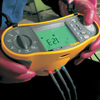
Certifying the equipment is often the task of a field technician, lugging four separate installation-related testers or one Fluke 1650 Series Multifunction Installation Tester.
One instrument replaces four
It all happens very quickly, says a field technician for a major global manufacturer of medical diagnostic equipment. "I once needed a voltmeter, a phase-rotation meter, a line-resistance meter, and a ground-test meter. Now we use one meter with one set of test leads. Tests that once required, typically, an hour and 15 minutes can be accomplished today in about 20 minutes with the Fluke 1653.
"The meter itself could not be any easier to use," he adds. "You just turn the rotary dial to whatever function you want, configure your leads properly, and you are ready to go."
"A fact of life in my business is shipping: all of that equipment had to be shipped to the job site. I would have to open a box, unpack all the leads, use the meter, wrap it all back up, put it back in the shipping container, and get it ready to ship to the next location. Of course, I would repeat that procedure with the other three pieces of gear."
"The Fluke 1653 is a pretty outstanding product. With a 4-to-1 reduction in overall instrument complexity, my task is considerably easier."
Exhaustive testing
Before medical test equipment can be used, the installation must be certified. To be certified, it must meet IEC 60364 specifications for fixed electrical installations in buildings. Once it is certified, then it is typically the job of the facility's biomedical engineering team to maintain the equipment to the industry standard.
Installation testing starts with the mains voltage, usually 3-phase 480 V. At the same time, the technician checks phase rotation, to make sure that the incoming lines are wired correctly to the main disconnect. Still, with the mains voltage within spec, line resistance could be a problem. "On one job, I discovered the mains voltage to be within specification but found significant line resistance," says the technician. "In this case, oxidation was so bad that the electrician had to remove the ground connector, use a burnishing tool to grind around it, and then reconnect it. Only then would it pass."
The technician also checks line resistance right at the last breaker box before the X-ray machine, to determine that the line resistance is within specification. The risk, he says, is that impedance on the incoming line could keep the X-ray machine from functioning at its highest capacity. What also causes problems, he says, is that electricians may have placed more equipment on the circuit. "It is Ohm's Law in action: when you start adding more equipment on a line, you change the overall line resistance. It is easy to say that you cannot load down the line; it is harder to say when a change in the individual loads on the circuit will compromise it."
The technician uses the Fluke 1653 to check for excessive line resistance. "What we are looking for is something less than 100 mΩ. The Fluke meter has done exceptionally well in measuring down to 10, 20 or 30 mΩ. That is pretty accurate, considering that the other machines we were using told us simply that the resistance was less than or greater than 100 mΩ."
Next, the technician powers up the unit and checks the power there to ensure that he sees 480 V. "I do all my grounding tests at this point. One thing about the world is that it oxidises - on a daily basis. The longer something oxidises and the longer it sits, the more it starts to rust." Oxidation, he says, can be a hazard all the way back to an incoming line that may have been in place for a period of time.
Safety in numbers
The technician considers ground safety the greatest challenge in medical imaging equipment installation. "It would not be difficult to overlook something, and, if you do, a patient or operator could actually die on the table. If a patient is lying on an X-ray table, and his arm is touching any metal on the table, and the table is not grounded properly - that is, back to the main hospital ground - you might see anywhere from a couple hundred millivolts to a couple volts of potential difference. It is all in the numbers."
"In some environments, those numbers would not constitute a hazard. But if the hospital staff has run a catheter into a patient's bloodstream, the patient's body resistance becomes almost zero. If the doctor were to reach up and grab an overhead surgical light that is grounded at one portion of the hospital, and reach down and touch the catheter - and there is a couple of volts of ground potential there - it could cause the patient to defibrillate and die."
A grounding in the fundamentals
In the technician's view, the most important role of the Fluke 1653 in a hospital environment is in confirming every potentially 'live' point in the system with respect to the main hospital ground. "By 'live' I mean any point in the system with which the patient or doctor could come in contact. And we must not find anything higher than a 0,2 Ω resistance at any point. With the Fluke 1653 providing readings down to 0,01 Ω we would know of any grounding problems immediately and have them investigated."
The technician says that an installation tester should be the tool of choice for ground resistance testing. "You cannot accurately test ground resistance with a voltmeter. Let us say I connect the meter to a copper pipe and I put the other lead on the patient table. A voltmeter will only send out a couple-volt signal and tell me if there is continuity between the pipe and the table. However, that is not a very reliable indicator. If you have a weak or loose ground, you are still going to read continuity."
"Now consider the ground safety test on the Fluke 1653. It is going to run a current through that ground, measure the voltage drop across the ground, and tell me how good the conductivity of the ground is." While checking for grounding problems, the technician also performs a current leakage test. "Before I received my Fluke 1653, I would actually have to order a second and more accurate meter just to see if a leakage problem was real or not. Now when a problem occurs, my findings are clear-cut - indicating exactly how good this meter is. It can save lives."
Power-hungry equipment
"Initially, we go in and record all the appropriate readings," says the technician. "We find, for example, that the line resistance is less than 200 mΩ. If we were to come back three years later and find 800 mOmega; of line resistance, it is because three or four pieces of equipment may have been added to the line, increasing the overall line resistance. Then we would have to go back in and reconfigure the facility."
"With the X-ray machine, line resistance can be a real issue," says the technician. "The exposure is very short, but we have to pull a ton of power across the line in a split second. Quite simply, if the line cannot deliver that, we are required to deregulate the machine. We will say that we cannot deliver the required 80 kW, but only 70 kW or 60 kW, because the line resistance is too high. You can get that kind of power at a number of different voltages, but in any case you have to have the proper line resistance and the proper gauge of wiring." His diagnosis: "The Fluke 1653 does a great job of sniffing out real line resistance, from the instrument in question all the way back to the power feed. With such a device, electricians can make informed decisions about how to derive the maximum benefit from the diagnostic equipment that is the lifeblood of their business."
Storage and reporting
In medical facilities, both before and after certification, storing and reporting test results is often key to successful installation testing. The Fluke 1653 memory stores up to 500 measurements, and the built-in computer interface allows technicians to upload test results to the PC.
For more information contact Val Verwer, Comtest, +27 (0) 11 254 2200.
| Tel: | +27 10 595 1824 |
| Email: | sales@comtest.co.za |
| www: | www.comtest.co.za |
| Articles: | More information and articles about Comtest |






© Technews Publishing (Pty) Ltd | All Rights Reserved
 printer friendly version