



Convergence of PC-based and automation technologies is fast becoming a reality in the world of industrial control. The border lines are increasingly crossed as customers demand more open systems and more interaction between hardware and software devices, but is openness the way forward? Tommy Hákansson, technical manager of a leading HMI supplier, Beijer Electronics, puts the use of Microsoft's Windows CE into perspective.
In recent years, Beijer Electronics only offered HMIs based on bespoke realtime operating systems to their customers. They have continually monitored new technologies though and waited for a time where they can offer a cost effective, secure and efficient solution to what customers require now and in the future. With the advent of the latest release of Microsoft's Windows CE operating system (commonly called CE.NET), and processors that could maximise its performance, the time is right to offer more open HMI solutions. Now Beijer Electronics has designed its new Exter terminals around a Windows CE.NET operating platform.
Openness, reliability and vulnerability
One of the major advantages of a normal desktop PC-based system is openness, but this has to be tempered by its vulnerability to abuse and reliability to run without any spurious problems. A bespoke realtime operating system has virtually no openness, but it is extremely reliable and virtually invulnerable to unauthorised access. A medium way is using Windows CE. It is not as open as a PC-based system, but has a proven greater reliability and is certainly less vulnerable to external attacks.
Windows CE is not as vulnerable to external attacks as a PC-based system. Before explaining the reasons on the decision to use CE.NET the best thing to do is to clarify a few points on what and how the internal elements of an HMI work, enabling easier understanding of the advantages and disadvantages of using Windows CE-based HMIs.
Hardware, operating system and application
Any CPU driven device basically consists of three main elements. The first is the 'hardware' which consists of the processor, memory, I/O and other electronic components. The second element is the 'operating system' that handles hardware access, control of the application software (load/start/stop), file storage and supplies an application program interface (API) to the application developer. The third and last element is the 'application' which is the software that performs the actual end user tasks.
When initially developing the new Exter concept, Beijer Electronics design engineers looked at all present and forthcoming operating system solutions such as Microsoft (various), Linux, QnX, VXworks and even Tron (Asian operating system). They even looked at new horizontal operating systems such as Windows Mobile, which is coming to the forefront for certain applications, but found since it is intended for use in intelligent consumer systems it did not fulfil all of their requirements.
Linux and embedded XP operating systems
One of the reasons Windows CE.NET was chosen was its flexibility in size (footprint). The footprint dictates how much physical memory is required by the host device to store and also to run the operating system; thus with a large footprint it can potentially have a significant effect on the manufacturing price. For example, Windows XP-Embedded typically requires about four times as much memory for its installation as Windows CE.NET. Linux was considered, including embedded Linux, but it can take up to 10 times the memory depending on the required installation. Since Windows CE.NET takes only a relatively small amount of memory (including the memory used by designers for interfacing), and is flexible in its footprint, it was found by Beijer Electronics to be the best to suit their needs and also the needs of their customers.
Another major advantage in using CE.NET is that on most open operating systems (such as Microsoft's Windows XP-Embedded) any normal PC application software can be run, but on Windows CE.NET only software written specifically for CE.NET can be used, and this will only work if the required drivers, etc, are installed by the device manufacturer. This restriction to allow only tested software to run on the HMI gives greater security to the device and prevents unauthorised tampering with the application and operating system set-up.
Support and connectivity were also keen factors in the choice of CE.NET. If they had chosen Linux, Beijer Electronics would lose the possibility of using an abundance of commercially available third party PC peripherals and software, which may be required by some customers. Also, since Linux is not owned by any company, another major problem with implementing it is getting support on just how to do the interfacing. With Windows CE.NET, Microsoft offer direct specialist support in all areas of implementation, and have full responsibility for the correct working of the operating system.
Windows CE configuration
When a Windows CE.NET operating system is put together the device manufacturer can select features of the operating system that it wishes to incorporate into its product. The range of drivers, communications options, software elements, etc, is very large so to keep the operating system down to a minimum, the hardware developer simply chooses the elements it requires for its particular product. This created selection for an operating system is called an 'image'.
The image is built using a drag-and-drop 'platform builder', available from Microsoft, and when the elements are selected the platform builder compiles it into the image. An image is the operating system in a binary format. The result is that the Windows CE operating system installed is specific to the hardware device, optimising its speed and performance. The image contains the foundation of all Windows-based applications, and can include elements such as graphics, networking and XML
When the image has been created, the manufacturer exports its specific application interface (API) to a software development kit (SDK). The SDK is then used in Microsoft's Embedded Visual C++, and it is with C++ that Beijer Electronics develop the end-user application. What is great for added device security is that when creating CE.NET operating systems certain SDK elements can be blocked, preventing unauthorised interfacing onto the terminal.
Other advantages of CE.NET
Since CE.NET allows parallel processing of applications, other software (when compatible) can run on the terminals at the same time as HMI API (Internet browsers, etc). CE.NET also enables a high level of software integration through the use of .NET Compact Framework and XML Web services. These services were not previously available on previous versions of Windows CE, and take CE into a completely new era in usability and communication. These Web services are small discrete software building-block applications that connect to each other in the device as well as to other devices and to larger applications over the Internet. These blocks give the new Exter terminals true Internet enablement and allow them to be used for PC type information transfer.
Choosing a CPU for Windows CE.NET
Another decision engineers faced when designing the new HMI was which processor was the best to run their chosen operating platform. Windows CE can be constructed for use on four different CPU-architectures. Software compiled for one CPU architecture cannot run on another core without recompiling, so the decision on which CPU to use was critical.
MIPS architecture CPUs were considered. MIPS offered an extremely reliable hardware platform, but did not really maximise the potential of CE.NET. After lots of reviewing, a high performance 300 MHz 32 bit XScale CPU from Intel was chosen as the brain for the new Exter terminals.
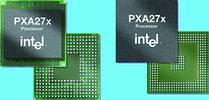
XScale processors are a range of reduced instruction set computer (RISC) CPUs. XScale is an advanced RISC machines (ARM) processor with a few extra features. ARM processors are the most common processor architecture used in Windows CE applications, mainly in the Pocket PC marketplace, and it is this compatibility to pocket PC that makes the XScale processor the perfect choice for the new HMIs.
PC-based X86 type processor not the best option
There are many reasons why Intel's XScale processors were chosen over PC-based CPUs. A main reason was that most software viruses are designed for PCs and primarily attack X86 type processors. Also since XScale processors are RISC CPUs they give faster processing of data for simple applications than complex instruction set computer (CISC) systems, which typically run on X86 processors.
An advantage of using a RISC-based processor is it offered Beijer Electronics a low-cost, fast time-to-market solution. Therefore, the Exter HMI could be produced and fully tested more rapidly. Since a RISC processor requires fewer transistors than comparable CISC processors it also means they are a much smaller size. This reduction in size leads to requiring less power, no cooling of the CPU, and therefore they produce no audible noise. Since the CPU requires no cooling fan there are no vibrations on the main circuit boards. Having no moving parts also gives a very high mean time between failures (MTBF) figure, and unlike fan cooled CPUs dust is not drawn into the HMI, thus preventing deposits collecting on components (dust deposits on components can cause heat build-up and reduce the efficiency and life expectancy of the components).
Safe file system ensures data integrity
Using Intel's XScale ARM processors allows the Exter HMI to offer a totally safe file system by using PSM (Intel's Persistent Storage Manager). PSM integrates both executable code and file storage functions into a single flash chip, giving fast access time and ensures that system files and data are not corrupted even when power fails during file writing.
PSM also means that the HMI can be turned off immediately and the operator does not need to wait for the system to shut down. This saves valuable production time and improves the overall reliability of the whole process.
What about licence fees?
With Windows CE.NET the operating system is embedded into the HMI and therefore it is not necessary to buy end user licences directly from Microsoft. What happens is Beijer Electronics buys a licence package from Microsoft and is responsible for all updates and support requirements. This is unlike desktop PC operating systems where the licence is individually sold by Microsoft and it is responsible for all support and updates.
In conclusion
Now, with Windows CE.NET and XScale processors combined in the Exter HMI there is enough processing power for any possible solution. Using CE.NET as the operating system for Beijer Electronics' new HMI has the advantage that future developments and connections can easily be incorporated, keeping all development possibilities available for inclusion, as well as offering a very stable open solution with a very reliable platform that is secure enough for industrial customers.
The Exter will be released in January 2005.
For more information contact Varispeed, 011 466 0830.






© Technews Publishing (Pty) Ltd | All Rights Reserved
 printer friendly version