



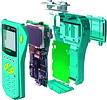
Daimler-Chrysler has selected a pioneering diagnostic tool that can be both hardware and software customised. The handheld computer can be used in development or service roles and can test and diagnose many components and their functionality. It can be used in any industry including environments that require equipment to be intrinsically safe.
All automotive manufacturers are eager to investigate and apply new technology. And the Daimler-Chrysler group is no exception, having chosen to use the latest generation of powerful handheld computers as part of its R&D, and road-testing programme for the SMART car range.
In-car electronics have reached a new level of sophistication with the increasing use of the electronic control unit (ECU). From its humble beginnings, this is now a device capable of communication with a wide range of vehicle components, ranging from the engine management systems and suspension control, to power window regulators and lighting systems.
To enable this communication to take place, the SMART car uses the latest CANbus network. This system allows communication between component devices and the ECU, but it also enables the re-programming of the operational criteria of the intelligent components and, perhaps more importantly, offers the opportunity to interrogate the ECU and modify/replace the current ECU software.
Since all of the components run from the same wiring network, this is fast becoming the only viable method of diagnosing certain problems in today's vehicle. Moreover, the ability for an engineer to communicate directly with the 'nerve centre' of the vehicle dramatically speeds up the service process, bringing the benefits of savings in time and money to the customer.
However, the SMART R&D team is taking things a step further. In an effort to utilise this new technology, SMART contacted one of SKF's specialist condition monitoring companies; Diagnostic Instruments (DI), who developed and produce the Di-225, a robust, simple to use, modular handheld computer. Of crucial importance to the SMART R&D team, the Di-225 can be modified to exactly meet the technical specifications, and withstand the demanding environment of the automotive industry in general and their requirements in particular. This unit, capable of communicating with ECUs using CANbus communication protocol represents a significant leap forward - it is, in effect, a handheld CANbus diagnostic tool.
Ideal for test scenarios, it makes a simple plug-in-and-interrogate tool for diagnostics - which explains why 50 of these units are presently being used as a development tool during road trials for their next generation of SMART cars.
"We identified at an early stage the shortcomings of the PC-based solution," says Hendrik Salomon of SMART, who is the project leader in the development of this groundbreaking instrument. "Windows CE offered the solution, but we needed a suitable platform. Following a period of evaluation, we selected the Di-225." He goes on: "The ability to fully integrate our CANbus hardware into the unit, and to customise the connector panel was ideal. The size and weight of the unit allows us to connect the diagnostic tool to the ECU from within the car cockpit. It gives us the flexibility we need, which translates to a valuable reduction in time to market for SMART."
Though presently used as a development tool, DI is excited about its potential as a service tool.
"Its capabilities offer extensive benefits to the automotive industry," says Jim McNiven, marketing manager at Diagnostic Instruments. "While it is now common practice to regularly interrogate the ECU on a production line, this requires a PC-based local system. The flexibility and size of the new unit, with the ability to access data from the Internet, makes it the ideal service tool for dealerships and franchises."
Diagnostic Instruments, now an SKF Group* company, has 10 years' experience in designing and manufacturing portable instruments. These products are sold worldwide through distributors and OEM customers. McNiven says: "Advanced technology has allowed us to develop a range of 'mobile computing platforms', the processing capability and storage power of which is far greater than that possible with a desktop a few years ago." He goes on: "The applications for industry are almost without limit. Until now, if you required flexibility, the only real option for many industries was a laptop... cumbersome and fragile. That can now be replaced by a handheld unit which is truly customisable for specific applications."
The Di-225 is unique in the fact that it is fully modular. Both the hardware and the software come in cost-effective interlinking modules that have been thoroughly tested and proven. Based on the Windows CE operating system (which interfaces smoothly with office PCs) the customer can start with just the software kernel, and then expand into more and more application software as the need arises.
All of this makes the device truly flexible, with numerous customisation options open to the customer, allowing them to select the computing power, the memory size and RAM. A PC card slot broadens the range of applications by providing access to such things as GSM, GPS, Internet, and flash memory via off-the-shelf PCMCIA cards.
Perhaps more importantly, there is even room for customised electronics, thanks to an internal PCB. By plugging a PCB straight into the main digital board, the customer has a unit tailor made for his requirement. Indeed, he can even write his own software or download an existing Windows CE-based application. Everything from screen size - 1/8th VGA and 1/4 VGA - to keyboard layout, and the unit colour is customisable.
"It is a mobile computing platform on top of which you can build your application, in terms of both hardware and software," says McNiven. "There is even a version that has been certified intrinsically safe, which means it can go where other PCs fear to tread."
The benefits are many. Because the system is based on common architecture and components, the hardware and software can be customised, allowing for inexpensive upgrades and application enhancements.
For more information contact Jim McNiven, marketing manager, Diagnostic Instruments, Livingston, Scotland, 0944 1506 470011, [email protected], www.ruggedhandheld.com
*About SKF
SKF is a leading global supplier of customised solutions, products and services in the bearings and seals related businesses. Its strategy is to expand its operations into electronics, monitoring and reliability systems via its own technology and competences, acquisitions and partnerships. A recent example of this strategy is the world's first fully functioning drive-by-wire systems; developed by SKF and featured on the FILO, a concept car designed by Bertone and shown at the Geneva Auto Show in March 2001. General Motors has since chosen SKF as its partner to develop drive-by-wire systems for its future generation concept car: AUTOnomy.






© Technews Publishing (Pty) Ltd | All Rights Reserved
 printer friendly version