



Reviewer Details
Name: H. JOOSTE
Position/Designation: Owner
Company: Mnemonics I.T. Systems
Telephone: 021 807 3167
Product details
Vendor: Ana-Digi Systems
Product name and version: LG GM6 and GM7 PLC. LG PMU 300BT HMI
General
Q: What industry (eg mining, food and beverage, automotive, etc) is the PLC being applied in?
A: Wine production and bottling industry at the KWV cellars in Paarl.
Q: Describe the application briefly, giving a description of any existing control systems, any previous PLC system that was in place, etc. If relevant, describe the switchover from the previous system.
A: The system consists of two LG GM6 Rack PLCs running in master-to-master format, each with 2 x 16 digital input and 2 x 16 digital output modules. Each rack is also fitted with a four input analog module and a four output analog output module.
6 x LG GM7 DR20A PLCs were also employed as slaves to the above racks with each slave having a LG PMU-300 Touch Screen HMI.
Four requirements were to be met:
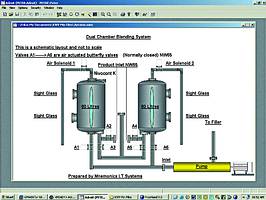
* Automatic control of wine blenders while excluding oxygen, which would contaminate the product. These pumps work on a PID control loop in order to sustain product pressure level and answer varying demand of the bottle fillers.
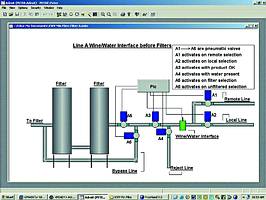
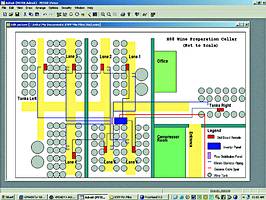
* Automatically route the correct wine type to the relevant bottling line. A selection is made on the HMIs between remote, local, filtered and unfiltered applications.
* Automate the sensing of water/wine (pipes are initially filled with rinse water after cleaning) by conductivity checking. Water is pumped to waste. Once wine is detected, valves are routed to direct the product to the relevant filling machine.
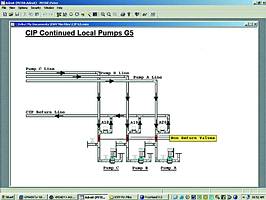
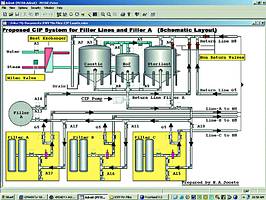
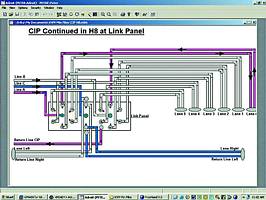
* Automate the CIP (cleaning in place) process after-hours to ensure hygienic product feed pipes. CIP is of utmost importance to ensure product integrity. This entailed complex procedures that had to be strictly adhered to.
This system was deemed necessary, as the process was previously manually routed, which led to loss of production time and errors in product routing. Wine/water detection was also a manual process, which could lead to discrepancies in product consistency.
Q:Who did the system installation/integration?
A: Mnemonics I.T. Systems
Box 1044, Wellington, 7655
Tel: 021 807 3167, Cell: 082878 6539
Member: H.A. Jooste
Q: Approximately how many man-hours did the installation/integration take?
A: Approximately 720 hours.
Q: How is the after-sales support handled (eg, remote-dial-up, e-mail, Internet access)?
A: In-house, by KWV personnel. Where necessary by e-mail or telephonic discussion with suppliers.
A dial-up modem can be incorporated at a later date to access the PLC programme for remote maintenance.
System architecture
Q: How many I/O does the installation have? Analog? Digital? Maximum possible?
A: As built; analog 16; digital 248;
max possible: analog 80, digital 790.
Q: What impressed you most about the architecture? Open standards, wide range of drivers, the ability to upgrade, etc? Please elaborate.
A: Open standards with easy expandability. The main reason for using LG GLOFA PLCs is the easy use of function blocks to achieve complicated logic control without extensive advanced programming.
Q: Does the PLC have a built-in user interface? Describe.
A: Yes. Three LG PMU-300BT monochrome touchscreen HMIs were utilised at the bottle fillers for adjustment of filling machine level set-point, pump control; and valve control, both for product routing and cleaning sequences.
The PLCs communicate with each other via RS 485 over long distances, while the HMIs communicate with the local PLCs via RS232.
Q: What sort of redundancy is built into the system?
A: Each of the master racks can be expanded to accommodate a further two modules [either analog or digital]. The slave PLCs can be expanded by a further 20 digital I/O each and an additional 12 analog inputs. Further redundancy can be obtained by using GM6 or GM4 PLC Racks.
Compatibility
Q: Do you run the PLC in conjunction with any third-party application software or hardware? Describe.
A: At this stage the system is configured as a standalone system.
Conclusion
Q: What impressed you the most about the system?
A: Ease of implementation. The function blocks provided in the software enable complicated logic and analog control without extensive complicated programming.
The LG system offered substantial cost saving over other makes of equipment, without compromising functionality.
Q: What was the predominant feature (or features) that made you decide to employ this PLC, rather than another (ie, ease of use, support from the vendor, upgrade path, redundancy features)?
A: Ease of use. Excellent vendor support. Expandability. Compatibility with other makes of equipment. Reasonably priced without compromising system requirements.
Tel: 021 948 1452
e-mail: info@anadigi.co.za
URL: www.lgis.co.za






© Technews Publishing (Pty) Ltd | All Rights Reserved
 printer friendly version