



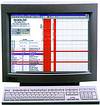
The Quadlog safety matrix is a toolkit for the Quadlog safety PLC that cuts configuration, testing and maintenance in half by merging into one tool the traditionally separate steps of creating a cause and effects matrix diagram and configuring the safety system. It was developed as both a development tool and a methodology and to be easy-to-use by a variety of plant personnel – from process (safety) engineers to operations and maintenance personnel.
The Quadlog safety matrix provides:
* Straightforward, easy-to-learn method of documenting safety system requirements.
* Easy-to-understand, graphical documentation to facilitate better review and maintenance.
* Automatic generation of the safety system logic from the matrix logic for reduced development effort.
* Automatic regeneration of the safety system logic when a change is made to the matrix for minimised documentation and maintenance efforts.
Reducing engineering time and expense
A cause and effects matrix identifies the possible causes of process events and their resulting effects. Traditionally, a matrix is developed as part of a safety specification to identify relationships which must then be converted to the logic to be executed by the safety system. As such, a traditional matrix serves only to ensure that the safety system requirements are defined thoroughly, requiring the user to write a program that reflects the matrix logic. In addition, extensive testing is usually needed to detect any potential errors and users frequently build some form of hardwired mimic or matrix panel to convert the safety system's ladder logic back into the cause and effects matrix.
With the safety matrix, however, the matrix logic is automatically generated from a complete matrix worksheet. Besides reducing configuration significantly, this also eliminates errors associated with manually converting the matrix to logic. There is no need to do any additional programming because I/O configuration details are entered within the matrix as well. It is seamlessly integrated with ProcessSuite Control Simulator which allows the user to develop and test the matrix logic entirely on a single PC.
Minimising implementation and maintenance costs
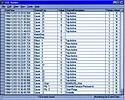
The safety matrix also helps in the maintenance of up-to-date documentation because it automatically regenerates the logic when a change is made to the matrix. These modifications and any other user activities related to the matrix are logged and time-stamped in the system's integrated Sequence of Events (SOE) viewer (Figure 1), thereby providing you security and change history.
Ensuring system security
The safety matrix's security system which provides multi-user, multipassword access and allows an administrator to assign up to six configurable levels, is built into the matrix itself. This means that such vital information resides with matrix - not the PC of origin. The various access levels which can range from read-only to full change control and downloading capabilities provide plant personnel with the information they require without jeopardising system integrity.
Providing ease-of-use
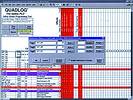
The safety matrix is easy for noncontrol engineers to learn and use due to the familiar spreadsheet-based user interface which animates the American Petroleum Institute (API) 14C standard. It also includes customisable displays to further facilitate ease-of-use.
The software includes:
* The safety matrix configuration program which enables graphical configuration and documentation of a cause and effects matrix.
* The safety matrix function block library which executes the completed matrix within any APACS+ or Quadlog control module or ProcessSuite control simulator.
* The safety matrix operations and maintenance program (shown below) for online monitoring and secured maintenance.
These integrated components work together with the other APACS+ engineering tools (ProcessSuite 4-mation configuration, ProcessSuite Vision and the SOER Viewer) to provide a complete development, testing, troubleshooting, training and operation environment for automating the cause and effects methodology.
Delivering intuitive graphical configuration
As with the ProcessSuite 4-mation configuration software, Quadlog safety matrix configuration data is sent and stored in the controller in an uncompiled format. Thus, this data, including tags, notes, descriptions and security levels, can be viewed in the same graphical format in which it was created. The configuration can also be automatically uploaded from a running controller which eliminates the need to maintain back-up files.
In configuring the Quadlog safety PLC, the safety matrix is used to relate process events (inputs or causes) to shutdown devices (outputs or effects) by listing all possible causes on one axis and all effects on the other. The relation of causes to effects is defined by marking the appropriate box (intersection) in the matrix.
Causes
As shown previously, causes are configured by clicking on any cell within the row or column identified as a cause. A dialogue box enables entry of the details supporting each cause. The application supports a wide variety of cause types, up to three inputs per cause and a variety of logic functions to be performed on the inputs to generate the cause. This flexibility allows complete implementation and documentation of the safety logic in the matrix. With complete implementation, there is no need for external signal conditioning logic which minimises much of the inherent communication and troubleshooting benefits of the cause and effects methodology.
Effects
Effects are configured by clicking on any cell within the row or column identified as an effect. The dialogue box enables entry of the details supporting each effect.
Intersections
As shown previously, intersections define relationships between the causes and the effects.
Facilitating easy logic execution
The safety matrix function block library is at the heart of the Quadlog safety matrix toolkit because it executes the safety matrix configuration program logic. These blocks run in any Quadlog control module such as the critical control module (CCM) or any APACS+ control module such as the advanced control module (ACM) or ProcessSuite control simulator.
As delivered, the blocks are empty cause and effects matrices possessing all of the program logic necessary to execute the matrix, log events to the SOE Viewer and administer matrix security. Thus, matrix execution is automatic.
The safety matrix operations and maintenance program communicates with the live controller or ProcessSuite control simulator to execute a safety matrix function block. As such, the program consolidates realtime input data regarding all interlocks and provides dynamic graphical visualisation of one or more running matrices.
Users also access an existing matrix using the program and depending upon their security level may be granted the ability to apply maintenance bypasses, resets and overrides. All such actions are automatically recorded in the SOE log. Besides the action itself, this log file records the date, time, user name and reason, thereby providing comprehensive change history.
Moore Process Controls
(011) 466 1673
| Tel: | +27 11 466 1673/9 |
| Email: | info@moore.co.za |
| www: | www.moore.co.za |
| Articles: | More information and articles about Moore Process Controls |






© Technews Publishing (Pty) Ltd | All Rights Reserved
 printer friendly version