



South Africa is a land in which people like to play. Part of this outlook involves the eating of good food and the drinking of good beverages! In this regard, South Africa is up there with the rest of the world as far as the quality of our food and beverage industries is concerned.
Most beverages require the addition of water during the manufacturing process. Beer, for example, consists primarily of barley malt, hops, yeast and water. Many beer drinkers want their beer to be additive-free (including preservative-free), as laid down by the Reinheitsgebot, or German Purity Law.
Issued by Duke Wilhelm of Bavaria in 1516, this strict edict permits the use of only water, barley malt, hops and yeast when making beer. This law was originally issued to prevent brewers from using additives in beer in order to disguise unpleasant smells and tastes that developed as the beer aged!
The Reinheitsgebot is considered to be one of the oldest, nonreligious food laws in the world - and all thanks to those who love beer! However, while beer lovers around the world may wrangle about the possibilities, or not, of adding other ingredients to the process there is another lesson to be learned from this German purity law. Simply put, it is this: how good is the water itself that you put into your beer - and indeed, any of the other beverages you consume? It is quite plain that in order to obtain a quality product, the use of high-quality water is a given - or should be.
Water is one of the cornerstones of the beverage industry and the quality of the raw water can make or break the quality of the beverage. Breweries, manufacturers of nonalcoholic beverages and bottlers of mineral water will place entirely different requirements on the composition of the raw water that they need. Nonetheless, whatever the type of beverage you are involved in, the user will require hygienic, perfect water for production or filling. It must not contain anything that will influence smell or taste, cause haze, influence the manufacturing process or leave corrosion or deposits in the system or on bottles.
Hennie Cronjé of BWT (Best Water Technology) Africa says: "In the daily functioning of the beverage industry, it is vital to organise the supply and delivery of high quality water for a number of different functions and needs. It is particularly important to remove undesirable elements like germs, bacteria and chemical traces from water."
Since every source of spring or fountain water has different components, each treatment process must be custom-made so that the water delivered meets all quality and customer requirements. BWT Africa ensures that finely tuned, individual installation concepts incorporate modern technology with thoughtfully considered ecological aspects.
BWT Africa is based in Gauteng and specialises in the design, manufacture, installation and commissioning of water treatment plants, products and technology across a range of industries. Most of the water treatment plants are manufactured locally. BWT Africa's mother company, the European-listed group of companies known as Best Water Technology AG, supplies some of the specialised technology, equipment and components.
The most common processes used to obtain high quality water standards are ion exchange or reverse osmosis steps combined with other general treatment technology. The use of UV disinfection and/or disinfection by means of ozone is becoming commonly used where high microbiological standards are called for and where chemical disinfection is not permitted or wanted due to environmental or health reasons. Cronjé says UV or ozone disinfection is an excellent choice where a safe and environmentally friendly process is required, and that it does not change the water in any other way.
In the food and beverage industries, a high level of disinfection is also required on items such as packing foil, plastic cups, bottles, bottle caps and products on a conveyor belt. In washing the bottles, water hardness in the pipes and water system can cause lime scaling and build-up of deposits in the warm water zones of the bottle washer, as well as in and on the bottles. Deposit build-up can increase the overuse of an installation, leading to potential operational malfunctions. It can also create a nest for bacteriological contamination and cause an increased demand for cleaning agents. In extreme cases, lime scaling can only be removed by the replacement of the piping.
The use of softened or partially desalinated water eliminates all these problems. BWT Africa is capable of the design, supply, installation and commissioning of water softening equipment by using either ion exchange or reverse osmosis technologies. This equipment can be provided as stationary centralised systems or as modular applications for point-of-use applications.
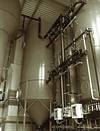
Drinking water treatment
It must be remembered that mineral water is operating under a double-edged sword. On the one hand, high legal demands in regard to quality are made on mineral water, and on the other hand, mineral water must remain as natural as possible. The conditioning processes mainly concern the removal of iron, manganese and hydrogen sulphide. Iron is generally removed by oxidation with atmospheric oxygen and subsequent sand filtering. The removal of manganese is more problematic, and involves partial current oxidation with ozone and subsequent sand filtering. UV disinfection, activated carbon filtration and sterile filtration are also used.
Fruit juices
Dilution water for manufacturing fruit juice must be extensively desalinated in order to avoid secondary reactions with the concentrate that might lead to haze or a change in the taste of the product. The trend here is towards environmentally compatible membrane processes, ozone technology and UV disinfection.
And not forgetting.... beer
When brewing beer, the taste, appearance and preservability of a beer is derived essentially from the composition of the brewing liquor, which is different for every type of beer, be it lager, bitter or stout. Legal conditions (such as nitrate content) make brewing liquor treatment absolutely necessary on many levels.
According to the composition of the untreated water, three different processes are available. These are: lime carbonisation, ion exchange and membrane technology.
* Lime carbonisation: The process of high-speed pressure decarbonisation has been widely used for decades in the brewery industry. This process alone is sufficient in situations in which there are no significant variations in the composition of the raw water and only the carbonate hardness should be reduced. However, the magnesium hardness must not be significantly above the noncarbonate hardness of the raw water or amount to more than 90 ppm CaCO3, or other processes become necessary to obtain a perfect brewing liquor. In addition to the reduction of carbon hardness, lime decarbonisation also removes other undesirable materials like ion salts from the water.
* Ion exchange: Through a series connection of weak and strong acid cation exchangers, combined with anion exchangers, trickle degassing modules and activated carbon filters, water of every composition can be conditioned or its composition adjusted to desired values. This includes raw water that is rich in magnesium or nitrate.
* Membrane technology: These processes allow water of every composition to be treated as long as the water is free of chlorine, iron and oil, and all material contained in it can be reduced equally. Reverse osmosis requires no regenerating chemicals, which means no additional salts have to be added for wastewater neutralisation. Reverse osmosis is a preferred conditioning method for the brewing industry because of its environmentally friendly applications, its simplicity regarding automation, its user-friendly aspects and the small amount of space it requires. Nano-filtration, the newest addition to membrane technology techniques, is used to reduce water hardness in particular.
In conclusion: next time we raise our glasses we should be thankful, that in South Africa, we have such stringent safety standards concerning the purity of the water that goes into our beverage making - and the technology to adhere to these standards. As Duke Wilhelm might have said himself in 1516: "Prost!"
Hennie Cronjé, BWT Africa
(011) 315 7376






© Technews Publishing (Pty) Ltd | All Rights Reserved
 printer friendly version