


Maintenance, Test & Measurement, Calibration


Innovative measuring techniques for sewage treatment plants

September 2000 Maintenance, Test & Measurement, Calibration

The treatment of wastewater, especially sewage, has recently become more critical as rural communities move into the cities, placing unprecedented pressure on sewage treatment plants.

This treatment has a number of clearly defined stages: filtration, primary clarifiers, pre-treatment, aeration, secondary clarifiers, thickeners, primary and secondary digesters, etc.

Some of these stages are mechanical or physical processes, but the most complex are chemical or biological reactions. Important parameters that need to be measured are ammonium, phosphates, nitrates and nitrites. When treating sewage, it is desirable to remove nitrogen as this helps the biological cleaning process. A common practice is to use the natural process of nitrification first, and then denitrification. Phosphorous is the main fertiliser apart from oxygen that causes water eutrophication.

The growth of algae diminishes only when the phosphorous concentration falls below 1 mg/litre. A by-product of denitrification in a biological clarifier is dissolved ammonia, which must be monitored carefully. More often, the reduction of energy costs is the main reason for using ammonium measurement in the aeration process. Reliable and accurate measurement of these parameters is essential for sewage treatment optimisation and cost-effective operation.

Staiger Mohilo analyser philosophy

A new generation of analyser measuring systems for sewage and wastewater treatment plants has been developed by Staiger Mohilo, recently acquired by Endress+Hauser. It combines the repeatable availability of concentration values with high efficiency due to low consumption of chemicals and minimum wearing parts in a quasicontinuous procedure. Using colorimetrical measuring techniques, which involve the addition of reagents to the process sample, has many advantages. The intensity of the colour indicates the concentration of each substance: ammonia (NH4), nitrate (NO3), phosphate (PO4) and nitrite. To detect the colouration, the coloured sample is illuminated and the light intensity is measured (Figure 1). The light intensity is only attenuated at a specific wavelength, so it is possible to use a single device at different wavelengths to determine the concentration of the different chemicals.
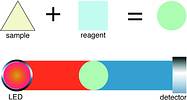
Figure 1. Principle of colorimetrics

Photometrical processes normally have relatively small known transverse sensitivities as a result of a specific reaction causing specific colour changes which are measured at specific wavelengths.
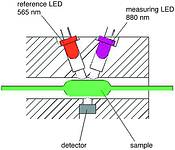
Figure 2. Phosphate (PO<sub>4</sub>)
Figure 2. Phosphate (PO4)

Measuring procedures are based on DIN to allow recourse to tried and trusted procedures with known influence factors, the only exception being the determination of the nitrate ion. For ammonium, the DIN 38406-5 (sodium dichloro isocyanrate and sodium salicylate) specification measures the quantitative colouration in a photometer at a wavelength of 660 nm. By using optimised reagent concentrations, and careful design, a reliable result can be obtained within three minutes. For nitrates, the analyser operates differently from DIN 38405-9 in order to avoid development of toxic compounds and favours chromotropic and sulphuric acid. The colouration caused by the nitrate is quantitatively measured in a photometer at a wavelength of 430 nm. Results are available within 6 min. In the case of orthophosphate, the very economical principle of the molybdate-vandate method proposed in the notice ATV-M 269 is used. The colouration is measured quantitatively in a photometer at a wavelength of 880 or 430 nm. In all cases the measuring light is compared in the photometer with a reference light at a wavelength of 565 nm to prevent any falsification of the measurement due to turbidity.
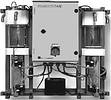
Figure 3. Two-channel sedimentation unit

For potable water and industrial applications, the analysers are provided for nitrite, iron, calcium, sulphite and fluoride with additional parameters being prepared.
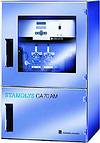
Figure 4
Figure 4


Credit(s)


Share this article:
Share via emailShare via LinkedInPrint this page

Further reading:

Oils don’t die, they degrade
Wearcheck Maintenance, Test & Measurement, Calibration
WearCheck explores the main ways lubricants degrade in service and how these degradation modes affect oil performance and machine reliability.

Read more...
Inspiration for times of change
Endress+Hauser South Africa News
More than 2000 customers, partners and experts gathered in Basel, Switzerland, for the Endress+Hauser Global Forum in April 2026. Under the theme of driving sustainable transformation together, the event combined keynote sessions on strategy, technology and the future of work with practical case studies from across the process industry.

Read more...
Real-time spectrum analyser
Vepac Electronics Maintenance, Test & Measurement, Calibration
The PXE series real-time spectrum analyser covers frequencies up to 20 GHz with a 100 MHz analytical bandwidth and ultra-fast sweep speed, supporting spectrum monitoring, interference finding and RF test and measurement functions.

Read more...
Preserving a French heritage landmark
Omniflex Remote Monitoring Specialists Maintenance, Test & Measurement, Calibration
Omniflex supplied a remotely monitored impressed current cathodic protection system for the Perret Tower in Grenoble, a protected French heritage site, combining 24/7 corrosion protection with integrated surge protection against lightning strikes.

Read more...
Operational efficiencies and safety compliance with preventive maintenance programmes
Maintenance, Test & Measurement, Calibration
Konecranes explains how its Lifecycle Care Preventive Maintenance programme reduces unexpected downtime, improves safety compliance and delivers measurable financial benefits for operators of cranes and lifting equipment across any make or sector.

Read more...
Portable appliance tester
Vepac Electronics Maintenance, Test & Measurement, Calibration
Vepac Electronics’ new portable appliance tester enables precise safety testing of electrical appliances in accordance with DGUV regulation 3 and BetrSichV, with simple three-button operation and battery-powered mobility.

Read more...
Why lubrication fails in mining and what to do about it
Maintenance, Test & Measurement, Calibration
Lubrication Engineers explains the recurring failure points behind mining lubrication problems and how the right product, storage and application practices can improve equipment reliability.

Read more...
When digital twins move from concept to critical tool
IT in Manufacturing System Integration & Control Systems Design Maintenance, Test & Measurement, Calibration
Digital twins are moving out of the lab and onto the mine, the factory floor and the transport network where they predict failures before they happen. Amritesh Anand looks at where they earn their keep, the data and integration work behind them, and the security questions every organisation should ask before switching one on.

Read more...
Why asset level intelligence is now essential for resilient wastewater plants
Schneider Electric South Africa Maintenance, Test & Measurement, Calibration
Sub-Saharan Africa’s wastewater operators face mounting pressure to keep ageing plants running smoothly and meet tougher environmental standards, all while lacking visibility into the health of their medium-voltage (MV) drives and other critical rotating assets. Adding predictive analytics, digital twins and enterprise dashboards enables optimisation across multiple sites, ensuring every drop moves safely and efficiently through the water cycle.

Read more...
Optimise sludge treatment and reduce operational costs
Endress+Hauser South Africa Sensors & Transducers
Endress+Hauser’s inline measuring devices, the Proline Teqwave MW 300 and the Proline Teqwave MW 500, determine the total solids content of wastewater directly through microwave transmission.

Read more...


While every effort has been made to ensure the accuracy of the information contained herein, the publisher and its agents cannot be held responsible for any errors contained, or any loss incurred as a result. Articles published do not necessarily reflect the views of the publishers. The editor reserves the right to alter or cut copy. Articles submitted are deemed to have been cleared for publication. Advertisements and company contact details are published as provided by the advertiser. Technews Publishing (Pty) Ltd cannot be held responsible for the accuracy or veracity of supplied material.


© Technews Publishing (Pty) Ltd | All Rights Reserved

