Closing the gap
April 2020
Maintenance, Test & Measurement, Calibration
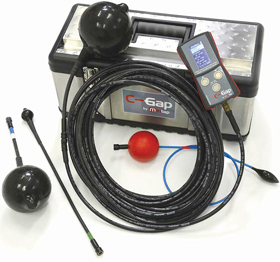
A new closed side setting (CSS) measurement device – the C-Gap – is now available to the South African market through Control Systems Rustenburg and Steelpoort. The C-Gap offers accuracy, safety and reliability to the quarrying and mining industries for the measurement of the CSS in gyratory, jaw and cone crushers.
Mintap was established by Perth-based metallurgist, Brant Tapley, and a European crusher vendor while conducting an audit at an iron ore mine in Norway. After spending countless hours at mine sites trying to optimise crusher performance and explaining the need to measure the CSS of primary crushers accurately to management, Brant said that seeing the C-Gap placed on a smoko table far from home was a ‘eureka’ moment.
Mintap has secured the distribution rights to the C-Gap and obtained Australian RCM certification. To cater for most crusher installations, the system can measure the CSS between 7 and 220 mm with an accuracy of 1 mm. The swivelled hoses connecting the sensors to the portable dustproof handheld unit are offered in lengths from 5 to 30 m, enabling users to remain well clear of the crusher, without needing to lean over any handrails.
The C-Gap works by placing selected high-density rubber hollow bulbs into the crusher mantle. When the bulb is squeezed between the fixed and moving plates, the air pressure in the hose increases, then, by correlating the air pressure through manual calibration, the CSS is measured.
The process of measuring the CSS on all four sides of a cone crusher takes less than five minutes and requires only one operator. Jaw and gyratory crushers are about the same.
The C-Gap effectively replaces current methods of CSS measurement, namely the use of lead weights, steel drums, aluminium or clay balls, or manual measurement. Because the procedure is so quick and easy, the CSS can be measured every shift on all crushers, ensuring consistent crusher operation by achieving targeted set points across all crews.
Maintaining the CSS
To date, there has not been a quick, accurate and safe way to measure the CSS in larger primary crushers; the CSS on these crushers is usually measured during shutdowns only, meaning it runs unchecked for potentially weeks at a time. This results in reduced crusher performance, placing increased emphasis on downstream circuits.
By measuring every shift, the CSS can be maintained and mantle wear can be documented, assisting with service planning. Operators on sites using the C-Gap commended its ‘safety advantage’ over the lead weights. Through site comparative trials they noted the C-Gap had an improved accuracy over the use of traditional means. The C-Gap is available for outright purchase or 12-month hire-purchase. Cost-benefit analyses of sites that currently use lead weights have shown a payback within six months of purchase, when one considers the cost and safe disposal of these. Sites that do not use lead weights enjoy the improved accuracy of the C-Gap.
Further reading:
Infrared thermometers for electrical, industrial and HVAC applications
Comtest
Maintenance, Test & Measurement, Calibration
: Comtest, distributor of Fluke test and measurement equipment, explains how handheld infrared thermometers are transforming maintenance in electrical, industrial and HVAC environments, with three measurement strategies and a wide range of practical applications.
Read more...
Reverse-engineering legacy industrial gearbox parts
Maintenance, Test & Measurement, Calibration
WEG Africa’s turbine workshop uses 3D scanning technology to reverse-engineer components for legacy gearboxes, turbines and compressors, enabling equipment to run for decades after OEM support and spare parts have dried up.
Read more...
Unlocking ICCP remote monitoring
Omniflex Remote Monitoring Specialists
Maintenance, Test & Measurement, Calibration
Cathodic protection keeps buried and submerged pipelines safe from corrosion, but verifying it traditionally means costly, hazardous manual site visits. Omniflex explains how a retrofit module brings remote monitoring to ageing transformer rectifiers without replacing functional infrastructure.
Read more...
Microdieseling – the explosions you never hear
Maintenance, Test & Measurement, Calibration
Microdieseling is a pressure-induced thermal degradation mechanism in which entrained air bubbles are compressed so rapidly that the surrounding oil ignites, producing soot, varnish and sludge. WearCheck explains how it happens, why the damage varies, and how oil analysis detects it.
Read more...
Electrostatic spark discharge – when static strikes back
Wearcheck
Maintenance, Test & Measurement, Calibration
WearCheck technical manager, Steven Lumley explains how static electricity accumulates in modern low-conductivity lubricants, why compact system designs and fine filtration make ESD more likely, and how to recognise the degradation it leaves behind.
Read more...
High-speed cameras for crash testing
Horne Technologies
Maintenance, Test & Measurement, Calibration
Vision Research has expanded its Phantom C-series with two cameras optimised for crash and safety testing, offering 4 and 8 megapixel sensors rated to 170G, up to 1180 frames per second, and Phantom Academy application training planned for South Africa next year.
Read more...
SKF extends remanufacturing expertise to bearing clearance modification
SKF South Africa
Maintenance, Test & Measurement, Calibration
Using its clearance modification expertise, SKF helped a mining equipment OEM salvage spherical roller bearing inventory that would otherwise have been scrapped, confirming a new capability within its remanufacturing services and avoiding redundant procurement.
Read more...
When maintenance-system compliance starts replacing plant reliability
Wearcheck
Maintenance, Test & Measurement, Calibration
WearCheck ARC division manager, Annemie Willer argues that the greatest threat to effective maintenance is no longer a lack of technology, but the gradual replacement of technical judgement by CMMS compliance, leaving no one owning the machine.
Read more...
Automatic lubrication systems drive mobile mine machine reliability and uptime
SKF South Africa
Maintenance, Test & Measurement, Calibration
SKF’s Lincoln P203 progressive lubrication systems are improving reliability and uptime on mobile machines at a Zambian gold mine, with installation of 45 units completing by October 2026.
Read more...
Nitration: the acid you didn’t see coming
Wearcheck
Maintenance, Test & Measurement, Calibration
Nitration is as destructive as oxidation in many engines but far less understood. WearCheck technical manager, Steven Lumley explains how nitrogen oxide gases degrade lubricants, why the process is difficult to detect, and what oil analysis can reveal before damage occurs.
Read more...










 printer friendly version