



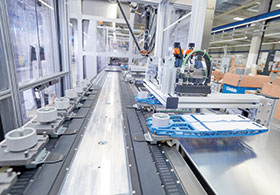
Flexibility, efficiency and sustainable use of resources are the core points that designers and users of packaging machines are currently focusing on in light of Industrie 4.0 and changing customer needs. Beckhoff experts Andrew Plater, global market manager food, beverage and tobacco, and Frank Würthner, business management packaging, explain in this interview how PC and EtherCAT-based control technology and the eXtended Transport System (XTS) can contribute to achieving these goals.
What are the current industry trends and end user requirements in the packaging environment?
Frank Würthner: In the past, large quantities or units of items like coffee or chocolate bars were produced and packaged uniformly. Today, the trend clearly goes towards smaller lots up to individually personalised products. Examples include individual combinations of items such as coffee capsules, or the ability to personalise standard products with your own name or picture. Packaging machine makers must be able to respond to these market requirements. We refer to this as ‘lot size 1’ production. Based on this trend, more and more big players in the B2C field, such as Amazon, will become direct customers of the machine engineering industry in the future.
Andrew Plater: Product diversity has increased significantly for each vendor in recent years. This inevitably leads to the aforementioned smaller lot sizes and shorter production runs. As a result, the time needed to change product setups on the machine is becoming an increasingly critical productivity factor, which means that packaging machines must be even more flexible and modular so that they can be configured more easily. Pure output speed is becoming less of a machine requirement. In addition, new products must carry minimal production risk and have the shortest possible time-to-market, both of which can be realised with the help of simulations and virtual reality.
What new requirements do you see with regard to packaging?
Andrew Plater: As a rule, most consumers reach for products they are familiar with, for example in the supermarket. That is why you have to create attention for a new product. Accordingly, the packaging industry has been quite innovative, supported by the aforementioned trend to personalisation. We already see huge numbers of special sizes, promotional packages for campaigns, etc.
Frank Würthner: Another aspect is particularly important for the pharmaceutical industry. While look and feel are critical for food and beverages, as well as for other consumer products, the pharmaceutical industry must comply with regulations like FDA 21 CFR Part 11. According to this rule, a medical product, like a new artificial knee, must be totally clean and sterile when it arrives at the hospital, and product traceability enables end customers to minimise liability risks.
Do demographic factors like smaller households and the rising average age play a role as well?
Frank Würthner: Rising population numbers and – at least in Europe – the rising average age of consumers lead to increasing demand and changing requirements for modern food packaging. For instance, vendors must employ better printing processes, more see-through windows and more ergonomic package design to compensate for older people’s deteriorating vision and physical strength. One such example are easier-to-use resealing systems even senior citizens with less strength and agility in their fingers don’t have trouble handling.
Andrew Plater: The pharmaceutical industry provides a good example of this. According to a study, roughly 40% of older people take approximately 100 pills per month from up to seven different products. If you cannot see so well anymore, you have trouble reading and opening the packages, especially if you have to take many different medications. This is where packaging can help that combines the various medications and tells people exactly when to take them. Accordingly, you need a packaging machine that is able to place the hundreds of pills into patient-specific blisters instead of having a single blister card for each medication.
Frank Würthner: The young population – whose share is growing in Asia, by the way – also poses special demands, because this is a market where modern and stylish packaging increases sales. We are also seeing a trend towards more direct-use packaging, i.e. portion packs, display packages, etc, as well as smaller portion sizes for single households and to-go packaging for takeaway. The demand for vacuum, multi-layer, multi-portion and multi-function packages is also rising. There are even new package types that combine the packaging with electronic components, for example.
Andrew Plater: Different regional requirements are another factor that increases the need for flexible packaging machines, particularly for product manufacturers that sell worldwide. They spend a lot on R&D to be able to meet local requirements for different regions. For example, while many European products are popular in Asia, they must still be adapted to match local tastes with specific flavours. Portion sizes also make a big difference in many cases. While small 25-gram bags of crisps are popular in Great Britain, Americans prefer larger bag sizes; but then, smaller package sizes are becoming more popular in the US too, as are multi-packs that contain a variety of flavours and special promotion packs, such as printing a sporting event result. All of this requires highly flexible packaging technology.
What are the special advantages of PC-based control from Beckhoff for packaging machine manufacturers and users?
Andrew Plater: Traditional PLC technology increasingly runs into performance problems where modern and highly flexible packaging machines are concerned. PC-based control, on the other hand, has sufficient performance reserves to run such installations efficiently and enable very rapid product changeovers. As a consistent platform, it also provides easy links to visualisation systems and higher-level scada, MES and ERP systems. PC-based control also makes it easy to implement the current trend towards more demand-oriented production backed by solutions based on IoT, Industrie 4.0 and smartphones, which may be used to directly adjust the production process on the basis of social media surveys regarding flavours, etc. This would simplify the flexible adaptation to the actual market demand and would help avoid costly overproduction, especially of products that have a short shelf life. As a result, valuable resources could be saved and production efficiency increased.
Frank Würthner: That is why PC-based control has already become firmly established in the packaging machine field, and Beckhoff offers all the necessary functionalities in its TwinCAT automation software. Another advantage arises in connection with Industrie 4.0 concepts, because they can be implemented much more easily with PC-based machine control than with standard PLC technology.
Andrew Plater: And let’s not forget about the inherent advantages of IPC technology. Due to the high processing power of industrial PCs, all machine functions down to high-performance motion control can be implemented with a single device. In conventional machines, the separate systems for PLC, motion control, safety control, robotics control and HMI take up much more space and require much more maintenance, which means everything costs more. Additionally, with the advantages of PC Control, we have managed to reduce the use of packaging material by up to 40%.
What support does Beckhoff provide on the road to optimised packaging applications?
Andrew Plater: Traditionally, the component supplier talks to the OEM, and the OEM talks to the end-user. We, on the other hand, aim to bring all parties together, because we believe that this is a much better way to deliver critical business benefits like improved product quality, more flexible production, and faster delivery. It is a highly partnership-oriented approach that allows the end-user to specify his requirements in detail and the OEM to build something that matches them perfectly.
Frank Würthner: This approach has proved to be very successful for all parties involved in recent years, for instance, we have been able to come up with some exceptional solutions, like packaging lines with a significantly reduced footprint and maximised availability for 24/7 operation.
What makes the packaging solution from Beckhoff special?
Andrew Plater: We offer machine manufacturers a complete solution ranging from an exceptionally broad spectrum of I/O components to HMI systems with high-level control software to high-end motion control and drive technologies. In addition, our systems are open, which means that PC-based control is well-suited for heterogeneous automation environments. One highlight of our solution is the linear XTS transport system, which offers machine manufacturers exceptional innovation potential, enabling them to implement totally new machine designs.
Frank Würthner: Implementing motion and handling tasks with XTS reduces the mechanical requirements significantly. You can also build machines with significantly reduced space and cabling requirements. And in addition the systems are more flexible with faster workflows and fewer maintenance requirements. The small footprint in particular is important, because many large end-users are older companies with plants that are located in urban areas with limited room for expansion. XTS is a critical factor in such environments, because it does so much more than replace an existing conveyor belt – it makes a totally new machine design possible.
For more information contact Kenneth McPherson, Beckhoff Automation, +27 (0)11 795 2898, [email protected], www.beckhoff.co.za
| Tel: | +27 11 795 2898 |
| Email: | [email protected] |
| www: | www.beckhoff.com |
| Articles: | More information and articles about Beckhoff Automation |






© Technews Publishing (Pty) Ltd | All Rights Reserved
 printer friendly version