



Every production and maintenance engineer knows that downtime must be defeated but a solution has always proved elusive.
Is the answer to tackle the problem quicker when it happens or to prevent it happening in the first place – or perhaps a combination of both?
The traditional way
The traditional solution to minimising downtime has been to maintain sufficient levels of stock of replacement components and then get them in situ as soon as possible when production starts to be affected. The obvious problems with this approach are the high cost of holding the stock, the fact that the production team is always reactive rather than proactive, and the fact that there is no way that disruption can be predicted or planned for. The situation is made worse if there are hundreds or thousands of individual parts that need to be maintained. It is a huge challenge to keep detailed records or maintenance logs and most asset management systems don’t have the ability to flag up which individual components are likely to wear out or fail unexpectedly.
It can be an incredibly frustrating and time-consuming experience identifying and replacing faulty hose assemblies, for example, especially when the only source of information is an out of date or hard to find manual. Worse still if complex hose routings are involved when the only option is to remove the whole item and take it to a distributor for a replacement.
But what if there was an easier way? What if production engineers could plan in when a component was likely to fail or need to be replaced? Then they could take quick and effective corrective action, halting production for the shortest time possible while the faulty part was removed and a new part fitted. The obvious question would be how is it possible to know which part is likely to fail and when – and the simple answer lies in asset tagging and tracking.
Advances in tagging and data collection technology
The technology around asset tagging and tracking has been around for some time but it has advanced significantly in recent years. The main change is that whereas only complete pieces of equipment were tagged in the past, now individual standard and custom parts within a piece of equipment or a machine can be tagged. This makes a huge difference.
Another ‘game changer’ is the ability to tag and track a component using a relatively low-cost hand-held device such as a tablet or smartphone, on to which an asset tracking platform has been downloaded in the form of an app.
But how does tagging work? Essentially, a label attached to a component at the time it is made contains a 128-bit barcode and all the relevant information needed on that particular part. This information could include the product’s history and replacement information, customised instructions for maintenance, repair and operations (MRO), and a full bill of materials – hose, fittings, accessories, length, cleaning specifications, how it should be installed, lot number, custom instructions and more. Other key data that could be held on the label – which is able to cope with extreme temperatures, UV, salt spray, non-conductive conditions and submersion in salt water and other fluids – includes customer contact information, assembly date, fluid and environmental data, system information and so on.
Armed with this amount of accurate information on an individual item, it becomes possible for the user to record, manage and retrieve all critical data on an asset. In turn, this facility enables replacement to be speeded up considerably, regardless of where or when the original component was created. Because there is no need to wait for removal of the old component before acquiring the new one, transaction time can be cut and the end-user can make massive productivity gains through a much higher level of uptime than was previously possible.
Of course, data collection is nothing new and bar codes have been around for many years but what is making a real difference today is how the data is collected and how it is shared. By making asset management easier, faster and more accurate, operational efficiency can be improved significantly, as we’ll see later.
We’ve already highlighted the shift towards mobile data collection using low-cost devices but the other half of the equation is the simplicity with which data can now be sent to stockists immedi-ately and replacement components sourced so much faster. And because the information on a component is held on that component, there is no longer any danger of errors being made when parts are ordered. What’s more, seamless data integration means that all critical data can be transferred bi-directionally (both to and from the source) which means asset visibility and performance are kept a premium. There is also a growing trend towards better record-keeping as regulations tighten up and it is important that users are aware of inspection and/or replacement dates so that they can be pro-active in all maintenance planning.
Most important of all, however, is having that ability to take action before a failure occurs. Because component labels confirm the date of manufacture and contain vital information relating to warranty, inspection or maintenance, this data can be used to set alerts and drive product-specific replacement instructions. Essentially, instead of the user having to interrogate the database looking for expired components, the ones that need to be replaced will automatically alert the maintenance engineer. And with the use of web-driven technology, this makes MRO planning so much easier.
Parker’s web-based solution
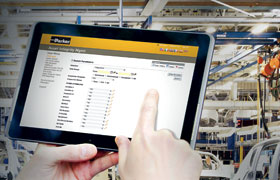
The Parker Tracking System (PTS) from Parker Hannifin uses the latest web-based application architecture which not only tracks and measures replacement history (storing and retrieving all inspection results) but also connects with distributors and channel partners around the world to ensure components are available when they are needed – and even before.
The beauty of such a system is that it can be accessed securely through any computer with an Internet connection and can be used on a variety of mobile devices on-site. It can also be paired with other applications to provide a truly integrated asset management solution, linking up with an audit and scheduled replacement program, for example, to prevent failure before it happens.
Exclusive to the ParkerStore network, the PTS mobile app means users have access to a faster, easier and more accurate replacement experience. The user simply scans the barcode on a PTS tag and locates the part’s record in Parker’s global database. The replacement part can then be ordered via an e-mail that is generated automatically by the app, with precise details sent to a local distributor for quoting and processing. This means that an identical replacement part can be sourced before the customer arrives at the distributor or the finished assembly can be delivered directly to the customer’s site.
For easy pick-up, the app even shows a map with directions to the nearest distributor using the user’s smartphone GPS. If the product in question is not tagged or it is hard to identify, the user can simply photograph the part and send the photo to a distributor to help identify the item. Finally, all details of the asset can be exported to Excel reports for easy reporting and management.
However, the real benefit of such an app is that all of the above can happen in a virtual environment without the need for lengthy and inconvenient downtime. In other words, the huge advantage of being able to plan maintenance proactively in this way is that machinery on the shopfloor can continue to be in operation while the engineer is waiting for the new part to arrive. This means that the only downtime incurred will be when the replacement work is being carried out, which is a significant improvement on what traditionally happens on shop floors around the country.
In today’s competitive world, uptime is everything and so it makes sense to embrace internet-based technology and mobile apps to banish lengthy downtime to the history books.
For more information contact Lisa de Beer, Parker Hannifin SA, +27 (0)11 961 0700, [email protected], www.parker.com/za
| Tel: | +27 11 961 0700 |
| Email: | [email protected] |
| www: | www.parker.com/za |
| Articles: | More information and articles about Parker Hannifin - Sales Company South Africa |






© Technews Publishing (Pty) Ltd | All Rights Reserved
 printer friendly version