



A new wave of thinking and standards is helping HMI designers to overcome the traditional ‘mimic replacement’ way of designing mimics. How can users design scada/HMI graphics, including navigation that assists operators to drive higher efficiencies and get better performance from their plants?
Situational Awareness
Situational Awareness (SA) is the perception of environmental elements with respect to time or space, the comprehension of their meaning, and the projection of their status after some variable has changed, such as time, or some other variable, such as a predetermined event. It is also a field of study concerned with perception of the environment critical to decision-makers in complex, dynamic areas from aviation, air traffic control, ship navigation, power plant operations, military command and control, and emergency services such as firefighting and policing; to more ordinary but nevertheless complex tasks such as driving an automobile or riding a bicycle.
SA involves being aware of what is happening in the vicinity, in order to understand how information, events, and one’s own actions will impact goals and objectives, both immediately and in the near future. One with an adept sense of situation awareness generally has a high degree of knowledge with respect to inputs and outputs of a system, i.e. an innate ‘feel’ for situations, people, and events that play out due to variables the subject can control. Lacking or inadequate situation awareness has been identified as one of the primary factors in accidents attributed to human error. Thus, situation awareness is especially important in work domains where the information flow can be quite high and poor decisions may lead to serious consequences (e.g., piloting an aeroplane, functioning as a soldier, or treating critically ill or injured patients).
Having complete, accurate and up-to-the-minute SA is essential where technological and situational complexity on the human decision-maker are a concern. Situation awareness has been recognised as a critical, yet often elusive, foundation for successful decision-making across a broad range of complex and dynamic systems, including aviation, air traffic control, ship navigation, healthcare, emergency response and military command and control operations, and offshore oil and nuclear power plant management.
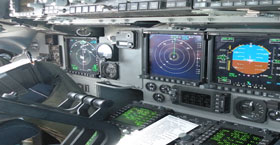
A good example of an SA environment
For cutting edge technology to be applied, consider a military and aviation application. For UI design there is no better example than the aviation industry – consider the cockpit design of even the simplest aeroplane.
Real-time data used all the time in normal visual flight includes speed, altitude, position, course, engine data, fuel levels, flying details (time in flight, time to next waypoint, destination) etc. Additional SA data to support decision making, especially in crises, includes weather radar, nearby airports, services available at nearby airports, proximity to rising terrain etc.
It is obvious that the right level of information pertinent to running and managing this environment efficiently and safely is required. So what is the current status quo in industrial scada/HMI design?
Looking at the history of PC-based control systems one sees that we came from mimic panel replacement and to some extent have been stuck there for over 20 years. In fact some people think we have actually gone backwards given that operators 20 years ago had to walk around the large mimic panels and look at paper trends dials and other indicators in order to best run a process. They certainly didn’t have to stare at red and green views of motors, valves and pretty complex graphics as we do today.
They had a mile-high view of the process. One of the challenges of this was, of course, that the experience of any process was largely held by the ‘grey beards’ who had spent years doing this. In turn this posed a challenge to sharing the knowledge for obvious reasons. They got to ‘know’ what was about to happen, by glancing at various indicators, even being able to predict with great accuracy what was going to happen if they didn’t take some action.
We as human beings are very good at ‘pattern recognition’ and have to some extent dumbed up our operators through ‘process’ driven solutions, where we have over the years through the use of repeatable automation solutions using PLCs and digital control taken away the ability to ‘tweak’ any system. This has allowed us to create repeatable, high quality manufacturing business that are not necessarily optimised.
Management by walking around
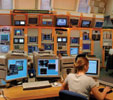
Walk into most control rooms today and the operators are largely desk bound and navigating with a mouse and staring at very nice looking, but fairly complex graphics. In fact, some people believe that one should show the status of the physical machines. Any operator worth his salt knows the mechanical design and flow of his plant and this is backed up by PLC-driven alarm systems that are designed to annunciate when there is a problem. So technically, one does need process and instrumentation diagram type mimics. This has driven a lot of the new thinking around HMI design.
Designing for high performance?
Given the above, the new wave of thinking is about giving operators a big picture view that is then supported by more detail as needed. In addition the following overriding philosophy needs to be included in the thinking: Design for the most important information to be able to:
• Distinguish between process conditions.
• Increase operator response times.
• Less is more – less data more information.
• Operator comfort.
• Pay attention to console design and screen organisation.
• Pay attention to colours.
Navigation
Navigation needs to be approached using the following method, supported by the ISA95 standards.
• Level 1 – Process area overview.
• Level 2 – Process unit control.
• Level 3 – Process unit detail.
• Level 4 – Process unit support and diagnostic displays.
Where the Level 1 and Level 2 mimics would be the target for high-performance focus, one should also use quick navigation features, like tree structures, right-click menus to be able to get anywhere within the system within three clicks of a mouse.
In summation
Adroit has built the objects necessary to support a new approach. Technical director Mike Lamusse explains, “We have built them as wizards, this allows customers to change them to their own specific requirements. In addition we have made some modifications to the analog agents to support time based statistics.”
Dave Wibberley, managing director of Adroit Technologies concludes: “As always we continually focus on delivering higher value to our users, at no extra cost. Combining the Situational Awareness developments with Alarm Management and the Adroit SCADA Intelligence offer customers an enterprise control and supervisory platform that compares with anything on the market. We are looking forward to customers using and giving us great feedback on the improvements this approach brings to their organisations.”
For more information contact Dave Wibberley, Adroit Technologies, +27 (0)11 658 8100, [email protected], www.adroit.co.za
| Tel: | +27 11 658 8100 |
| Email: | [email protected] |
| www: | www.adroitscada.com |
| Articles: | More information and articles about Adroit Technologies |






© Technews Publishing (Pty) Ltd | All Rights Reserved
 printer friendly version