



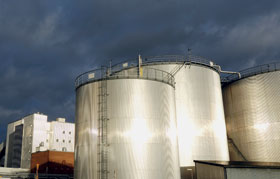
Flowmeter manufacturers are sometimes asked by tank operators why there is a difference in the cumulative measurements from the flowmeters, compared to the inventory measurements from the level gauges in the tank. This article is based on a study carried out for a customer using a Krohne custody transfer metering system, alongside a tank inventory system. It outlines some of the issues, gives a listing of where errors can occur and can accumulate.
Which system do I choose? Ultrasonic flow, turbine flow, or level gauge inventory?
When installed flowmeters are directly compared to shore tank volumes a significant amount of uncertainties has to be considered. Are we comparing a single batch going into the tank for inventory purposes, or a single batch exiting the tank for billing purposes?
In the latter case, multi-beam ultrasonic meters are the measurement of choice. They do not drift, they are repeatable, and offer a high custody transfer accuracy of 0,15%, which is virtually impossible with any tank inventory system currently installed.
Factors affecting the accuracy of a tank inventory system
The uncertainties most commonly faced when bulk liquids are being measured can be divided into three categories:
1. Spurious error.
2. Systematic error or bias.
3. Random error.
When an uncertainty has been defined, the source of the error has to be investigated and its significance or weighting determined.
Sources of error:
1. The first obvious source of error is the product to be measured. Many influences can be taken into consideration for determining the actual volume of liquid. Generally the higher the viscosity the higher the uncertainty in the measurement.
2. The second common source of error is the uncertainty of the individual instruments required for the measurement.
3. The third potential source of error is the influence of the instrument operator.
4. The fourth source of error is caused by environmental influences on the instruments.
There are basically four important parameters to be considered in shore tank measurement:
1. Accuracy/uncertainty of the applied strapping tables.
2. Accuracy/uncertainty of the applied level measurement procedure.
3. Accuracy/uncertainty of the applied temperature measurement.
4. Accuracy/uncertainty of the applied API tables.

Accuracy of the applied strapping tables
The following aspects of the tank have to be accurately measured:
• The exact dimensions of the tank shell.
• The contours of the tank floor.
• The size and location of ‘dead wood’, ie, struts, agitators, and others intruding parts.
• The weight (volume) of the floating roof.
Accuracy of the applied level measurement procedure
To compensate for any human errors, it is preferable to use automatic level gauges. Mechanical gauges have to be calibrated prior to installation and have to be checked periodically using a certified measurement tape. The influence of the uncertainty of level measurement in shore tank operations has frequently been overestimated; it is common practice to measure a single batch and try to compensate for the delay in start/stop of the level gauge. An accuracy of level measurement of ±2 mm is in most applications the best achievable figure. It is obvious that the influence of the uncertainty of the level gauge depends on the transferred volume, on a batch of 1 metre the influence will reach 0,4 % while for an 8 metres batch it can drop to 0,05 %.
Accuracy of the applied temperature measurement
The influence of temperature on shore tank measurement is frequently underestimated. It cannot be too strongly emphasised that errors in temperature measurement can account for the most significant part of the total error in shore tank measurement. Errors of 2°C in calculating the average shore tank liquid temperature can easily be introduced, resulting in measurement errors of approximate 0,2%. Even if highly accurate temperature measurement devices are applied this deviation can be experienced; and it should be remembered that determining an average temperature of a completely filled shore tank based on a single spot temperature measurement is a common, but difficult operation.
The preferred approach for determining the liquid temperature is to apply multi-spot temperature measurements at different heights in the tank instead of using a single spot temperature at the output of the shore tank.
API table uncertainty
For calculating the GOV (gross observed volume) to GSV (gross standard volume) a VCF (volume correction factor) has to be applied. In general, this VCF is extracted from the dedicated API tables. In practice it is acknowledged that the uncertainty in these API tables is 0,05%, assuming that the correct density is utilised.
Combined uncertainty
When all uncertainties are combined, a consolidated measurement uncertainty can be calculated as presented and based on the calculation, it can be concluded that the impact of the level and VCF uncertainty are not significant components.
General considerations:
• When was the tank calibrated, to what standard and to what accuracy?
• How and where is the temperature measurement being made in the shore tanks?
• Are the temperature instruments calibrated to custody-transfer requirements?
• How is the level measured and to what standard and accuracy?
• Is water interface and sludge an issue?
• What are the dimensions of the tank?
• Calculation routines (strapping tables) for tank?
• Crude oil properties?
• Process conditions?
• Minimum transferred volume?
• Pipeline layout from shore tank terminal to the meter skid?
• Definition of criteria for verification (repeatability)?
• Handling/reporting of verification results?
This article has purposely not dealt with the differences in the level gauging systems, and it is acknowledged that the choice of level gauge (radar, TDR, ultrasonic level, capacitance, float, yo-yo or even level switches) can play a role in the amount of trust the operator can put in his inventory management system.
For more information contact John Alexander, Krohne SA, +27 (0)11 314 1391, [email protected], www.krohne.com
| Tel: | +27 11 314 1391 |
| Email: | [email protected] |
| www: | www.za.krohne.com |
| Articles: | More information and articles about KROHNE |






© Technews Publishing (Pty) Ltd | All Rights Reserved
 printer friendly version