



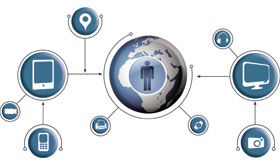
Smart devices connected through the IoT
In his leadoff presentation at ARC Advisory Group’s recent Industry Forum in Orlando, Andy Chatha, ARC’s president, dove right into the ‘connected devices’ theme by referring to Amazon’s recent, well-publicised announcement that the company is looking into using drones to deliver packages right to its customers’ doorsteps. “What is the role of all these connected, intelligent devices in all this, and what does it mean to us in industry and infrastructure?” Chatha asked the audience hypothetically.
He then elaborated a bit on the main components of the Industrial Internet of Things (IoT) as ARC sees it. These include intelligent devices, products, machines and other assets; a cloud-based infrastructure for data communications and big data storage capable of addressing a complex value chain; a combination of descriptive, predictive, and prescriptive analytics and software to support asset and system optimisation; and, of course, people, processes and systems. According to Chatha, our consumer smartphones represent the ultimate connected devices and that now we have to bring this type of technology to the industrial world. He also made it clear that most of the building blocks for the industrial IoT are already in place.
As one potential enabling technology for industrial applications, Chatha discussed the introduction of the Intel Edison IoT Device Development Platform at the recent Consumer Electronics Show (CES). The Intel Edison development board is a tiny, SD card-size and ultra-power-efficient development platform. It can be designed to work with almost any device and will even have its own app store. This development platform should make it easy and inexpensive to make any product smart and connect it to the Internet.
Significant challenges to overcome
Chatha highlighted that there are significant challenges to overcome before the IoT will become widely employed on the plant or factory floor or in other industrial applications.
Cyber security is the biggest of these challenges, since the Industrial IoT is so dependent on both the public Internet and private intranets. Lack of technology standardisation is another hurdle that must be overcome, as is intellectual property ownership. Social and political concerns abound, including privacy issues, such as those related to connected cars that know where the owners are at any time. And complexity-related issues will increase exponentially as the number of devices connected to a system increase over time.
“It is going to take a long time to figure the right level of use for this technology,” Chatha said. “I think that we have found the challenge of the century and the puzzle will be how to connect everything together without destroying the planet! It will be interesting to watch how we take the first steps over the next few years.”
He then addressed the IoT value propositions for industrial asset owner-operators and technology asset suppliers, stressing that since most industrial companies are both asset owners and either asset or product suppliers, they stand to benefit both ways.
Asset owner value proposition
For asset owners, the IoT value proposition falls under three general categories: improved asset performance, reduced asset lifecycle costs and by providing a platform for innovation.
Improved performance
Smart devices connected through the IoT can help improve plant performance by reducing downtime by helping predict, diagnose, analyse and rapidly remediate failures before they can interrupt production or compromise product quality.
Organisations can both share relevant information internally and use it to collaborate with suppliers to help solve problems.
The industrial IoT will also enable technology suppliers to collaborate more effectively with technology users to develop better solutions, and help product suppliers collaborate with customers to improve products and do a better job of meeting the customers’ needs. Ultimately, users will pay for actual value received, rather than just paying for products.
Lower asset lifecycle costs
Since connected devices can support remote configuration, remote monitoring, remote fixes and remote updates; asset owners can use the technology to reduce their engineering, maintenance, and repair costs over the entire lifecycle of an asset. And, as several presenters mentioned over the course of the Forum, unlike typical IT assets, industrial assets typically remain in service for 10, 20 or 30 years, or more, so these savings can really add up.
Platform for innovation
Through data collection, increased interactivity and collaboration, connected products can provide a platform for product innovation. According to Chatha, “Just as many companies run business software in the cloud and pay for the software on a monthly subscription basis, you can do the same with products; pay for the value derived from the product, not the product itself. Many companies already run IT applications in the cloud, why not for software at the plant level as well, at least for larger assets?”
Asset supplier value proposition
Chatha also believes that there’s a parallel value proposition for asset suppliers that can help them justify ‘jumping on the bandwagon’. For asset and technology suppliers, this involves improved productivity, improved service business profitability, and (as for asset owners) a platform for innovation.
Connected devices can improve field service workforce productivity by enabling service personnel to diagnose and fix customer problems remotely, without having to travel to the customer’s site. They can help improve the profitability of a supplier’s service business by helping customer solve business problems, lowering warranty costs and improving overall customer satisfaction. And the IoT can provide a platform for innovation by enabling suppliers to move from supplying products, to supplying products-as-a-service. Here, there’s ample opportunity to work with customers to achieve incremental product innovations.
The connected plant
To start discussion of the connected plant, Chatha presented several assumptions:
* Most industrial asset owners/technology users have already installed and use both control systems and plant management applications.
* Most business applications are already in private clouds and some as-set owners/technology users already take advantage of advanced analytics to analyse the data.
* It is likely that as asset owners will move more of their data to the cloud, they will share appropriate data with their asset and service suppliers, and in this manner, can help asset owners improve the reliability of their plant or other industrial assets.
Based on the above assumptions, Chatha proposed an interesting option: Connecting big assets directly to private clouds using a secure plant network. What’s the benefit? First, it can save asset owners a lot of money, since connecting a device to the control system is usually very expensive. By buying a field device with a dual interface (WirelessHART and Wi-Fi), asset owners could make use of either or both interfaces to inexpensively connect to the cloud and add many more sensors to the big assets, enabling them to predict failures before they happen to improve plant reliability.
Chatha believes that with this approach, there is no need to change systems; asset owners can just add incremental sensing points and smart devices using the dual interface approach for applications such as asset monitoring.
“This is not for every plant, but for some it can make sense by helping eliminate downtime, particularly for remote industrial assets such as oil and gas production fields and mines.” Chatha added, “Clearly, the connected asset value chain becomes much more complex, but failures in plants can be big things, particularly if you don’t have a good grasp on what happened.
“Let me leave you with this thought. We in the industry have an opportunity to lead this revolution since we’re already using many connected devices.”
For more information contact Paul Miller, ARC Advisory Group, +1 781 471 1126, [email protected], www.arcweb.com






© Technews Publishing (Pty) Ltd | All Rights Reserved
 printer friendly version