




The increasing use of Ethernet and TCP/IP for industrial networks is an established industry trend. Anyone familiar with industrial automation systems is well aware why: TCP/IP networks provide a much greater flexibility of deployment than serial systems, allowing network engineers to take advantage of the Internet to integrate traditional serial devices with the full spectrum of communications and information technology. That means that I/O nodes, control and communications cabinets, actuators, and scada systems may be empowered with more intelligent and more expansive capabilities across greater distances than ever before. The speed, size and diversification of Ethernet means that control, communications, voice, and video data may all share a single, unified, highly redundant network that links IA systems across cities, nations, or even oceans.
IT keeps creeping in on IA networks
One of the great conveniences that Ethernet allows is the Simple Network Messaging Protocol (SNMP), one of the core protocols of the TCP/IP stack. Besides its ability to serve as an excellent substitute for Fieldbus technology, much of SNMP’s value for industrial automation lies in its history as one of the most solid and long-standing free software projects. This makes it an ideal tool for organisations that require unassailable reliability and security but are still interested in cutting-edge innovation.
SNMP is the standard tool used by IT administrators to monitor, manage and adjust network devices. As a consequence, it has evolved into an easily extensible and freely modifiable resource. Today, this universality and free adaptability are being exploited to turn SNMP into a programming resource that will bring the ease and comfort of cross-platform monitoring and control to a new generation of networked computing devices.
Typically, the protocol requires two complementary pieces of software to be effective: SNMP agents are server software and run on the device to be monitored; while the clients these agents report to are called ‘Network Management Software’, or NMS. NMS systems run on a control computer, providing a graphical network map and user interface. Following from recent innovations in IA networking, it is also now possible to integrate SNMP into existing OPC servers, making it an extremely useful addition to any existing scada system. Whether it is through an NMS or an OPC server, the central management system may poll SNMP agents for information, but can also receive agent-initiated messages called traps, which serve as alarms.
With properly adapted hardware, the SNMP framework is the perfect tool for IT people who need to implement monitoring and control over RTUs, I/O nodes and other automation devices, while at the same time serving as the most effective means for traditional scada systems to integrate monitoring and control of their IT networks. This makes a complete SNMP software suite a perfect IT substitute for any application where Modbus has traditionally been used.
Using SNMP to control that computer
Originally developed to monitor remote hardware like routers, switches, firewalls and bridges, today SNMP can be found on nearly any networked device, whether server, printer or monitor. Additionally, its open source code allows it to be continually adapted for new uses, so that advancements are steady and rapid. Despite all this though, one of the places SNMP controls are conspicuously absent is on industrial computers.
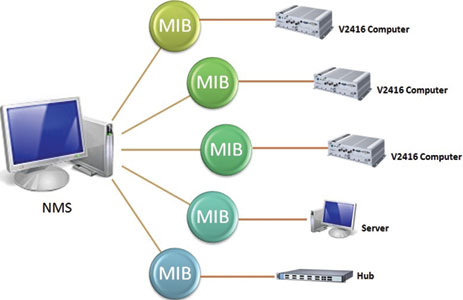
There are almost no providers of industrial computing platforms who currently furnish their computers with MIBs (management information bases) and considering the benefits that SNMP can bring, there is no clear reason why this is so. It is certainly not technological inadequacy. Nor is it a lack of need: PC controllers and data processors are, after all, integral parts of a network, and like any networked device (whether remote or local), they do need to be controlled.
Truthfully, these wasted opportunities are passed over for nothing more basic than the intersection of habit and utility: industrial PC providers don’t concern themselves with extending SNMP conveniences because they don’t need to. Reducing their customers’ time-to-market for software engineering is just not part of the bottom line, so it has never become an imperative. Yet there is no better example of the great innovation SNMP can deliver than the new uses it can be put to on industrial PCs. Properly implemented, SNMP extends monitoring and control capabilities to computers in an easy, straightforward way and in the process makes it possible to do things on and for computers that most system administrators have only dreamed of.
The convenience and comfort of a trusty old tool
Besides some basic coding skills, the only thing needed to make SNMP into a powerful tool for industrial automation is an awareness of what administrators want. Properly informed, virtually any conceivable control function may be implemented. For instance, imagine a computer that can be remotely commanded to upgrade its BIOS, or change its boot order on-the-fly, without a restart. This would make it possible for network management platforms to monitor remote systems and automatically perform network drudgery like OS recovery and firmware updates. The technology is easy, and already available; the only thing needed is the determination to build these features into the BIOS. Linking them to SNMP controls is really a trivial matter.
Yet SNMP also offers a tantalising simplification for system developers that, on first glance, is easy to miss: the convenience of a high level, shell-accessible control language that remains standardised across all systems. Automated controls for monitoring serial and USB interface activity, reporting CPU temperatures, or reconfiguring UART interfaces already exist. The problem is that implementing them is typically a platform-dependent process where a system integrator or end user must get elbow-deep in hexadecimal addressing, proprietary APIs that change from system to system (or device to device), and authoring and compiling low level code to make everything work together. SNMP is a perfect fit for the missing solution: a standardised, platform-independent, high level control system that gives full access to low level, platform-dependent hardware.
Model-view-controller architecture for rapid feature development
The magic key to unlocking that door is the model-view-controller (MVC) design architecture. By using an MVC design pattern, the user interacts solely with a single SNMP interface built around a single MIB, one that remains consistent across every device in this family. This is the ‘view level’, beneath which subsists a database of system parameters such as IP addresses, hardware addresses, sensor readings, and so forth. This constitutes the ‘model level’, a software layer pre-configured by the system developers that references all of the system’s operating parameters, linking each with an executable agent that may be called by the user. Instead of directly accessing the device addresses, the SNMP agent calls and writes to these database objects; meanwhile, the database in turn references its own agent, which executes scripts and other control software whenever a database object is altered. Those utilities and scripts – the ones called by the database – form the final layer, the ‘controller level’.
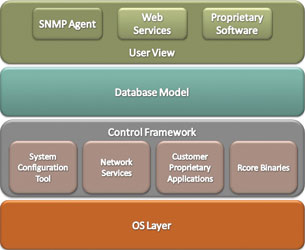
With an MVC design model, rather than directly calling system utilities and processes through the kernel, users instead access system information and controls at the highest layer, the view level. This allows data representations to remain consistent and easily accessible via a database of information referenced to OIDs. System processes remain unseen, running in the background, in the control layer. Through this architecture it remains possible to call system commands and programs in the normal manner, but as more and more utilities are added to the control layer it becomes possible to write scripts for alarms that monitor and react to system events (for instance, hard disk S.M.A.R.T. reports, or internal CPU temperature readings) without ever referencing hardware addresses, or touching a single line of C. Quite simply: the only limits to ever-increasingly automated controls are the imagination of the engineers and the determination of users and system integrators to develop them.
And more is on the way
In order to cut our customers’ time to market, Moxa is implementing precisely this SNMP architecture in its full line of products, beginning with the V2416 Series of embedded computers. Thanks to a wholly new and unique combination of SNMP with a MVC design model, not only can IT engineers call on SNMP to stand in for Fieldbus protocols, but system integrators and end-users alike may now use it to change boot order in the BIOS without ever turning off the machine, or to upgrade the computer’s BIOS automatically. Using SNMP, the V2416 can be configured to monitor its I/O interfaces for connectivity as well as activity, and further features will soon be available: S.M.A.R.T and CPU temperature monitoring, for instance, as well as quick scripting access to Rcore utilities, such as Smart Recovery.
With its robust feature set, proven reliability and rapid growth within the industrial automation, SNMP is one of the most valuable IT tools around. Now, Moxa has given this proven protocol a new and unprecedented role in automated processes, to create a powerful tool of convenience, extensibility and utility. With Moxa’s revolutionary software framework and rapidly growing proprietary MIB, users will be able to use SNMP to create custom controls for every feature on the network, whether that means monitoring data, controlling edge devices with custom scripts, automatically calling computer utilities (such as Rcore binaries), or using SNMP in a more traditional way, to monitor and manage routers, switches, and controllers. With Moxa’s SNMP innovation, every application can be adapted to whatever end is demanded, whether that is processing, monitoring, or control. This allows users to deploy needed applications and improvements more rapidly and conveniently than could ever be imagined before.
| Tel: | +27 11 781 0777 |
| Email: | [email protected] |
| www: | www.rjconnect.co.za |
| Articles: | More information and articles about RJ Connect |






© Technews Publishing (Pty) Ltd | All Rights Reserved
 printer friendly version