



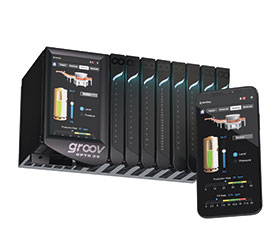
All controls engineers are familiar with PLCs and PACs (programmable automation controllers). Both have been used and improved over many years, incorporating capabilities that used to be found only in scada systems, adding communications with Microsoft Windows-based HMIs, running on standard Ethernet networks, and so on.
But now we need more from our automation systems. For the kinds of applications we want to do in the future, we need a new approach that simplifies connections and communication – a new product that does much more than a PLC or even a PAC. We need an automation product that shrinks or eliminates the middleware and lets us move data from where it is produced to where it needs to be, in far fewer steps. Fortunately that product has recently appeared on the market. It is called EPIC – an edge programmable industrial controller. An EPIC device eliminates middleware and shrinks the steps required to get the data we need, thus reducing complexity, lessening security risks, and decreasing the time and expense required for installation and maintenance.
So what exactly is EPIC?
Let’s take a look at each part of the acronym and see what it means for an automation application.
Edge
All data acquisition starts at the edge because that is where data is produced. A manufacturing line or shipping department in a factory, refrigerated rooms or barcoded containers in a warehouse, pumps and pipes and storage tanks at remote sites: all are at the edge of the network, and all have data that could be used to improve processes and profits.
If we can get that data directly from the source, then we know it is accurate. So an EPIC device sits at the edge and connects directly to sensors and actuators through its I/O, the inputs and outputs that gather sensor data and send control commands. It also connects to existing PLCs or other devices to gather their data and issue commands, if needed.
Programmable
An EPIC device is not a PLC, not a PAC, and not a PC, but like them it must be programmed for control. An EPIC device gives you several programming options, some of which reflect traditional automation tools and others that come from PC and Internet backgrounds.
An EPIC device does not limit your programming options like PLCs and PACs, or force you to learn a new programming language in order to use it. Instead, it lets you leverage what you already know, so you can build control, data exchange, and HMI programs more quickly.
Industrial
As engineers, we often have to place controllers in severe environmental locations. One problem with PCs in industrial automation is that an off-the-shelf PC cannot be trusted to stand up to harsh environments. Only a more expensive industrial PC will work.
In contrast, EPIC devices grew from real-world automation experience and were designed to withstand tough conditions. Industrial-grade components and processors are designed for long life. UL hazardous locations approval and ATEX compliance are standard. Operating temperature ranges are wide, for example, -20 to 70°C, while EPIC I/O is hot swappable.
Stainless-steel chassis come in different sizes to fit enclosures or machine designs and can be DIN-rail or panel mounted.
Controller
At heart, an EPIC device is a real-time industrial controller designed to run control applications – a device that does everything we have always expected from a PLC or PAC.
Programmed with standard automation tools like flowcharting, structured text, and even traditional ladder logic, an EPIC works just like a PLC or PAC in a control system – but an EPIC device is much more than just a controller. Its I/O modules offer multiple channels. Modules with isolated channels are also available. Analog and discrete I/O accepts a variety of signals, through channels that are software configurable.
Taken as a whole, an EPIC system offers significant options for automation and IIoT projects, which include security, gateway functions, HMI, data communications, control and scalability. EPIC devices offer a new kind of industrial controller – an edge programmable industrial controller – that not only gives automation engineers real-time control for all kinds of traditional automation applications, but also positions them to be able to provide the IIoT and data-based tasks companies want to do now.
Interested readers can download a complete Opto 22 White Paper, which includes a more detailed description as well as a real-world case study at https://instrumentation.co.za/papers/J4922.pdf.






© Technews Publishing (Pty) Ltd | All Rights Reserved
 printer friendly version