Fast payback on steam turbine cogeneration systems makes this power source an attractive option across numerous industries. This is according to Leandro Magro, manager steam turbines at Zest WEG Group, who explains that any industry with a boiler installed has a potential for cogeneration using a steam turbine. “The electricity cost savings usually pay back the investment in less than three years, but this payback period can be further reduced depending on the applicable electricity price tariff in effect,” he adds.
Power plants, sugar mills, pulp and paper mills, steel mills, oil and gas installations, food and beverage manufacturing operations and many other industries, including commercial and institutional facilities use steam turbines for electricity production or to drive mechanical equipment such as compressors, fans, mills and blowers.
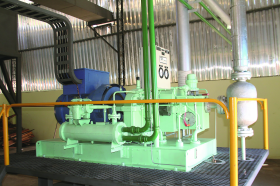
When used for the production of electricity, the steam turbine is coupled to a generator set. Magro says that typically, industrial steam turbine models start from a 30 kW capacity and go up to 150 MW. “These turbines can operate at a very low steam pressure (5 bar or less), or at high pressure up to 140 bar, using saturated or superheated steam at temperatures up to 540°C,” he says.
“The operational availability of an industrial steam turbine should be about 98%, however a proper maintenance programme is essential not only for prolonging the life of the equipment, but also to ensure the correct operation of the turbine,” says Magro.
The best way to achieve this is to enter into a service contract with the OEM who will recommend an appropriate maintenance and service programme. A new steam turbo-generator set could be installed in the plant to operate in parallel with the pressure reducing valve, so when maintenance is required on either, the processes that require steam would not need to be stopped.
“Steam turbine cogeneration is not only suitable for large installations, but can play a vital role in medium and small applications, saving the end-user a significant amount in energy costs over the expected life span of the system which, depending on the design, can vary from 20 to 30 years,” Magro concludes.
Engineering resilience into Africa’s energy future
Electrical Power & Protection
Zutari’s managing director of water explains how Burundi’s landmark Jiji and Mulembwe hydropower projects demonstrate what resilient, climate-adapted infrastructure delivery looks like – and what this means for Africa’s energy future.
Read more...Voltage Tester with LED-Display Vepac Electronics
Electrical Power & Protection
The PeakTech 1094 is a reliable and robust two-pole voltage tester that has been specially developed for the safe and precise measurement of AC and DC voltages in the 12 to 400 V range.
Read more...Schneider Electric launches circuit breaker for cost-effective LV protection Schneider Electric South Africa
Electrical Power & Protection
Schneider Electric has launched its EasyPact CVS C4 moulded case circuit breaker in South Africa, extending the Easy series to 1 600 A and giving consultants, contractors, and end users a cost-effective solution for non-critical low-voltage applications.
Read more...Schneider Electric launches cost-effective, high-performance LV protection Schneider Electric South Africa
Electrical Power & Protection
Schneider Electric has launched its EasyPact NW air circuit breaker in South Africa, extending its Easy series portfolio with a cost-effective solution for non-critical low-voltage applications in commercial, industrial and residential projects.
Read more...SF6-free switchgear brings digital intelligence to mining Schneider Electric South Africa
Electrical Power & Protection
Combining pure-air switchgear with embedded digital intelligence helps mines cut greenhouse gas emissions, improve safety and meet sustainability targets while enabling real-time visibility into critical electrical assets.
Read more...Turning plastic waste into clean hydrogen
Electrical Power & Protection
Researchers have developed a solar-powered process that converts plastic waste into hydrogen and useful industrial chemicals while using spent acid from vehicle batteries. The approach could help create a circular system for dealing with several challenging waste streams at the same time.
Read more...SA port could generate wave energy
Electrical Power & Protection
A feasibility study has identified the potential for an 8,3 MW wave energy power station at the Port of Ngqura in the Eastern Cape, using the port’s existing breakwater infrastructure.
While every effort has been made to ensure the accuracy of the information contained herein, the publisher and its agents cannot be held responsible for any errors contained, or any loss incurred as a result. Articles published do not necessarily reflect the views of the publishers. The editor reserves the right to alter or cut copy. Articles submitted are deemed to have been cleared for publication. Advertisements and company contact details are published as provided by the advertiser. Technews Publishing (Pty) Ltd cannot be held responsible for the accuracy or veracity of supplied material.










 printer friendly version