



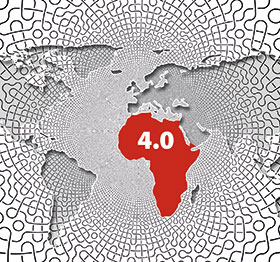
The Fourth Industrial Revolution (4IR) is here. This is evident in the way banks have started offering digital services and disrupting the modus operandi of traditional banks; it is evident in schools, where books are being replaced with tablets, and it will roll out in almost every sector in the country.
The distinguishing factor of 4IR is the scale and speed at which this revolution is taking place. The fear that arises from the advent of 4IR is that it will also disrupt the workforce, as in the case of Standard Bank, which is now planning to close 91 branches and retrench 1200 employees.
The latest figures from Statistics South Africa, released in April, show that the country is now sitting with about 6,2 million unemployed people, 60% in the youth category, and the disruption that 4IR could bring is a frightening concept. Dr Andrew de Vries, general manager of smart industries at The Innovation Hub, said: “Let us be encouraged by the fact that new types of jobs will emerge from this revolution and focus our efforts and resources on upskilling and reskilling our labour force. Let us continue to promote and support local innovation for the benefit of economic growth.”
However, we need to reframe the way we think about the industrial revolution and start asking how this revolution can answer the questions we have about economic growth, both as a country and as a continent. Industrialisation is about employment creation and economic growth, but what is possible in South Africa? What questions should we ask ourselves about the challenges and opportunities that this industrial revolution brings?
Further, we also need to be mindful of the people for whom we are trying to solve problems. People from a technical background often design technology to suit their immediate needs, with companies then dumping their technology on other economies. These innovators believe that because a technology works in the United States, China or Europe, for example, it will also work in South Africa. The idea is to just go and sell the product.
However, this does not meet local culture and local needs and often this technology fails. But keep in mind that in Kenya there are hardly any automatic teller machines. Everything is done through mobile phones and technology. Will this technology work in South Africa? Firstly, there would be zero cash in transit. Again this would disrupt employment, but would bring other benefits, such as improved safety and reduction of cash in transit heists. Science and technology parks play a critical role in meeting these needs and answering these questions. One such example is The Innovation Hub, the innovation agency of Gauteng. This has a unit focusing on smart industries that relate to the Fourth Industrial Revolution, particularly looking at the Internet of Things, artificial intelligence and additive manufacturing, amongst others.
To understand the opportunities that this revolution has to offer, these parks and hubs have to consider diverse opinions from all over the world and speak to the people that are impacted by the problems that we are trying to resolve. Science parks and hubs also have the potential to close policy gaps around 4IR by entering into partnerships on incubation and enterprise development, while also facilitating incentives to answer these questions.
One opportunity that arises locally is the space around our mobile operators. South Africa currently has four mobile operators with 87 million subscribers. Combined, these operators share an annual turnover of R200 billion. Therein lies an opportunity for local innovators and science parks for future positive disruption.
We have to think how these digital forces can be used to change the mindset of the people who are participating in them to ensure that whatever the outcome, it disrupts in a positive way. Let us scale, let us have urgency and let us use digital enabling forces to make a dent in the unemployment numbers plaguing South Africa.
For more information contact Linah Nematandani, The Innovation Hub, +27 12 844 0030, [email protected], www.theinnovationhub.com






© Technews Publishing (Pty) Ltd | All Rights Reserved
 printer friendly version