



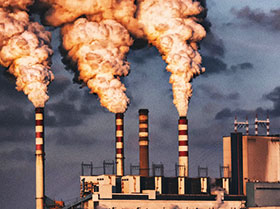
Steam is used to heat raw materials and treat semi-finished products. It is also a power source for equipment, as well as for heat and electricity generation. But steam is not free. Annually, it costs millions to feed the generation boilers.
Generally speaking, steam is an efficient way to transport heat energy because the amount of latent heat required to produce steam from water is quite large, and it is easily moved in pressurised piping systems that can deliver that energy at manageable costs. When steam gets to its point of use and gives up its latent heat to a process, it condenses into water, which must be returned to the boiler for re-conversion to steam.
Several condition-monitoring technologies are useful for monitoring steam systems to determine how well they are functioning. Among those technologies is infrared (IR) thermography, in which technicians use thermal imagers to capture two dimensional images of the surface temperatures of equipment and structures.
Thermal images of steam systems reveal the comparative temperatures of system components and thereby indicate how effectively steam system components are operating.
What to check
Using a combination of ultrasound and thermal inspection significantly increases the detection rate of problems in steam systems. Check all steam traps and steam transmission lines, including any underground lines. In addition, scan heat exchangers, boilers and steam-consuming equipment. In other words, examine every part of the steam system with a thermal imager.
Steam traps are valves designed to remove condensate as well as air from the system. During inspections, use both thermal and ultrasonic testing to identify failed steam traps, and whether they have failed open or closed. In general, if a thermal image shows a high inlet temperature and a low outlet temperature (< 100°C) that indicates that the trap is functioning correctly. If the inlet temperature is significantly less than the system temperature, steam is not getting to the trap. Look for an upstream problem – a closed valve, pipe blockage, etc. If both the inlet and outlet temperatures are the same, the trap probably has failed open and is ‘blowing’ steam into the condensate line. This keeps the system operating but with significant energy loss. Low inlet and outlet temperatures indicate that the trap has failed closed and condensate is filling the trap and the inlet line.
Also use the thermal imager to scan steam transmission lines for blockages, including closed valves, and underground steam lines for leaks, heat exchangers for blockages, boilers, especially their refractories and insulation, and steam-using equipment for any anomalies.
Consider creating a regular inspection route that includes all key steam-system components in the facility, so that all traps are inspected at least annually. Larger or more critical traps should be inspected more frequently, as the potential for loss is greater. Over time, this process will help determine whether a hot or relatively cool spot is unusual or not and help to verify when repairs are successful.
What represents a ‘red alert’?
Water boils at 100°C making steam, which is routinely transmitted at high pressure, extremely hazardous, so any condition that poses a safety risk should take the highest repair priority. In many situations, the next most important kinds of problems to deal with are those that can affect production capabilities.
The cost to an operation that completely loses its steam system varies from industry to industry. Among the industries that use the most steam are chemicals, food and beverage processing and pharmaceuticals. If the facility has performed no maintenance of steam
traps for three to five years, expect 15 to 30 percent of the traps to have failed. So, if there are 60 medium-sized traps on the system, losses from ‘blow by’ are estimated to be between R0,5 million and R0,85 million annually.
To check steam trap performance, sight, sound and temperature are the dominant techniques. Implementing a basic annual inspection of the steam traps and associated equipment with infrared inspections will
likely reduce steam losses by 50-75%. A sensible approach to a steam system management programme is to establish repair priorities based on safety, steam/energy loss and possible impact on production and quality. Whenever a problem is discovered using a thermal imager, use the associated software to document the findings in a report, including a thermal image and a digital image of the equipment. It is the best way to communicate the problems found and to suggest repairs.
For more information contact Comtest, +27 10 595 1821, sales@comtest.co.za, www.comtest.co.za
| Tel: | +27 10 595 1824 |
| Email: | sales@comtest.co.za |
| www: | www.comtest.co.za |
| Articles: | More information and articles about Comtest |






© Technews Publishing (Pty) Ltd | All Rights Reserved
 printer friendly version