Alternating current is the blood that flows through the veins of most power grids. It conveys electrical energy across great distances from the power station to factories and homes. But the monopoly of alternating current is coming to an end. Consumers such as mobile phone chargers, LED lamps and electric vehicle batteries increasingly require direct current. There is also an increasing number of power generators that supply direct current instead of alternating current, such as photovoltaic units. The necessary conversion between alternating and direct current consumes large amounts of energy. That is why energy experts are campaigning for the construction of direct-current grids. The industrial sector, especially the automotive industry, has also begun to equip factories to run on direct current. But there is a problem: direct current places new demands on infrastructure, including cables.
The first series cable for direct current
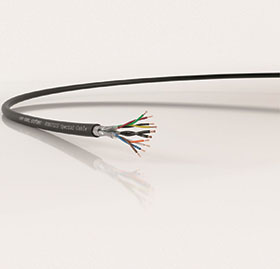
Leading connection systems manufacturer Lapp has taken a close look at these challenges and the company is due to showcase its first series product at SPS IPC Drives 2018. The Ölflex DC 100 is specially developed for supplying motors and systems with direct current. The cable is the result of comprehensive experiments in the Lapp laboratory and at the Ilmenau University of Technology, where Prof. Frank Berger researches the influence of direct current on the ageing process in cables. “In principle, cables for alternating current can also be used for direct current”, he explains.
In terms of long-term durability, however, there are still many open questions and very little in the way of knowledge, even though direct current has been around since the 19th century. Researchers have found evidence that direct current fields place different strains on the plastic of the insulation than alternating current fields. “It is very important to precisely understand this correlation, which is why we are paying so much attention to this issue, which will shape the future,” says Guido Ege, head of product development at Lapp.
Similar, but not identical
The new Ölflex DC 100 is designed to withstand decades of use with direct current, just like its alternating current equivalent the Ölflex Classic 100. The two cables feature different insulation, but otherwise share similar properties. They both have PVC sheaths and offer identical dielectric strength, for example. The only visible difference can be seen once the sheath is removed. The colour coding of the wires is different: red, white and green/yellow according to the standard DIN EN 60445 (VDE 0197):2018-02 that was updated in February 2018. The Ölflex DC 100 is available now.
Making high-quality industrial enclosures more accessible
Enclosures, Cabling & Connectors
Rittal has reduced the list price of its AX, KX and stainless-steel compact enclosure ranges, making these IP66-rated solutions with tool-free installation and 30% more cable space more accessible to South African manufacturers and engineering businesses.
Read more...Electromagnetic interference filters Vepac Electronics
Enclosures, Cabling & Connectors
Electromagnetic interference filters suppress unwanted noise in electronic systems, ensuring devices meet compatibility standards, and operate reliably in environments from medical equipment and radio circuits to industrial power converters and renewable energy systems.
Read more...Ready-to-use hybrid cables igus
Enclosures, Cabling & Connectors
igus South Africa is expanding its readycable hybrid range, combining power and data transmission in a single line to simplify automation cabling. The latest additions include harnessed cables for Siemens Sinamics S210 drives and SEW-EURODRIVE motors with MOVILINK
Read more...Cutting-edge plastic e-chain protects cables in cleanrooms igus
Enclosures, Cabling & Connectors
igus has developed the C6 cleanroom energy chain with an e-spin guide system that allows abrasion-resistant cable travel over distances of up to 30 metres without generating the microparticles that standard energy chains produce.
Read more...Energy chains transform Durban ship loader productivity igus
Enclosures, Cabling & Connectors
South African Bulk Terminals has installed a 140 m opposing energy chain system from igus to improve the management of cables used in the operation of two of its massive ship loaders.
Read more...Rittal’s flat-pack enclosure solution Rittal
Enclosures, Cabling & Connectors
The launch of Rittal’s FR IT flat-pack enclosure earlier this year marked a milestone for the company, introducing the local market to a high-capacity, top-tier IT enclosure in a convenient and cost-effective flat-pack format for the first time.
Read more...Reliable connectivity for the food and beverage industry LAPP Southern Africa
Enclosures, Cabling & Connectors
The food and beverage industry operates in one of the most demanding industrial environments where hygiene, efficiency and reliability are critical to daily operations. To support these growing industry demands, LAPP has introduced a new generation of sensor cordsets designed to perform in challenging food and beverage environments.
Read more...Safety-critical fibre optic systems in mining Omniflex Remote Monitoring Specialists
Enclosures, Cabling & Connectors
Omniflex highlights the importance of fibre optic technology in in enabling systems in the mining industry to transmit shutdown commands reliably over tens of kilometres and verify that they have been executed.
Read more...Compact integration of 3A and 4A connectors
Enclosures, Cabling & Connectors
With the new AT-HA grommet, icotek is expanding its innovative IMAS-CONNECT adapter system with a forward-looking solution for industrial use.
While every effort has been made to ensure the accuracy of the information contained herein, the publisher and its agents cannot be held responsible for any errors contained, or any loss incurred as a result. Articles published do not necessarily reflect the views of the publishers. The editor reserves the right to alter or cut copy. Articles submitted are deemed to have been cleared for publication. Advertisements and company contact details are published as provided by the advertiser. Technews Publishing (Pty) Ltd cannot be held responsible for the accuracy or veracity of supplied material.










 printer friendly version