



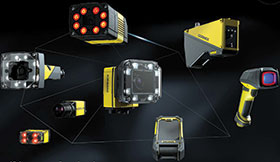
Image-based barcode readers are rapidly replacing laser scanners in a wide range of industries including food, beverage, consumer goods, pharmaceutical, and logistics, but when considering a transition from laser scanners to image-based barcode readers many think the investment cost is too high.
Thanks to advances in technology, image-based barcode readers are now not only comparable in price to laser scanner technology, but are also more powerful. Today’s most advanced image-based barcode readers have overcome the technical and economic hurdles and now offer a more attractive alternative to industrial laser scanners on the factory floor. In use, the latest generation of image-based barcode readers has proven to actually outperform lasers.
1. Read rate performance: read rate (the ratio of number of successful reads divided by the number attempted) is the most important
measure of how reliable and robust the reader is for the barcodes seen in practice:
• Image-based readers view the entire barcode, not just a single line as do lasers, so they can use advanced algorithms to overcome code damage issues that cause laser scanners the most trouble.
• Image-based barcode readers are able to use light sources to read codes that lasers cannot see, including barcodes printed with UV ink.
2. Omnidirectional code reading: one image-based barcode reader is able to read barcodes in any orientation within a single view. In contrast, multiple laser scanners are often required to be configured together to read barcodes in applications where orientation is not repeatable. Image-based barcode readers not only handle the typical ladder or picket fence orientation of barcodes, but also are able to locate and read barcodes in any orientation.
3. 2-D code reading: many industries are making the transition from 1-D to 2-D codes, such as Data Matrix or QR Codes. More information can be stored in 2-D codes to help with product traceability throughout the manufacturing process and the supply chain. However, laser scanners can’t read Data Matrix or QR codes. In contrast, image-based barcode readers can reliably read 2-D codes as well as 1-D barcodes – and even both simultaneously. In fact, image-based readers are often designed to read the most difficult-to-read 2-D codes that are directly marked onto the part (also known as direct part mark or DPM).
4. Multiple code reading and output capability: with so many types of image-based barcode readers available today, it’s important to note that they are not all equal. The best image-based barcode readers use advanced algorithms that can locate and decode multiple barcodes of any type (1-D or 2-D). These barcode readers also allow the user to configure the order of readout to make it easier to integrate the reader into the production process.
5. Long-term reliability: laser scanners use an oscillating scan mirror to move the laser beam rapidly across the barcode, creating the laser line that reads the code. These moving parts often wear out or break requiring repair or replacement of the laser scanner. Image-based barcode readers have no moving parts and are designed for longterm reliability and low maintenance.
6. Visualisation: image-based readers are inherently different from laser scanners because they take pictures of the products as they go by and locate the barcode within the image for decoding. Production line operators can have options that allow them to monitor the read rate statistics and look at the images that the barcode reader takes; allowing them to understand how the system is working and to quickly recognise what is happening if there is a no read. In addition to being able to ‘see’ what the reader sees, the operator can also make simple adjustments to the barcode reader through the online view without having to find a manual to understand how to make setup changes.
7. Image archiving: with a laser scanner, there is no way to understand what happened if the scanner did not read the barcode. The most powerful image-based readers can be set up to archive images of reads. Most often, users archive failed reads to understand what caused it to occur for process improvement. For example, the image can be used to see if the barcode was not present or was too severely degraded to decode.
8. Barcode quality feedback: in many production lines, it is important to maintain the barcode print quality at a high level to ensure that the code can be read by other readers in the product distribution chain. Image-based readers can provide feedback on the quality of the print so the manufacturer can make adjustments before they ship badly printed codes to their customers.
9. Communication: industrial protocols like Ethernet/IP and Profinet allow image-based barcode readers to be easily integrated into the factory network. Direct communication with PLCs allows both data communication and control to make the reader part of the quality control process.
Final thoughts
For users currently using laser scanners, now is the time to investigate the advantages of image-based barcode readers. It may be that image-based barcode readers open up new opportunities to identify, track, and trace products and components more effectively throughout the supply chain.






© Technews Publishing (Pty) Ltd | All Rights Reserved
 printer friendly version