



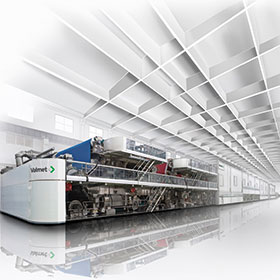
Valmet Oyj has evolved to become one of the world’s most important providers of capital equipment, automation and services for the paper, pulp and energy sectors. Today, the company employs more than 12 000 people on five continents, and operates 16 R&D centres, 34 production units and 100 service centres across the globe. Valmet’s partnership with SKF began in 1951, when the first papermaking machine to carry the company’s name was equipped with SKF bearings. Since that time, the two companies have broadened and deepened their relationship.
A changing industry
Paper may have been a basic commodity for decades, but the papermaking industry has changed dramatically in recent years. Sales in some of the most important traditional categories, like newsprint, have declined in line with the rise of digital media and the associated changes in consumer behaviour, for example. The rapid expansion of consumption in emerging markets, meanwhile, has fuelled demand for a host of paper-based products, from packaging to bathroom tissue.
In turn, those changes have driven a dramatic shift in the types of equipment used by the paper industry, and in the location of its production sites.
“Ten years ago, paper production was all about economies of scale,” says Arto Huttunen, global strategic account manager at SKF. “Customers wanted the largest, fastest and widest machines, and they expected those machines to last for 20 or 30 years of continuous production.” Today, however, there has been a shift to smaller, cheaper and more flexible equipment. “Instead of 11 m wide rolls, many modern machines use 6 m or 7 m rolls,” he adds. “Smaller machines offer a host of advantages from simpler, cheaper logistics, thanks to the lighter weight of components, to a quicker return on investment, something that is critically important in fast moving, volatile markets.”
As its markets have evolved, so has Valmet’s design approach. The company’s latest OptiConcept M machines, for example, use a modular design to simplify specification, assembly, operation and maintenance. Compared to conventional designs, the OptiConcept M design requires up to 40% less space. The approach also allows mills to optimise machinery investments according to their needs, providing increased flexibility to change the type and grade of material produced or to adjust capacity as demand changes.
In a world where flexibility, efficiency, low cost of ownership and rapid return on investment are so important, every detail of machine design is critical for Valmet. As it has done in the past, the company has looked to SKF to help it find innovative solutions for its latest generation of machines.
Innovative bearing solutions
“The biggest, fastest machines would have design speeds of up to 2000 m per minute,” says Huttunen. “Specifying bearings for the loads and speeds involved often called for customised solutions. With the modern, smaller machines with design speeds of up to 1700 m per minute, it becomes possible to use standard components, which can provide significant savings in capital and maintenance costs.”
Using standard parts doesn’t mean Valmet relies any less on SKF expertise, however. The bearing maker uses its deep knowledge of materials science and rotating equipment to help Valmet’s engineers select precisely the right size and grade of bearing for each application.
“Our advanced bearing life calculation models mean we can recommend the right product to suit the end-customer’s operating conditions and lifetime requirements,” says Huttunen. “Frequently, that means they can use a solution that is 50% cheaper than they might have chosen if they’d relied on more traditional selection approaches.”
Other approaches focus on reducing operating costs for Valmet’s customers. Replacing oil-lubricated bearings with units that are sealed and lubricated for life means one less thing for maintenance teams to worry about, for example. SKF is also working with Valmet to capture the opportunities offered by the industrial Internet. Integrated condition monitoring technology is helping the company to improve the support it provides for hundreds of machines around the world, and it is also providing rich data on real-world operating performance that can be used to inform and refine future designs.
“Designing and building equipment that costs less and provides faster payback for customers is every bit as demanding as making the largest, fastest machines of the past,” concludes Huttunen. “Valmet has asked us to bring ideas from our experience with a wide range of different industries, from car manufacturing to wind power. I’m sure that together we will be able to find many more innovative solutions.”
For more information contact Samantha Joubert, SKF South Africa, +27 (0)11 821 3602, [email protected], www.skf.co.za
| Tel: | +27 11 821 3500 |
| Email: | [email protected] |
| www: | www.skf.co.za |
| Articles: | More information and articles about SKF South Africa |






© Technews Publishing (Pty) Ltd | All Rights Reserved
 printer friendly version