



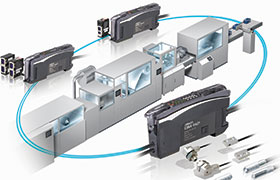
Introduced as a concept in 2011 to describe and connect trends across different industries, the term Industry 4.0 has evolved to herald a new paradigm in manufacturing. Defined loosely as the computerisation of manufacturing, it refers to a shift towards self-organising manufacturing operations, with a greater distribution of intelligence towards individual machines and components.
Production lines configure automatically
Under Industry 4.0, the hypothesis is that production lines will reconfigure automatically in order to optimise productivity, reduce changeover times and accommodate wide product variations. Driven from an end-to-end array of technologies and software systems, ranging from sales acquisition, order processing, supply chain management, logistics and production management, it is clear that future production machinery and components will need to integrate dynamically and seamlessly into higher level IT systems.
As an integral part of most production machinery, sensor systems will require a number of enabling technologies to provide the necessary functionality to realise the demands of an Industry 4.0 ‘ready’ machine.
It is clear that the passive on/off operational functionality of standard sensors will not provide sufficient capabilities to support the required level of integration.
Integrated sensors that can communicate with higher-level control systems to monitor and configure automatically, will undoubtedly be a prerequisite to enable dynamic changes to machine configurations, as described by the Industry 4.0 concept.
Taking the simplified example of automating a product changeover process on a machine, this could be vastly improved using intelligent and integrated sensor systems. Traditionally sensors are configured individually and manually during machine changeover processes based on the requirements of the product being manufactured; potentially this could be due to a change in colour, size or any other physical difference in the product. This can be time consuming, inefficient and a source for manual errors.
Considering the Industry 4.0 concept, the process could be fully automated, being driven end-to-end from point of order and production scheduling through to machine configuration down to component level, even including sensor systems. Intelligent control systems will automatically set detection parameters and settings to allow seamless product changeovers, improving efficiency and eliminating common manual errors.
In addition, with increased levels of integration of sensor systems, the operational status and stability of a sensor could be communicated back to the machine control system, via the intelligent link. By monitoring this status, automatic optimisation of a sensor is possible, therefore improving production efficiency even further. The intelligent link could also provide fault diagnostics and preventative maintenance information, helping to reduce machine downtime and again improve production efficiency.
Integrated sensor systems
Unlike many elements of the Industry 4.0 concept, which are currently based on futuristic and unrealised technologies, integrated sensor systems with an advanced intelligent link already exist today. Essentially integrated sensor solutions incorporating a fieldbus interface are readily available, providing all the necessary functionality to realise the demands of a fully integrated production system.
There are now a number of fieldbus solutions available for sensors, each with its own benefits and restrictions. Some fieldbus technologies were specifically designed for sensor communication, like I/O Link, developed to support the unique requirements of sensors. But, there are also generic fieldbus solutions which support additional devices beyond sensor systems and provide a single machine fieldbus solution for all common machine components.
Whilst Omron supports a wide range of fieldbus technologies, the primary offering uses EtherCAT, which is widely recognised as one of the fastest fieldbus solutions currently available. It is also has the flexibility to support the integration of a wide range of peripheral devices. Integration of these devices into the fieldbus network is extremely simple and accomplished with a few mouse clicks, providing instantaneous data exchange with the machine control platform and the sensor system. This eliminates developing complex protocols or writing custom code, providing fast and seamless integration.
Whilst the functionality of integrated sensors is very much a reality today, it is clear the uptake of these solutions is very much in its infancy. However, with the ever increasing demands of manufacturers and the drive towards the realisation of the Industry 4.0 concept, the expectation is that demand for these integrated sensor solutions will increase exponentially in the coming years.
For more information contact Evert Janse van Vuuren, Omron, +27 (0)11 579 2600, evert.janse.van.vuuren@eu.omron.com, www.industrial.omron.co.za
| Tel: | +27 11 579 2600 |
| Email: | info_sa@omron.com |
| www: | www.industrial.omron.co.za |
| Articles: | More information and articles about Omron Electronics |






© Technews Publishing (Pty) Ltd | All Rights Reserved
 printer friendly version