


IT in Manufacturing


Emerson enhances reservoir modelling software

August 2015 IT in Manufacturing

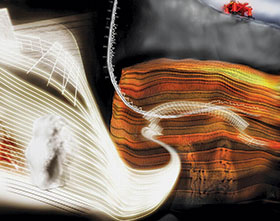
Emerson Process Management has launched the latest version of its reservoir modelling software, Roxar RMS. The new version – RMS 2013.1 – comes with enhanced structural modelling tools that acknowledge realistic uncertainties in the data and improve volumetric sensitivities. This makes it faster and easier for modellers to build geological scenarios, investigate the full effects of structural uncertainty, and maximise the value of their reservoir assets.

“Too often in the past reservoir modellers have had to resign themselves to using best case estimates of faults and horizons, with the inherent uncertainty in these interpretations often neglected and thereby underestimating the actual uncertainty in reservoir volumes,” said Kjetil Fagervik, managing director of Emerson’s Roxar Software Solutions.

He continues: “With our new version of Roxar RMS and our tightly integrated structural modelling and gridding tools, users will be able to quantify uncertainty more effectively and increase confidence when it comes to crucial decisions on where to drill, what production strategies to adopt, and how to maximise recovery.”

As part of the new enhancements, RMS 2013.1 also sees fault uncertainty tools further integrated with structural modelling and 3D gridding. This enables users to build fault uncertainty models in full and investigate a wide variety of scenarios corresponding to the uncertainty in the input data.

In addition, horizon uncertainty modelling is significantly enhanced, allowing users to create horizons and zones based on uncertainty data and information derived from well picks, velocities, seismic travel times and isochores. Uncertainty modelling has also been extended with new parameters added such as the modelling of fault sealing effects and fractures.

The accuracy of the models can be further improved with the new tool for adjusting the 3D grid to well picks, and enhanced isochore modelling tools that provide users with full quality control over isochore input data.

The focus on the geophysical domain sees further enhancements to the new Model-Driven Interpretation (MDI) tools first released in RMS 2013 with improvements to MDI and velocity modelling through new tools for QC-ing the velocity model, providing input for horizon uncertainty modelling, and for well-ties.

Efficiencies and performance is improved through multi-threading (the ability for computing to take place in parallel), new SEG-Y importing functionality and RMS Data Explorer that allows users to manipulate large amounts of data with advances in well administration and fault grouping/sorting.

Finally Roxar RMS 2013.1 also comes with new predictive analytics tool for identifying sweet spots within unconventional fields.

Kjetil Fagervik concludes: “When it comes to strengthening operator confidence in their reservoirs’ economics, improving decision-making and increasing workflow productivities and efficiencies, Roxar RMS is changing the reservoir modelling landscape. RMS 2013.1 will be the first of a number of significant modelling advances over the coming months.”

Emerson’s Roxar RMS is comprised of 24 fully integrated software modules that form a seamless and fully integrated seismic to simulation workflow. This includes seismic interpretation, structural model building, 3D gridding, facies and petrophysical modelling, flow simulation, well planning and uncertainty modelling tools. RMS operates on Red Hat Enterprise Linux 64-bit versions 5 and 6 and on Windows 64-bit 7.

For more information contact Michael Eksteen, Emerson Process Management, +27 (0)11 451 3700, [email protected], www.emersonprocess.com


Credit(s)


Share this article:
Share via emailShare via LinkedInPrint this page

Further reading:

OMRON simplifies safety verification for SA manufacturers
Omron Electronics IT in Manufacturing
OMRON’s NX Safety platform, Online Safety Functional Test Verification is a feature built into the Sysmac Studio engineering environment. This intuitive tool allows safety verification to be carried out digitally, with step-by-step guidance and full traceability, all from a single workstation.

Read more...
Range of CDUs to meet the rising demands of HPC and AI workloads
Schneider Electric South Africa IT in Manufacturing
Motivair by Schneider Electric has introduced two new coolant distribution units that are engineered to meet the rising thermal demands of HPC and AI workloads.

Read more...
Data centre design powers up for AI, digital twins and adaptive liquid cooling
IT in Manufacturing
The Vertiv Frontiers report, which draws on expertise from across the organisation, details the technology trends driving current and future data centre innovation, from powering up for AI, to digital twins, to adaptive liquid cooling.

Read more...
Siemens drives next-generation vehicle development
Siemens South Africa IT in Manufacturing
The Siemens PAVE360 Automotive technology is a new category of digital twin software that is pre-integrated and designed as an off-the-shelf offering to address the escalating complexity of automotive hardware and software integration.

Read more...
How digital infrastructure design choices will decide who wins in AI
Schneider Electric South Africa IT in Manufacturing
As AI drives continues to disrupt industries across the world, the race is no longer just about smarter models or better data. It’s about building infrastructure powerful enough to support innovation at scale.

Read more...
How quantum computing and AI are driving the next wave of cyber defence innovation
IT in Manufacturing
We are standing at the edge of a new cybersecurity frontier, shaped by quantum computing, AI and the ever-expanding IIoT. To stay ahead of increasingly sophisticated threats, organisations must embrace a new paradigm that is proactive, integrated and rooted in zero-trust architectures.

Read more...
2026: The Year of AI execution for South African businesses
IT in Manufacturing
As we start 2026, artificial intelligence in South Africa is entering a new era defined not by experimentation, but by execution. Across the region, the conversation is shifting from “how do we build AI?” to “how do we power, govern and scale it responsibly?”

Read more...
AIoT drives transformation in manufacturing and energy industries
IT in Manufacturing
AIoT, the convergence of artificial intelligence and the Internet of Things, is enhancing efficiency, security and decision making at manufacturing, industrial and energy companies worldwide

Read more...
Today’s advanced safety system is but the beginning
Schneider Electric South Africa IT in Manufacturing
Industrial safety systems have come a long way since the days of hardwired emergency shutdowns. Today, safety systems are not just barriers against risk; they are enablers of safer operations.

Read more...
Siemens brings the industrial metaverse to life
Siemens South Africa IT in Manufacturing
Siemens has announced a new software solution that builds Industrial metaverse environments at scale, empowering organisations to apply industrial AI, simulation and real-time physical data to make decisions virtually, at speed and at scale.

Read more...


While every effort has been made to ensure the accuracy of the information contained herein, the publisher and its agents cannot be held responsible for any errors contained, or any loss incurred as a result. Articles published do not necessarily reflect the views of the publishers. The editor reserves the right to alter or cut copy. Articles submitted are deemed to have been cleared for publication. Advertisements and company contact details are published as provided by the advertiser. Technews Publishing (Pty) Ltd cannot be held responsible for the accuracy or veracity of supplied material.


© Technews Publishing (Pty) Ltd | All Rights Reserved

