



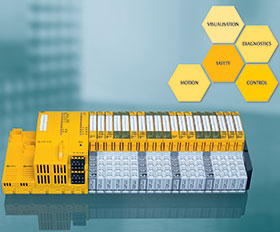
Pilz has developed a one-stop solution for most industries, including packaging. It has tailor-made solutions for complex applications using the PSS4000 safety PLC or straight-forward applications using the tried and tested safety relays. For everything in between, Pilz has a range of programmable safety relays (the PNOZ multi range), which is cost effective, expandable and easy to configure.
Pilz has an excellent reputation on the control side and now it is able to offer a full range of safety sensors for all applications on automated lines, which includes light curtains, e-stops, coded sensors, gate locks, etc. A new coded sensor has just been launched with a magnetic holding force, so that a latch is not necessary, and the advanced light curtains come with a full range of options, such as blanking and muting.
When it comes to choosing a safety sensor or control device it should not just come down to price: when a risk assessment is done there are a number of factors to be considered and one of these is the mean time to dangerous failure. (This value is determined in systems as a safety parameter according to standard EN ISO 13849.) Pilz carries out repeat testing of equipment and safety devices, to make sure that these meet and exceed the safety standards.
Safety devices are often seen as a hindrance to productivity, but with the correct design and best choice of products, safety and productivity can be achieved. Machine operators should not feel that life or limb is in danger while they are working.
How much safety does a packaging machine need?
Safety is gaining ground in modern engineering. Every day new functions are being added to packaging machinery in order to cope with the different types of products in terms of design, size and container. Machinery is now more flexible as a result of decentralised drive technology, which means the demands on safety, including the implementation of the relevant safety functions, has increased. The question “How much safety does a machine actually need?” is easy to answer: The protection of man and machine must be guaranteed, as must the ability to design production processes individually.
Short product life cycles, high variability and modern packaging materials mean that machines are ever more flexible and place heavy demands on technology and processes alike. Everyday life is governed by the frequent interchange of contents and packaging. Automation technology with individual drives meets this requirement for flexibility, dynamics fault reaction, and changeover at the touch of a button. Generally it offers even greater availability while still increasing performance. In doing so, the limits of automation are often reached, while operator capabilities must also be considered as part of the production process.
Safety devices protect operating personnel
Even on packaging machinery with high quantity output, the operator often plays no more than a subordinate role. Interaction with the machine is mostly limited to packaging refills, or brief interventions in the case of a fault. For this reason, not too much importance is attached to the use of qualified personnel to operate the machine. Covers, fences and gates are used as safety devices to prevent direct access and exclude the possibility of injury. Hazards arise when the machine is run outside of production mode, during setup or cleaning for example, or when the process requires some intervention while the machine is active. In this case, machine safety must be designed to enable human errors to be intercepted.
Safety in the classical sense will always refer to personal safety: risk must be kept to a minimum. To exclude the risk completely manufacturers would actually need to stop using operating personnel all together. However, the huge increase in machine flexibility has only come about as a result of improved interaction between man and machine. Complete automation, including during setup and cleaning, would increase costs and labour exponentially. Over the next few years, this interaction between man and machine will result in even more developments in the area of safe sensor technology and safe data communication.
For more information contact Craig Cuff, Prime Automation, +27 (0)41 819 7746, [email protected], www.primeautomation.co.za






© Technews Publishing (Pty) Ltd | All Rights Reserved
 printer friendly version