False alarms caused by surges can be prevented
July 2015
Electrical Power & Protection
The function of emergency alarm systems is to produce an alarm in the event of danger and to remain passive when there is none. The malfunction of these systems, either no alarm sounding if there is danger, or an alarm sounding unnecessarily, is not just a nuisance; it can also be dangerous and can result in expensive call-out fees.
False alarms have the following consequences:
• Personnel start ignoring the alarm messages.
• Emergency staff is unnecessarily called out.
• The triggering of fire extinguishing systems can cause interruption of operations.
All these factors cause unnecessary costs and can be prevented if possible causes of false alarms are recognised at an early design stage and are eliminated by taking suitable preventive measures. Lightning strikes are one such cause, and given the profusion of summer storms in South Africa, this is a real threat.
Coordinated lightning and surge protection prevents false alarms and increases the availability of the systems.
Many of today’s emergency alarm systems have an increased immunity to transients on the primary lines, secondary lines and mains voltage cables according to IEC 61000-4-5. Nevertheless, only external and internal lightning protection measures provide comprehensive protection against damage resulting from lightning strikes and surges.
Monitoring principles
Different monitoring principles are used for emergency alarm systems:
Pulse polling technology:
• Information from the sensor which has triggered the alarm is digitally transmitted. This allows the identification of the sensor and its exact location.
• DC circuit technology: According to the closed circuit principle, every alarm line is permanently monitored. If a sensor in a line is triggered, the line is interrupted and an alarm is produced in the alarm panel. However, only the alarm line, but not the individual sensor can be identified.
Irrespective of the monitoring principle used, all cables extending between the different areas of the emergency alarm system must be integrated in the lightning and surge protection concept of the overall system.
Recommended protection
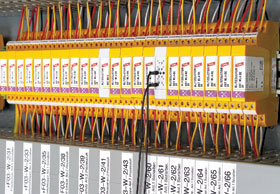
Dehn’s Blitzductor XT, type BXT ML2 BE, must be installed to protect two-wire alarm lines and connect the earth drain wire by means of an EMC spring terminal. For cables with more than two wires, a four-wire version, BXT ML4 BE, is available. Surge protective devices are selected according to the voltage of the alarm lines, which is typically between 12 and 48 V. The low internal resistance is also a clear advantage of arresters since the maximum resistances of the alarm lines must not be exceeded. For the outputs of the alarm panels (acoustic and visual) it must be ensured that the nominal current of the surge protective devices is not exceeded.
For more information contact Alexis Barwise, Dehn Protection South Africa, +27 (0)11 704 1487, alexis.barwise@dehn-africa.com, www.dehn-africa.com
Further reading:
High-performance industrial power converters
Electrical Power & Protection
Vepac Electronics supplies PowerGood’s range of industrial AC/DC and DC/DC converters, spanning 15 W to 700 W, with full protection features and compliance with EN55032 Class A and Class B electromagnetic interference standards.
Read more...
Decarbonising the energies and chemical industry without the risk
Schneider Electric South Africa
Electrical Power & Protection
Schneider Electric argues that decarbonisation in Africa’s energies and chemical industry need not compromise production or profitability. A phased, digitally enabled approach, starting with energy efficiency improvements, can reduce emissions while strengthening competitiveness.
Read more...
Modular UPS system with scalable, high-availability architecture
Electrical Power & Protection
Legrand South Africa has launched its fifth-generation TriMOD three-phase modular UPS, available from 10 to 80 kW. The system features hot-swappable modules, multiple input/output configurations, and up to 99% efficiency in Eco Mode, designed for data centres and critical industrial environments.
Read more...
Accurate illuminance measurement for safer, more efficient environments
Electrical Power & Protection
The Sonel LXP-10A illuminance meter is designed for accurate measurement of lighting levels in industrial environments where adequate illumination is essential.
Read more...
Why mining operations need local lightning early warning
Senseca
Editor's Choice Electrical Power & Protection
Lightning can develop into a serious mining hazard before the first local strike, leaving crews little time to stop work and reach safety. Local early-warning technology can provide valuable lead time, allowing mines to connect developing storm conditions to defined trigger actions that protect people, explosives and equipment.
Read more...
South Africa’s dirtiest fuel is building its most resilient boilers
Electrical Power & Protection
Steinmüller Africa argues that duff coal, the low-grade fines and discards stockpiled over decades, can now underpin reliable, compliant industrial boilers using mature circulating fluidised bed combustion technology, turning a long-standing liability into a phased energy transition pathway.
Read more...
Retrofitting for sustainability
Schneider Electric South Africa
Electrical Power & Protection
As budgets tighten and sustainability targets increase, retrofit and modernisation strategies are gaining traction across Africa, allowing organisations to upgrade only what limits performance while preserving existing infrastructure and extending asset life.
Read more...
USB-Datalogger for voltage 0 to 30 V DC
Vepac Electronics
Electrical Power & Protection
The PeakTech 5186 is a data logger for DC voltages from 0 V to 30 V with terminals on the top of the device.
Read more...
Pole-top boxes for smarter, more secure electricity networks
Electrical Power & Protection
As South Africa accelerates the rollout of smart prepaid electricity metering, innovative enclosure technology from Power Process Systems is helping utilities improve network security, reduce electricity theft and protect critical electrical infrastructure.
Read more...
Simplifying electrical design compliance
Electrical Power & Protection
Referro Systems highlights how Rockwell Automation’s Global SCCR Tool simplifies short-circuit current rating compliance for complex industrial electrical systems.
Read more...










 printer friendly version