One sensor measures pH, redox and rH
November 2014
Sensors & Transducers
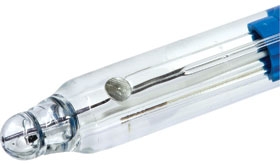
With Endress+Hauser’s Memosens sensors CPS16D, CPS76D and CPS96D, users can determine pH and the redox values with one single sensor. The combined sensors reduce the installation requirements by half for transmitters, assemblies and cables, and also reduce the on-going maintenance requirements for the measuring points. The rH value is also calculated using both measured values from the combination sensors.
The design, specifications and external dimensions of the new sensors do not differ from other pH and redox sensors. Even though several measurement parameters are combined in the combination sensors, they fit in all common assemblies.
First successful applications
The combined Memosens sensor CPS76D is being successfully used in the petrochemical sector, for example in the second stage of flue gas cleaning. In this process, the residual sulphur dioxide (SO2) is oxidised by adding hydrogen peroxide (H2O2) to sulphur trioxide (S03) and is then separated off as sulphuric acid. At the same time, chemically divalent heavy-metal ions are oxidised to become trivalent and are removed by a process of precipitation. In this step of the process, the CPS76D checks the rH value, which must lie between 18 and 28 for an optimal precipitation process.
Another example is the use of the Memosens CPS16D by a large galvanic specialist. There, the sensor monitors the cyanide oxidation with sodium hypochlorite (NaOCl). Due to the combination sensor, it was possible to optimise the process of removing the cyanide. This occurs by setting the pH and redox values at the same time. The heavy-metal ions in the waste water could also therefore be minimised and fewer chemicals are used.
In both cases, the combined pH/redox electrodes make an important contribution to environmental protection. The result is an optimisation of important chemical processes while, at the same time, reducing costs.
Another possible application for the combination sensors is corrosion monitoring using the rH value. If, in addition to the pure redox value, the pH value is also taken into consideration, the rH value represents a pH-independent criterion for the oxidising or reducing behaviour of a solution. This measured value can therefore provide valuable information about the corrosive behaviour of a process.
Measuring the reference resistance
If any medium penetrates the sensors junction and blocks it, this will be detected in good time. This leads to a warning being issued at the transmitter. This new function leads to improved monitoring of the sensors. The measurement of the reference resistance can be used, for example, to trigger automatic cleaning with the Chemoclean Plus function on the CM44 if a customer-defined threshold is exceeded. Predictive maintenance increases the operating time of the sensors.
New Memosens functionalities: due to this new technology, the last eight sensor calibrations are saved. The calibration history can be evaluated and the measuring point can be serviced in good time.
*rH = oxidation-reduction potential under special pH.
For more information contact Jan Swart, Endress+Hauser, +27 (0)11 262 8000, [email protected], www.za.enfress.com
Further reading:
Distance sensor for confined spaces
ifm - South Africa
Sensors & Transducers
The O6D100 from ifm has been designed as a powerful all-rounder for typical applications in object detection, distance measurement and positioning.
Read more...
Optimise sludge treatment and reduce operational costs
Endress+Hauser South Africa
Sensors & Transducers
Endress+Hauser’s inline measuring devices, the Proline Teqwave MW 300 and the Proline Teqwave MW 500, determine the total solids content of wastewater directly through microwave transmission.
Read more...
Inclination sensors for motion control
ifm - South Africa
Sensors & Transducers Motion Control & Drives
The JBC dynamic inclination sensor from ifm offers accurate angle measurement in the most demanding conditions, filtering out motion disturbances such as vibrations, shocks and vehicle dynamics to deliver reliable inclination values via IO-Link or programmable switch outputs.
Read more...
Fully integrated standalone thunderstorm warning system
Senseca
Sensors & Transducers Analytical Instrumentation & Environmental Monitoring
Senseca South Africa has introduced its BTD-1 fully integrated, standalone thunderstorm warning system, which detects lightning by monitoring the background quasi-electrostatic field. The system can generate alerts before the first lightning strike, with a detection raterange of up to 83 km.
Read more...
Technology and education are critical to advancing safety in the mining sector
Sensors & Transducers
As mining operations across Africa continue to evolve in scale, complexity and automation, the role of advanced safety technologies has become increasingly important in protecting people, equipment and productivity.
Read more...
Image processing cameras
Vepac Electronics
Sensors & Transducers
The intelligent camera series from Vepac is an integrated camera module consisting of a camera and high speed processor. It offers a high-performance image sensing function at the edge device by embedding standard image processing software or the customer’s developed software.
Read more...
OMRON launches non-contact safety door switch
Omron Electronics
Sensors & Transducers
OMRON has unveiled its latest innovation in non-contact safety door switches, designed to enhance workplace safety and streamline machinery operations.
Read more...
Conductivity sensing as a cornerstone of South Africa’s water smart industry
ifm - South Africa
Editor's Choice Sensors & Transducers
South Africa’s engineers operate at the intersection of resource constraint and industrial ambition. Few parameters illustrate this balancing act as clearly as water quality. Whether in municipal treatment works, food and beverage plants or mining operations, the ability to measure water quality accurately and continuously has become non-negotiable.
Read more...
Futureproofing pharma, one pixel at a time
Omron Electronics
Sensors & Transducers
In pharmaceutical manufacturing, there’s no room for error. Omron’s FH-AI and FHV7-AI vision systems introduce AI-powered inspection that adapts to real-world variability, something conventional rule-based vision systems cannot easily achieve.
Read more...
Long-range laser distance measuring sensor
Vepac Electronics
Sensors & Transducers
The MS-100A is a long-range laser distance measuring sensor with a range of 150 to 1000 mm. This sensor excels in applications requiring extended measurement capabilities, such as quality control and logistics.
Read more...










 printer friendly version